Latest News

NEWS September 2023
September 2023. Hi Atlantipedes, At present I am in Sardinia for a short visit. Later we move to Sicily and Malta. The trip is purely vacational. Unfortunately, I am writing this in a dreadful apartment, sitting on a bed, with access to just one useable socket and a small Notebook. Consequently, I possibly will not […]Read More »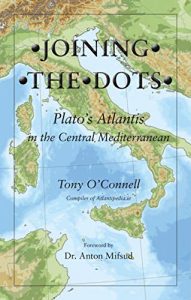
Joining The Dots
I have now published my new book, Joining The Dots, which offers a fresh look at the Atlantis mystery. I have addressed the critical questions of when, where and who, using Plato’s own words, tempered with some critical thinking and a modicum of common sense.Read More »
Agriculture
Agriculture is generally accepted as the critical foundation for the development of any civilisation. Without it, man would have remained a hunter-gatherer and have lacked the potential for generating surpluses, the division of labour and the establishment of urban communities. Therefore, it is not unreasonable to assume that if an ancient urban centre is found, it is evidence of the existence of agricultural skills in the locality at the time of its foundation. Evidence has now been gathered to demonstrate that alongside agriculture, carpentry also advanced, as shown by the improvement of woodworking tools at the same time(c). Studies published in 2013(b) indicate that farming first developed more or less simultaneously over a widespread area of the Middle East from Turkey to Iran.
However, a 2015 report from Israel, has offered evidence that an even earlier form of agriculture was practised in the vicinity of Galilee 23,000 years ago.(w)
A recent report has indicated that the small-seeded cereal, millet, had provided a link between hunter-gathering and agriculture(m).
At present, the world’s oldest known town is Jericho, which grew out of settlements established around 9600 BC(r) and was destroyed between 1500 and 1400 BC(q)
 Similarly, the remarkable discoveries at Göbekli Tepe, also dated to the same period, suggest a considerably settled community that would have been dependent on agriculture. There is evidence that the first farmers grew rye(x) and wheat(y) in Syria around 10,000 BC.
A huge cache of wild oats and barley, dated to 9000 BC, was discovered near Jericho in 2006(j). Also near Jericho, cultivated figs were discovered in an 11,400-year-old house(u).
In Egypt, prehistoric granaries that date back to the Neolithic era, which began around 9000 BC, have been discovered in Fayoum, southwest of Cairo. A recent report demonstrates how millet, domesticated in China around 10,000 years ago and used today as birdseed, was brought westward from China to Europe where “Nomadic tribes were able to combine growing crops of millet with hunting and foraging as they travelled across the continent between 2500 and 1600 BC. Millet was eventually mixed with other crops in emerging populations to create ‘multi-crop’ diversity, which extended growing seasons and provided our ancient ancestors with food security.”(o)
It was reported in the journal Nature of April 2020 that there is now evidence that crops were cultivated in the Llanos de Moxos region of southwestern Amazonia 10,000 years ago. “The researchers were able to identify evidence of manioc (cassava, yuca) that were grown 10,350 years ago. Squash appears 10,250 years ago(v), and maize more recently – just 6,850 years ago.”(p) This should be compared with an earlier report that corn (maize) had been cultivated in Mexico, even earlier at about 10,000 years ago(s). Philip Coppens has left us an interesting paper(t) on the history of maize in Mexico and its exploitation by the Maya. >The matter of the origin of corn (maize) outside of the Americas is discussed in a book by Professor Shakti M. Gupta who offers evidence of corn and at least five other New World plants in pre-Columbian temples in India!(z)<
R. Cedric Leonard had outlined on his website(a) a range of evidence that would seem to prove that agriculture existed in Egypt before the 9600 BC date that is recorded by Plato for the war with Atlantis.
Peripheral to this, is a recent report that when hunter-gatherers encountered early farmers, they made love not war(k)!
If Plato’s Atlantis existed, it is clear that agriculture was an important part of its economy. We are informed (Crit.118E) that two crops were harvested annually, thanks to rain in winter and irrigation canals in summer. Plato also mentions horses and cattle (Crit.117b). These references are written in the context of a need to feed a large city, not to mention its enormous army (and navy). Plato offers no suggestion than that this advanced agricultural system was anything other than part of an advanced Bronze Age society.
North African Algeria, Egypt and particularly Tunisia, were the ‘breadbasket’ of Rome and may also have been so for the Atlanteans who had control from North Africa to Tyrrhenia! It is worth noting that Mago, the Carthaginian author of a 28-volume work on the agricultural practices of North Africa, had his books brought to Rome after the destruction of Carthage in 146 BC, where they were translated from Punic into Latin and Greek and were widely quoted. It is clear that Mago’s work was a reflection of a highly developed agricultural society in that region, a description that could also be applied to Plato’s Atlantis! Although conditions have deteriorated over the past few millennia, Tunisia can still produce two crops a year in low-lying irrigated coastal regions.
The commencement of what we would recognise as agriculture began around the 10th millennium BC. So is theoretically possible that agriculture had developed somewhat by the early date of 9600 BC given by Plato for the war with Atlantis. However, the existence of anything over and above the level of subsistence farming, at this early date, is highly improbable. It would seem clear that Plato has described the agriculture of a Bronze Age civilisation because he would have had no clear idea regarding its state of development in the preceding millennia.
A 2013 paper(h) from Tübingen University has demonstrated that studies “show that the origins of agriculture in the Near East can be attributed to multiple centers rather than a single core area and that the eastern Fertile Crescent played a key role in the process of domestication.”
In 2008, archaeologist Melinda Zeder offered evidence that the domestication of animals began around the same time as the management of crops in the 9th and 10th millennia BC in the Near East. These new skills gradually spread throughout the length of the Mediterranean. In the same year, Dr Robin Allaby of Warwick presented a paper in which he pushed back the date for the gathering of wild cereals to before the last glacial maximum (18,000-15,000 years ago).
Even more dramatic is a more recent claim(i) that the dawn of agriculture can be extended even further, to 23,000 years ago.
It is interesting that Plato also lists (Crit.115b) produce that possibly grew wild or may have been cultivated:
- Pulses
- Fruits that have a hard rind providing drinks, meats and ointments
- Chestnuts (no evidence of cultivation before 2000 BC)
- Fruits that spoil with keeping
- The ‘pleasant’ kind of dessert
It would be worthwhile to investigate whether all the products mentioned by Plato are consistent with the same geographical latitude. Diodorus Siculus recorded that the Atlanteans did not know the fruits of Ceres – cereals. In fact, according to Wikipedia, cereals were unknown to American Indians. Rand and Rose Flem-Ath have an interesting chapter[062.12] on the subject of agriculture and its development in the context of their own theories. In 2013, Rand Flem-Ath republished(d) his paper on the origins of agriculture that first appeared in The Anthropological Journal of Canada in 1981.
Dale Drinnon’s website had a series of extensive articles(l) on the development of agriculture globally.
Similarly, the Golden Age Project website, now run by Edmund Marriage has a lengthy paper(n) by Steve Gagné on the spread of agriculture.
A more recent article considers the possibility that the introduction of agriculture may have inadvertently led to the endangerment of some early civilisations. The author, Annalee Newitz, editor-in-chief of io9.com cites the abandonment of Catal Höyuk as an example(g).
(a) See: Archive 2248 or https://web.archive.org/web/20170126225331/https://atlantisquest.com/Agriculture.html
(b) https://www.seeker.com/farming-sprang-up-in-multiple-places-1767636474.html
(c) See Archive 2250
(d) See Archive 2247)
(e) https://www.nytimes.com/2008/08/11/science/12visuals.html?_r=0
(f) https://www2.warwick.ac.uk/newsandevents/pressreleases/research_pushes_back/
(g) https://io9.com/how-farming-almost-destroyed-human-civilization-1659734601
(h) https://www.sciencedaily.com/releases/2013/07/130705101629.htm
(i) https://www.haaretz.com/jewish/archaeology/1.667258
(k) https://www.seeker.com/culture/archaeology/ancient-hunter-gatherers-and-farmers-made-love-not-war
(l) See: Archive 3344
(n) https://www.goldenageproject.org.uk/965.php
(p) https://www.bbc.com/news/science-environment-52217636
(s) https://www.sciencedaily.com/releases/2008/06/080627163156.htm
(t) Maize: food from the Gods? – Eye Of The Psychic
(u) Ancient Figs May Be First Cultivated Crops : NPR
(v) Scientists Find Earliest Sign of Cultivated Crops in Americas – The New York Times (archive.org)
(w) https://www.haaretz.com/archaeology/farming-already-begun-23-000-years-ago-1.5377791
(x) https://www.thoughtco.com/rye-the-domestication-history-4092612