Latest News
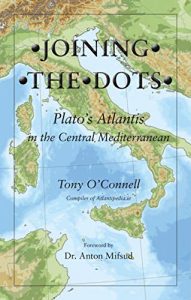
Joining The Dots
I have now published my new book, Joining The Dots, which offers a fresh look at the Atlantis mystery. I have addressed the critical questions of when, where and who, using Plato’s own words, tempered with some critical thinking and a modicum of common sense.Read More »
Aksyonov, Andrei
Andrei Aksyonov was a deputy director of the Institute of Oceanology of the Soviet
Academy of Sciences when he revealed in 1979(a) that photographs of man-made walls
and staircases had been taken at a depth of 200 feet in the Atlantic, 275 miles
southwest of Portugal, by a colleague, Vladimir Marakuyev. The location was the
underwater summit of the Ampere Seamount, part of the submerged Horseshoe
Archipelago.
The controversial images had been taken a few years earlier and consisted of two
photos. One shows eight stones, four rounded, four square, in a line just over
a metre in length. The second has three equally spaced stones which appear to
be part of a staircase. Aksyonov, believed that these ‘structures’ had once
stood on dry land, but did not claim them as Atlantean. However, a 1979 newspaper report(a) contradicts this.
Nevertheless, a couple of years later when better quality images were obtained, Akysonov declared that the original features were natural, ruling out an Atlantean explanation. However an Atlantis Rising article noted that Akysonov “Like his colleagues, was shocked by the official termination of all ongoing and future research at Ampere before the close of their 1986 expedition season. Director Akysonov had peremptorily declared that re-examination of the photographic surveys proved that all the seamount’s features were entirely natural, and no similar investigations would be government sponsored. He refused to disclose any alleged counter evidence and was the only scientist who reversed his long-held stance that the underwater features were artificial.” (b)
A somewhat indistinct copy of the image of the wall was formerly online, which seemed to have been copied from Charles Berlitz’s book, Atlantis, the Eight Continent[166].
This is no more convincing than Sarmast’s mile-deep wall off Cyprus.
(a) https://trove.nla.gov.au/ndp/del/article/110939505?searchTerm=Atlantis&searchLimits= Canberra Times Sunday April 8, 1979. p.8
(b) Did the Russians Find Atlantis? – ATLANTIS RISING THE RESEARCH REPORT (archive.org)