Latest News
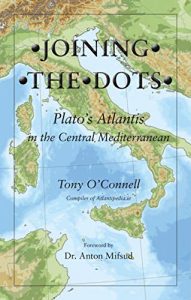
Joining The Dots
I have now published my new book, Joining The Dots, which offers a fresh look at the Atlantis mystery. I have addressed the critical questions of when, where and who, using Plato’s own words, tempered with some critical thinking and a modicum of common sense.Read More »
Archaeology
Archaeology has, so far, little to offer by way of a solution to the mystery of Atlantis. This does not mean that ‘Atlantis’ did not exist, but only that there is no record of any entity known by that name employed by classical authors. This is in no way surprising, as Plato explained that names in the original narrative given to Solon by the Egyptian priests had been Hellenised by Plato and/or Solon (Critias 113a).
It is more than likely that before it was Hellenised, ‘Atlantis’ was known by a number of other names to different peoples using a variety of languages.
A good example of this today is the land where ’Dutch’ people come from has been known variously as ‘The Low Countries’, ’Holland’ or ’The Netherlands’. My own country has been known as ‘Ireland‘, ‘Erin‘, and ‘Hibernia’ and its people are often referred to as ’Celtic’, ’Irish’, or sometimes ’Paddys’ in Britain or ’Micks’ in America.
Multiplying the number of possible alternative names is the fact that Plato’s Atlantis was comprised of a confederation of ten different constituents. no doubt, each with different names and possibly languages..Rational commentators are usually inclined to date the war with Atlantis to the latter half of the 2nd millennium BC. Coincidentally, around the same time the Trojan War was a conflict involving combatants on both sides from a variety of regions. Similarly, we are told that the Sea Peoples, a military alliance that attacked Egypt twice were also comprised of fighters from a number of different states. Extensive military alliances would appear to have been the norm then.
If the Atlantean warriors were just as diverse as the Sea Peoples and Atlantis or its capital was submerged, where does archaeology start to look? Frankly, underwater archaeology is slow and expensive and at its present state of development is not in a position to offer much in the search for Atlantis. However, the inevitable technological advances of the future should offer more cost-effective underwater exploration. Right now, archaeology has not much to offer the ongoing quest for Atlantis.