Latest News
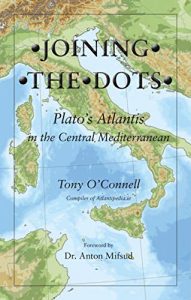
Joining The Dots
I have now published my new book, Joining The Dots, which offers a fresh look at the Atlantis mystery. I have addressed the critical questions of when, where and who, using Plato’s own words, tempered with some critical thinking and a modicum of common sense.Read More »
Divine Retribution *
Divine Retribution is the explanation offered by Plato (Crit. 121c) for the destruction of Atlantis in a manner that for us is reminiscent of the biblical tale of Noah and many other flood stories. Some modern writers such as Maxine Asher have promoted this concept of godly reprisal. However, there is one important element missing from Plato’s narrative, namely, the salvation of a chosen few. The idea that the entire story of Atlantis was concocted by Plato as some form of parable is incompatible with the elimination of both (bad) Atlanteans AND (good) Athenians (Tim.25d). Consequently, if Plato was not relating some form of invented morality tale, we are entitled to reconsider the probability that he was transmitting a story with a core of historical truth.
The earthquake and tsunami of 1755 that destroyed Lisbon and which killed up to 100,000 people is just another example of how divine retribution has been invoked as the cause of the catastrophe. For those that accepted this explanation, all it did was consolidate the power of the church and its clergy. For me, the event was just an example of twisted divine humour, when people were killed in churches and synagogues while the red-light district was left virtually intact(f).
The idea of a god on a punishment spree arose more recently when both Christian(e) and Muslim(d) survivors attributed the tsunami disaster in the Indian Ocean on December 2004 to divine retribution for the wickedness of man. Similar comments were expressed following the 2015 earthquake in Nepal(g). This modern knee-jerk reaction may explain the inclusion of similar sentiments in so many ancient flood stories.
William Lauritzen is a leading advocate of Atlantis having been situated on the Sunda Shelf where Indonesia is located today. He provides a more rational explanation for the tsunami tragedy in a new eBook(a) where he explains that the unstable geology of the area which caused the recent tragedy also destroyed Atlantis.
The following year the devastation caused by Hurricane Katrina in New Orleans was once again credited to the whims of a bad-tempered divinity.
The 2010 earthquake in Haiti produced a further stream of ‘divine retribution’ claims, among which were those from American evangelist Pat Robertson, who attributed the cause to the ‘satanic’ voodoo beliefs of many Haitians and somewhat surprisingly from the well-known movie actor Danny Glover who claimed that the earthquake was god’s response to the failure of the 2009 climate change conference in Copenhagen!!!
Charles Pellegrino expressed it well, when he wrote in Return to Sodom and Gomorrah[821.120], “when an explanation is sought for evil events in a presumably just universe, history brands the people villains because they became victims, victims because they became villains.”
All these nonsensical claims demonstrate that god has either an appalling sense of justice, executing good and bad with equal vigour or, as is my personal belief, that he/she/it does not exist at all. Tectonic fault lines and their attendant hazards exist irrespective of the moral behaviour of people living in their vicinity. Similarly, hurricanes sweep into the Caribbean and the southern United States every year bringing death and destruction, not because the people in the area are inherently evil, but because particular meteorological conditions exist in the region that cyclically generate hurricanes.
It is fairly clear then that a fault line existed in the vicinity of Atlantis, a fact which should help to identify or at least eliminate some suggested locations. Coincidentally, a BBC documentary How the Earth Made Us, aired today, highlighted the fact that many of the most important ancient cities were sited near fault lines in order to exploit the mineral resources that are frequently to be found associated with them.
Another ‘prophecy of doom’, from the late V.M.Rabolú (1926-2000), is that a planet five or six times the size of Jupiter, is approaching earth to destroy it, because of mankind’s wickedness. Rabolú claims to have travelled in his Astral Body to Venus and Mars and witnessed the inhabitants of those planets. He also points to the destruction of Atlantis being the result of the greed of its inhabitants. All this and more drivel is available in a free booklet, written by Rabolú, from the Alcione Association(b).
The concept of divine retribution was given a further twist in January 2014 when a British politician and member of UKIP, David Silvester, claimed(c) that the recent severe flooding in his country was a consequence of the same-sex marriage policy of the British government. Rain in Ireland seems a little heavier lately, following the referendum vote here in favour of same-sex marriage!
My final comment is a reflection on the fact that many western legal systems incorporate the concept of divine intervention with the use of the term ‘Act of God’ to describe catastrophic natural events leading to loss of life or property. Is it not time that such happenings be more accurately redefined as ‘natural but unanticipated’.
In February 2016 a paper was published(h) in Nature magazine with the interesting title of “ Moralistic gods, supernatural punishment and the expansion of human sociality”.
(a) www.earth360.com.
(b) https://www.hercolubus.tv#mantras
(d) https://english.pravda.ru/society/stories/13-01-2005/7593-0/
(e) Wayback Machine (archive.org) *
(g) https://sensuouscurmudgeon.wordpress.com/2015/05/01/ken-ham-nepal-earthquake-caused-by-sin/
(h) https://www.sciencenews.org/article/rise-human-civilization-tied-belief-punitive-gods