Latest News
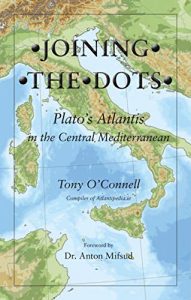
Joining The Dots
I have now published my new book, Joining The Dots, which offers a fresh look at the Atlantis mystery. I have addressed the critical questions of when, where and who, using Plato’s own words, tempered with some critical thinking and a modicum of common sense.Read More »
Atlantology
Atlantology as a distinct field of study is accepted by most to have begun with the works of Ignatius Donnelly, however flawed many of his ideas may have been. Since Donnelly, it has developed into a very complex multidisciplinary subject. Students of the topic are known today as Atlantologists, although an earlier designation was Atlantists, a term now used to describe supporters of political and economic co-operation between the USA and Western Europe. The inventive Zia Abbas prefers to use the term ‘Atlantisology’!
N. Zhirov, the leading Russian Atlantologist, has offered the following formal definition of the subject: “It may be regarded as a department of the biogeography of the modern, Quaternary period (Anthropogen) of the Earth’s geological history, a department chronologically relating to the period of the emergence of intelligent man, a period directly preceding our historical epoch beginning with the last glaciation.” He believed that Atlantis was primarily a geological problem that could only be resolved through a study of the geological history of the Atlantic Ocean.
A less cumbersome definition might be “the study of all aspects of Plato’s references to Atlantis”
A forum dealing with Atlantology(a) and suggested parameters for its study may be found interesting by readers. I personally disagree with a number of the headings proposed for inclusion, such as ‘Rudolf Steiner’, ‘Ireland & Tara’ and ‘Shangri-la’, as I consider them unrelated to Plato’s Atlantis. However, Atlantology is a ‘broad church’, a fact reflected in the pages of Atlantipedia.
As I see it, Atlantis seekers can be divided into three broad groups: fundamentalists, rationalists and fantasists. I view the fundamentalists as those who demand a strict acceptance of the details of Plato’s text, even when it conflicts with reason or the weight of indisputable scientific evidence, similar to the manner in which religious fundamentalists view their chosen ‘holy book’. For example, although Plato repeatedly dates the war with Atlantis to around 9600 BC, placing it in the Stone Age. However, Plato’s description of Atlantis is that of an advanced Bronze Age civilisation, while there is not a scintilla of evidence to support the existence of such a structured society in either ancient Egypt or Greece during the Stone Age.
To reconcile this apparent contradiction, some fundamentalists became fantasists by suggesting that the anomalous advanced civilisation of Atlantis was the consequence of extraterrestrial intervention. However, such a far-fetched explanation does not account for Athens being the military equal of Atlantis at such a remote date, while the archaeological evidence from that period consistently shows that the inhabitants of what is now Greece would have been armed with nothing more than sticks and stones.
The rationalists, on the other hand, recognise that there are anomalies and unexplained contradictions in Plato’s Atlantis texts and have produced a broad range of explanations in order to resolve these difficulties. Sceptics frequently cite the need to re-interpret details of Plato’s account as evidence of the incredibility of the entire Atlantis tale. However, it must be pointed out that re-interpretation is quite common when dealing with ancient texts because of linguistic, scientific or culturally generated problems. An obvious example of this is to be found in the creation story in Genesis, which declares unambiguously that the universe was created in seven ‘days’, a concept that was blindly accepted for centuries by all Christians until our scientific knowledge developed a more credible view of ‘creation’. Perhaps we should consider the fact that the works of Shakespeare, which are relatively recent, also require interpretation because in the comparatively short intervening period, language, cultural references and contemporary political issues, have altered far more than most 21st century English speakers fully appreciate.
Similarly, the numbers in Plato’s Atlantis story were not seriously challenged on any scale until the 20th century, when common sense combined with an improved knowledge of prehistory and ancient metrology prompted some writers to offer plausible alternatives to the 9,000 years and the dimensions of the described over-engineered features of the city of Atlantis. Although the fundamentalists and the rationalists hotly debate the numbers in the Atlantis story, it does not detract from the underlying probability of historical facts being at the core of the narrative any more than the ‘seven days of creation’ versus ‘millions of years’ debate regarding the Genesis story takes from the reality of the sequential development of the universe.
I personally favour the rationalist approach to the Atlantis question and have endeavoured to develop my views within the limits of that paradigm. In fairness to readers, I think it would be unreasonable to produce this compilation without declaring my views on the subject and doing so briefly through editorial comment throughout these pages and in a more structured way in Joining the Dots.
Seachild, ]the official seller of copies of Egerton Sykes Atlantis journals, has also produced a number of papers(c)(d) relating to scientific Atlantology and fields of study under which it should be investigated. These documents are now twenty or more years old and badly in need of revision.
Over the years that I have spent compiling Atlantipedia it became clear that different theories became ‘fashionable’ from time to time, because of new discoveries, the opinions of prominent individuals or as a consequence of heavily publicised books. The 15th century saw Gutenberg develop the printing press in 1436 and the first complete works of Plato, translated by Marsilio Ficino were published in 1484, so when Columbus discovered the New World in 1492, there were many who speculatively identified the Americas as Plato’s Atlantis. This idea persisted until the end of the 19th century and even today, some think it a possibility.
More specifically, when the monumental structures of the Maya and Incas were gradually revealed to Europeans, once again a link with Atlantis was proposed for South America and still, has some support today.
However, the most popular and enduring theory is that Atlantis had been situated in the Atlantic Ocean, with the Azores as the prime candidate. It received a boost in support with the discovery of the Mid-Atlantic Ridge in the 19th century and was used by Ignatius Donnelly in the formulation of his Atlantis theory.
In 1872, the elements of the Minoan Hypothesis began to appear when Louis Figuier was the first to link Atlantis with the 2nd-millennium eruption of Thera. Today, this idea is probably the most accepted, apart from the Atlantic location.
There are many other theories regarding Atlantis, some more exotic than others, but, in my opinion, none match all the criteria that can be gleaned from Plato’s account, although their authors would disagree.
In 1971, John S. Bowman [193] apparently coined the term ‘atlantist’ as an improvement on ‘atlantologist’ to describe those who have a keen interest in the study of Atlantis, but it got little support.
A potted history of Atlantology from Donnelly until Sykes is available at the Atlantis Online website(b).
(a) Introduction to Atlantology, page 1 (archive.org)
(b) Print Page – HIGHLIGHTS IN EARLY ATLANTOLOGY (archive.org)