Latest News
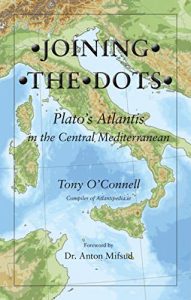
Joining The Dots
I have now published my new book, Joining The Dots, which offers a fresh look at the Atlantis mystery. I have addressed the critical questions of when, where and who, using Plato’s own words, tempered with some critical thinking and a modicum of common sense.Read More »
Carl Feagans
Usai, Luigi
Luigi Usai is the author of La Mappa di Atlantide (The Map of Atlantis) [1814], which, by his own admission, is the result of twenty days of intense study of the subject in early 2021!
Some of his principal claims are that Plato’s mention of the Atlantic Sea was a reference to the Western Basin of the Mediterranean, in the middle of which lay the island of Atlantis which today consists of the islands of Corsica and Sardinia, but which he believes were then conjoined. He specifies the Sardinian region of Sulcis as the home of the Atlantean capital!
His website(a) offers a list of 27 points in support of his thesis. The site itself seems to lack focus, wandering into unrelated areas such as suggesting a link between his Corsican/Sardinian Atlantis and the pre-Etruscan Villanovan culture of central Italy. He then proposes that ‘Moors heads’ on the flags of Corsica and Sardinia may have a Sumerian origin!
While I also favour a Central Mediterranean location for Atlantis, I must totally reject his date of 10,000 years ago for its existence as there was no civilisation in Athens or Egypt to attack at that time.
His paper ATLANTIDE ESISTE ED ERA IL GIARDINO DELL’EDEN (ATLANTIS EXISTS AND WAS THE GARDEN of EDEN) added the further claim that his Sardinian Atlantis was also home to the Garden of Eden.
At the very end of 2021, Usai claimed that he had discovered “a hidden unknown mysterious submerged civilization in Sicily-Malta Escarpment”(b). Unfortunately, he has not. In July 2021 I was sent several images, including the large image used by Usai, that purported to show anomalous underwater images in the Central Mediterranean, northeast of Malta. At first sight, they appeared to show extensive manmade features. However, further investigation by my correspondent eventually revealed that the images were the consequence of a flawed computer interpretation of sonar data.
In 2022, Usai published a number of images purporting to show underwater anomalies off the coast of Cuba(c). As Usai has already designated the central region of the Mediterranean as the location of Atlantis I cannot understand his reason for showing such images. Similar anomalies have been found in various parts of the world and explained by Google as data-gathering glitches (see Satellite Imagery). If any of the rectangular features were city walls or streets they would have been kilometres wide – a nonsensical suggestion.
In 2024, André Chaisson, a French civil engineering designer, has now revived interest in the Malta-Sicily Escarpment as the location of an ancient city. He reached this conclusion based on flawed underwater imagery, as did Usai. Chaisson avoids identifying it as Atlantis, as it is too big! Instead, he believes that this city “to be Telepylos, the legendary city of the Laestrygonians from Homer’s Odyssey—a land of flesh-eating giants”!(d) Carl Feagans subsequently offered a critique of Chaisson’s claims, while also noting Usai’s 2022 related theories(e).
In a December 2025 email, Usai made the additional claims that “Tritonis Lake has been found in Sardinia, it’s the sum of the ponds and lakes of Assemini, Elmas, Cagliari, Quartu S. Elena and Capoterra. The Atlas Mountains are the Sulcis Mountains. The Garden of Hesperides is the plain of Capoterra, Frutti D’Oro, near Cagliari.” Some further information is available on a multilingual website(f).
(a) Why didn’t scientists find Atlantis before Usai Luigi? ? Atlantis found!
(c) Cuba high resolution bathymetry – Atlantis exists! Found by Dr. Luigi Usai (atlantisfound.it)
(d) https://grahamhancock.com/chaissona1/
(e) https://ahotcupofjoe.net/2024/12/sicilian-atlantis-or-telepylos/
(f) https://zenodo.org/records/17918171 (the English text is after the Italian text)
Foerster, Brien
Brien Foerster is an American writer who now lives in Cuzco, the former Inca capital in Peru. He has studied the  ancient cultures of the Andes and believes that many predated the Incas and had advanced technologies that permitted the precise drilling of stone(a). His fully illustrated Kindle book, Lost Ancient Technology of Peru and Bolivia[0923], provides many examples. The book is worth purchasing for the images alone. There is now a video(d) that complements Foerster’s book.
Foerster has now studied the stonework of the ancient Egyptians and like Chris Dunn, concluded that their level of accuracy could not have been achieved without possession of a high technology, now lost(i). He has expanded on this in his 2014 book, Lost Ancient Technology of Egypt[1487].
However, Foerster has recently stepped out of line when he apparently chipped fragments from stones at the Bolivian Puma Punku site with a view to having them tested for age. The laboratory refused to test the fragments as Foerster did not have the appropriate export document from Bolivia(e). If the account of the incident is accurate, it would indicate seriously irresponsible conduct. Foerster subsequently disputed elements of the report and suggested that it might be libellous(f).
This episode is reminiscent of the two German scientists who, in 2013 were wrongfully accused of removing part of the ‘Vyse cartouche’ in the Great Pyramid and illegally smuggling it out of Egypt. This was subsequently shown to be a false claim by Zahi Hawass(l).
Elsewhere with regard to Atlantis, he claims “the most plausible idea is that Atlantis was not a single land mass that sank, but was a series of smaller states in the Atlantic area 12,000 years ago.”
In recent interviews, Foerster has proposed that the story of Atlantis is based on an Ice Age civilisation(g). His latest attention-seeking claim is that the Maya visited ancient Egypt, a trip that had some form of Atlantis connection(h).
He has also co-authored with David Hatcher Childress a book on South American cranial deformation and elongated skulls. These are reminiscent of similar skulls found in Malta(c) and Egypt as well as elsewhere around the world and date back many thousands of years(b).
In 2018, Baalbek Lebanon: Megaliths Of The Gods [2118] was privately published by Foerster. It’s a short but well-illustrated book. Unfortunately, although it provides a lot of interesting background material about Baalbek, it does nothing to solve the mystery of how the enormous, dressed stone blocks there were moved or by whom.
Carl Feagans’ website(j) has a number of articles that are highly critical of Foerster’s methods and motivation. Equally critical is a posting and comments on the newagefraud.org website(k).
(a) https://www.youtube.com/watch?v=xR7of1Lkef0
(b) https://www.atlasobscura.com/articles/head-space-artificial-cranial-deformation
(c) https://nexusilluminati.blogspot.ie/2013/03/ancient-elongated-skulls-and-cranial.html
(d) https://www.youtube.com/watch?v=HmK7Ng0eGV8
(h) https://verumetinventa.wordpress.com/2016/06/28/brien-foerster-good-evidence-of-maya-culture-in-egyptian-pyramids/ (link broken)
(k) http://web.archive.org/web/20220518221444/http://www.newagefraud.org/smf/index.php?topic=5345.0
(l) URGENT URGENT! BREAKING NEWS: EGYPT – Atlantisforschung.de (atlantisforschung-de.translate.goog)
Fuente Magna Bowl
 The Fuente Magna Bowl is an unprovenanced object said to have been found near Lake Titicaca in Bolivia. It has been promoted as a possible pre-Columbian artefact bearing cuneiform-like signs, but both its authenticity and the proposed Sumerian reading are disputed.
It is claimed that thermoluminescence dating has shown the object to be quite ancient and not a forgery. The same site(a) quotes at length a translation of the text by Clyde Winters, but a German website(b) denounces his translation as nonsense, although it accepts that the Bowl as genuine. Another site(c) offers a selection of detailed images of the Bowl.
Carl Feagans’ website(f) is equally critical of Winters’ ‘translation’ and raises a number of questions regarding the authenticity of the artefact.
April Holloway offered an overview of the controversy relating to the Fuente Magna Bowl on the Ancient Origins website, concluding quite reasonably, that further objective linguistic research could bring the debate to a conclusion(g).
Jim Allen and his supporters have sought to link the Bowl with the theory of Atlantis in the Andes(d).
The bad archaeology website has a reasonably balanced article(e) on the bowl which should be read.
Michel Leygues has published(h) his study of the Fuente Magna Bowl in which he endeavours to demonstrate the relationship between Sumerian, Akkadian, Aymara and Quechua. Unfortunately, so far it is only available in French.
(a) https://web.archive.org/web/20110727221012/http://www.world-mysteries.com/sar_8.htm
(c) See: https://web.archive.org/web/20160613101558/https://www.faculty.ucr.edu/~legneref/biados/fuentmag.htm
(e) https://badarchaeology.wordpress.com/tag/fuente-magna-bowl/
(f) https://ahotcupofjoe.net/2017/11/fuente-magna-bowl-not-cuneiform-not-sumerian/
Yonaguni
Yonaguni is a small Southern Japanese island that has remarkable underwater features off its coast, at depths as little as 20 feet in places. They have led to continuous debate since their accidental discovery in the mid-1980s. The conventional view is that the monolithic formations are natural in origin and composed chiefly of sandstone. Dr. Robert Schoch, who twice visited and dived at the site, supports this view.
However, there is a persistent claim that the enormous edifices are in fact the remains of an ancient sunken city. This school of thought is led by Professor Masaaki Kimura, a marine geologist from the University of the Ryukyus, who has conducted long-term diving and researchstudying at the site. An interview with Kimura is available online(d).
Some have gone as far as to claim that the site is that of the lost city of Mu, a Pacific counterpart of Atlantis.
Carl Feagans has published an extensive article debunking Masaaki’s claims(a), as has Brian Dunning(b). A BBC video clip(c) from February 2022 has also endorsed Schoch’s conclusion that the Yonaguni feature is natural, pointing out that similar large regular geological features are also to be seen on land.
(a) https://ahotcupofjoe.net/2017/10/yonaguni-monumental-ruins-natural-geology/
(b) https://skeptoid.com/episodes/4220
(c) (BBC Feb.23, 2022) https://www.bbc.com/reel/video/p0884j4s/the-truth-behind-japan-s-mysterious-atlantis-
Spain
Spain has been favoured as a probable location of Atlantis by a sizeable number of investigators, principally Spanish and other Europeans. For about a century, attention has been focused on the region of Andalusia, although one writer, Jorge María Ribero-Meneses, has opted for Cantabria in Northern Spain. The most vocal proponent in recent decades of a Spanish Atlantis is arguably Georgeos Diaz-Montexano, who has published of a series of books on the subject.
Richard Freund is a latecomer to the question of Atlantis and recently foisted himself on the excavators in the Doñana Marshes, announcing that the site was related to Atlantis/Tarshish and garnering widespread publicity ahead of the publication of his own book on Atlantis!
One commentator has suggested that the origin of the name of Spain itself was derived from the Semitic language of the Phoenicians, whose presence in Spain is conventionally dated from around the ninth century BC. They referred to the region as ‘span’ or ‘spania’, which means hidden! Cadiz, equated with Plato’s Gades, is frequently cited as the oldest colony of the Phoenicians. The date appears to be based on tradition rather than hard evidence. Archaeology puts the date closer to 800 BC.
The oldest Phoenician remains, found in the vicinity of Malaga, were discovered during the recent building of a second runway. The occupation of the site is dated to around 700-600 BC.
In September 2012 a report(a) revealed that at the La Bastida site in Murcia, Spain, fortifications dated to 2,200 BC had been discovered and heralded as “Continental Europe’s First Bronze Age City” and “is comparable only to the Minoan civilisation of Crete”.
Late November 2018 saw Merlin Burrows (M.B.), a British surveying company, claim to have found Atlantis in Spain close to the Doñana National Park (b). M.B.’s head of research, Tim Akers, claimed that “laboratory analysis of material recovered from Spain showed evidence of a type of cement not seen before.” This and evidence of ancient metallurgy were enough for him to conclude that it had come from Atlantis! So now it seems that if something previously unknown is found, it must come from Atlantis! That something has been found is not doubted, but it is more likely to have been the Phoenicians, who extensively exploited the rich mineral deposits in the region. Another website offers a more extensive report from Merlin Burrows(g) as well as a review of other failed Atlantis claims.
The report contains wild speculation, particularly when claiming that this new discovery dates back to the end of the Last Ice Age when Athens or Egypt did not have structured societies and so could not refer to Plato’s Atlantis. There is little doubt that a number of interesting sites over the 100-mile stretch have been located, but they do not include Atlantis. Expect a flurry of media responses (c) for a while as they await the next wild claim. Meanwhile, Merlin Burrows ha had their publicity, or so I thought. However, M.B. has now embarked on a further campaign promoting a series of new Atlantis films called Atlantica, employing director Michael Donnellan to drum up interest(j). His most recent outing in October 2021 on Spanish TV stirred P.R.Cantos to examine some of Donnellan’s dubious claims(k). Not unexpectedly, further criticism came from sceptic Carl Feagans(l).
Mid 2025 saw Merlin Burrows return with another claim of having located Atlantis and teased us with a promise of an upcoming three-part documentary series that will reveal all! (t) In July 2025, Donnellan endeavoured to revive interest in the idea of a Spanish location for Atlantis near Cádiz(u), once again receiving widespread media attention(v). We must keep in mind that finding the submerged remains of buildings under water is not unusual, but claiming that they are the remnants of Atlantis requires a whole new level of evidence.
The Doñana National Park was extensively investigated some years ago and was the subject of a National Geographic documentary, Finding Atlantis. Nothing remotely Atlantean was found. For my part, I prefer to follow Plato and point to the only territory named by him as Atlantean, namely Southern Italy, N.W. Africa and some of the many islands in the region.
The Doñana story took a new turn yesterday (22.11.18) when Georgeos Diaz-Montexano published a paper on the Academia.edu website, in Spanish and English (d)(e), which completely debunks the foundations of the Merlin Burrows claim. It is interesting to read about the arrogance of the video makers when challenged by Diaz-Montexano. The following day, Díaz-Montexano re-posted (f) the paper with additional comments by Professor César Guarde-Paz, a distinguished Spanish academic, who also denounced the Merlin Burrows claims.
Stavros Papamarinopoulos is also a keen supporter of locating Atlantis in Spain, outlining his reasons in a series of papers(m-r) delivered to the 12th International Congress of the Geological Society of Greece, Patras, 2010.
In March 2024, the UK’s Express newspaper published a report(s) from Spain offering yet another suggestion that Atlantis may have been discovered off the coast of Spain in the region of Cadiz!
“A team of Spanish researchers recently reported the discovery of several large concentric circular structures, resembling artificial walls, which are believed to share similarities with Plato’s accounts of the enigmatic lost city of Atlantis.
Although Mercedes de Caso Bernal, a renowned historian and archaeologist involved in the discovery, made it clear that the team would not disclose the exact location of their findings, he confirmed that the structures measured up to five meters in height and stretched as long as 450 meters.”
(a) La Bastida unearths 4,200-year-old fortification, unique in continental Europe | ScienceDaily
(d) ¿LA ATLÁNTIDA FINALMENTE DESCUBIERTA? Leer el artículo en https://atlantisng.com/blog/la-atlantida-finalmente-descubierta-segun-nuevo-documental-britanico-hoax-publicitario-o-el-mayor-de-los-ridiculos/ (link broken Dec. 2018)
(e) Página no encontrada — La Atlántida Histórica (archive.org)
(f) Página no encontrada — La Atlántida Histórica (archive.org)
(g) https://peopleus.blogspot.com/2011/07/has-real-lost-city-of-atlantis-finally.html
(l) How the Discovery of ‘Atlantis’ Made Big News Then Faded Away – Archaeology Review (ahotcupofjoe.net
(m) (PDF) ATLANTIS IN SPAIN II (researchgate.net)
(n) (PDF) ATLANTIS IN SPAIN III (researchgate.net)
(o) (PDF) ATLANTIS IN SPAIN IV (researchgate.net)
(p) (PDF) ATLANTIS IN SPAIN I (researchgate.net)
(q) (PDF) ATLANTIS IN SPAIN VI (researchgate.net)