Latest News
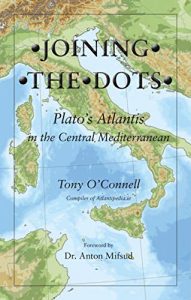
Joining The Dots
I have now published my new book, Joining The Dots, which offers a fresh look at the Atlantis mystery. I have addressed the critical questions of when, where and who, using Plato’s own words, tempered with some critical thinking and a modicum of common sense.Read More »
Ambiguities and Contradictions
Ambiguities and Contradictions are to be found in Plato’s Atlantis texts. Similar difficulties can be found in other documents that originated in the same period. Readers may be familiar with the discrepancies and apparent contradictions that are to be found throughout the Old Testament. Most of these difficulties stem from the fact that these texts were written in archaic languages that are still not totally understood and where the original text are no longer extant. In addition, these original have been translated into other languages that often included translation and transcription errors. These problems are often more apparent than real.
All these factors have led to most ancient writings being the subject of extensive debates. Plato’s work is no exception. The greatest controversy has arisen regarding the location of Atlantis, with the focus on the position of the Pillars of Heracles. Until relatively recently, the accepted wisdom was that the ‘Pillars’ could only have been at the Strait of Gibraltar. However, writers such as Eberhard Zangger, Anton Mifsud, Sergio Frau and many others have offered equally legitimate alternative locations for the ‘Pillars’, leading to a broadening of the debate on the location of Atlantis itself.
Another subject that receives ongoing heated discussion is the date of Atlantis’ destruction. Although Plato states that the war occurred 9,000 years before Solon’s Egyptian visit and that Atlantis was destroyed ‘afterwards’. It is clear that such an early date is incompatible with the Bronze Age society, which he so clearly describes and is quite definitely in conflict with the archaeological evidence, which denies the existence of structured societies in either Egypt or Greece at that time.
Other matters that continue to generate controversy are the size of Atlantis, whether Atlantis was a continent, an island or a peninsula and what will surprise many people, the exact location of Plato’s ‘Atlantic Ocean’. Another example is Plato’s consistent reference to Atlantis as an island, yet he twice mentions that part of North Africa and southern Italy, that are clearly not islands, were part of Atlantis.
These arguments usually arise because of the limitations of the developing Greek language and its numerical notation, as they existed at the time of Solon and Plato.
The result is that if you have, say, three proposed locations for Plato’s ‘Atlantic Sea’, six or more locations for the ‘Pillars’, various identifications of the ‘continent’ referred to, as well as debates regarding the size of Atlantis and it is obvious why there is such a multiplicity of Atlantis theories. Apart from which, Plato’s date for the Atlantean War of 9,600 BC seems to conflict with both archaeology and reason, adding additional confusion and yet more theories. Other details, such the identity of the Atlanteans, had only compounded matters further.