Latest News
Joining The Dots
I have now published my new book, Joining The Dots, which offers a fresh look at the Atlantis mystery. I have addressed the critical questions of when, where and who, using Plato’s own words, tempered with some critical thinking and a modicum of common sense.Read More »
Sicily
Sicily was known in earlier times as Trinacria because of its triangular shape. The island was first inhabited by modern humans during the last Ice Age(h) when lower sea levels exposed a land bridge between it and what is now mainland Italy.
Antoine Gigal, the French writer and explorer noted(f) that “In the Odyssey, Homer refers to Sicily as Sikania (in classical texts it is also called Sikelia) and mentions the Sicanian Mountains. This is why one of the three native peoples of Sicily was named the Sicani (Sikanoi or Sicanians). They were probably there from 3000-1600 BC, from the earlier proto-Sican period, where various Mediterranean influences reached the Neolithic population that was based more in the central and western part of the island.”
She added later, “Some modern researchers think that Siculo and his people originated from even further away, from the east. Prof. Enrico Caltagirone and Prof. Alfredo Rizza have even calculated that in the modern Sicilian language there are more than 200 words that come directly from Sanskrit. Then from the Bronze Age and classical antiquity there is evidence of another Sicilian people, the Elymians, who migrated from Anatolia and may have been descended from the famous “Sea Peoples”. The west of Anatolia was then occupied by non Indo-Europeans. Thucydides said they were refugees from Troy.
Indeed, a group of Trojans are supposed to have survived the defeat of Troy, having escaped by sea, and settled in Sicily and mixed with the Sicani. Virgil even writes that they were led by the hero Acestes, king of Segesta in Sicily, who gave help to Priam and Aeneas, and had Anchises buried in Erix (modern Erice).”
Plato was quite familiar with Sicily, having paid a number of visits there(i) and on one occasion was sold as a slave, after offending King Dionysius with his criticism of tyrannical rulers. Many think that his time in the capital, Syracuse, inspired elements of his description of the capital of Atlantis!
The island was probably first suggested as having a link with Atlantis by Lionardo Vigo in the 19th century and more convincingly by Mário Saa in a 1936 book in which he has Atlantis stretching from and including Sicily and the Maltese archipelago all the way to Tunisia. It was then more than four decades before Phyllis Young Forsyth wrote her book, Atlantis: The Making of Myth [266], in which she expressed her belief that Plato wrote the Atlantis story as an anti-war allegory partly based on his own experiences with the king of Syracuse.
More recently, several other 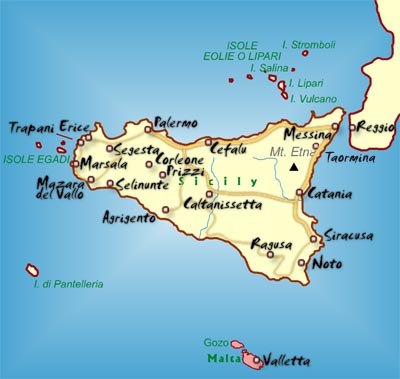 writers have also put Sicily forward as a location for Atlantis. One of these was Francesco Costarella, who is an Italian researcher and the author of two books relating to Atlantis. The first [1636] puts forward the idea that Plato’s Atlantis and the biblical Deluge, are in the author’s words, ‘two sides of the same coin’, while in the second [1637], he identifies Sicily as the location of Atlantis.
In the main, it has been European investigators who have advocated such a Sicilian connection and some have gone further and proposed a land bridge with Tunisia within the memory of man.
Dr Peter Jakubowski also offers(a) Sicily and the Malta Plateau as the location of Atlantis. He proposes a cosmic impact in the Atlantic which closed the Strait of Gibraltar around 4800 BC. When the dam eventually broke, the Mediterranean to the west of Sicily began to fill. This was then followed by the breaching of the land bridge between Sicily and Africa and finally, the dam in the Bosporus broke, flooding what was a much smaller Black Sea than we have today. Jakubowski’s site is apparently a reworking of Axel Hausmann’s book. A few years ago, he revamped his website but removed all the Atlantis material.
Patrick Archer has also adopted the concept of a Sicilian land bridge and promotes the idea that the breaching of it and its consequences were the inspiration for the biblical Deluge(e).
Alberto Arecchi(b) has added his voice in support of this Sicilian land bridge linking Italy with Africa and places Atlantis off the coast of modern Tunisia.
Further support has come from Thomas J. Krupa in his 2014 book[1010], which proposes that the land bridge was composed of limestone, which over time had been partially dissolved by rainwater and was under stress from the rising sea levels on its western side. He considers the land bridge the most likely location for Atlantis, which was destroyed when the isthmus was sundered by an earthquake.
Another exponent of a relatively recent collapse of the Gibraltar Dam is the previously mentioned Axel Hausmann[371] who locates Atlantis between Sicily and Malta.
Alfred E. Schmeck has written[542], in German, a detailed look at Sicily as the inspiration for Plato’s narrative.
Thorwald C. Franke has a well-balanced website(c), in German and English, supporting the idea of a Bronze Age Sicilian Atlantis. For topographical reasons, he places the city on the Plains of Catania on the east coast of the island. He sees that the importance of Atlantis within his hypothesis “is the transfer of culture from the eastern to the Western Mediterranean, e.g. there can be found parallels between the culture of the Etruscans, whose role in bringing eastern culture to the west is widely acknowledged.”
Sicily is also home to a number of step pyramids similar to the Canarian examples(d). Antoine Gigal offers(f) an extensively illustrated article about 23 previously unrecorded Sicilian pyramids as well as seven pyramids on Mauritius(g).
A 2020 article on the Ancient Origins website by Daniela Giordano reviews the subject of Italian pyramids and more particularly, the Sicilian pyramids and their possible connection with the Shekelesh one of the Sea Peoples, an idea also advocated by Nancy K. Sanders, the British archaeologist. The article goes on to suggest some linkage with the more than controversial Bosnian pyramids, which I find overly speculative(k).
Quite recently, a bronze object with a 13th century BC Sicilian connection was found off the coast of Devon in the UK, suggesting ancient trade between the Central Mediterranean and Britain(j).
(b) NEWS: ATLANTIDE NEL CANALE DI SICILIA (archive.org)
(c) http://www.thorwalds-internetseiten.de
(d) Archive 2006
(e) https://patrickofatlantis.com/
(f) https://www.gigalresearch.com/uk/pyramides-sicile.php
(g) https://www.gigalresearch.com/uk/pyramides-maurice.php
(h) http://www.sci-news.com/archaeology/article00749.html
(i) https://www.bestofsicily.com/mag/art407.htm
(j) https://atlantisonline.smfforfree2.com/index.php?topic=5703.0;wap2
(k) https://www.ancient-origins.net/ancient-places-europe/sicily-pyramids-0013233
Also See: Pantelleria