Latest News
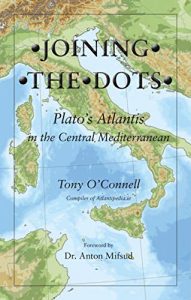
Joining The Dots
I have now published my new book, Joining The Dots, which offers a fresh look at the Atlantis mystery. I have addressed the critical questions of when, where and who, using Plato’s own words, tempered with some critical thinking and a modicum of common sense.Read More »
Volcanoes
Volcanoes at their most explosive have played an important part in the mythologies and histories of humans.
A recent Irish Times article (10/2/22) observed “Despite the small number of volcanoes here, European culture has been deeply influenced by volcanic activity. In ancient Greek mythology, volcanoes were where the Olympian gods had imprisoned their rivals, the Titans. When the Romans adopted the Greek religion, Mount Etna became the home of Vulcan, the god of fire and blacksmiths, who worked his forges underneath the mountain.”(u)
Volcanism is not part of the Atlantis story as related by Plato. His narrative clearly attributes the destruction of Atlantis and the Athenians to flooding and earthquake. Admittedly, flooding can be the result of some volcanic activity, but in the absence of any evidence to support this view in the case of Atlantis, the idea is only supposition. While most accept that Atlantis was named after its first king, Atlas, Frank Joseph’s fertile imagination suggests[104] that ‘the island of Atlantis was named after its chief mountain, a dormant volcano’. For those that place Atlantis in the Atlantic the idea of volcanic or seismic activity as the cause of the flooding of Atlantis AND Athens is hard pressed to suggest a location for this activity that would explain two catastrophes two thousand miles or more apart.
However, the red, white and black stone that Plato may be related to volcanic eruptions that produce rocks of tufa (red), pumice (white) and lava (black). Pumice has been found at various locations in Egypt(v) and identified as originating not only from Thera but also from eruptions on the Greek islands of Nisyros and Giali as well as the Italian Lipari Islands(o). Pumice has a chemical fingerprint which enables its source to be identified(t).
Jelle Zeilinga de Boer and Donald Sanders are the authors of Volcanoes in Human History[681] which supports the idea that the eruption of Thera was a factor in the development of the Atlantis story and also suggests a link with the Flood of Deucalion.
Nevertheless, a recent book by William Lauritzen, The Invention of God[745], makes a convincing case for accepting volcanic activity as the inspiration behind some of the imagery of ancient mythologies and most major religions. A recent article(i) on the BBC website expanded on this further. Lauritzen also suggests that the pyramids were meant to represent volcanoes.
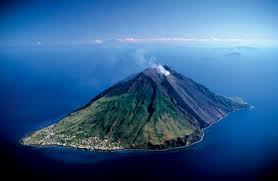
Stromboli
The most active volcanic region of Europe is to be found in Italy, where Etna and Stromboli have been continuously erupting for thousands of years(b). There is a report that a 6000 BC extreme eruption of Etna resulted in a tsunami 130 feet in height which swept the Mediterranean(c). However, the most devastating prehistoric volcanic eruption discovered so far seems to have been in Siberia 252 million years, which may have led to the most extensive mass extinction of life on earth(e). This is now rivalled by Tamu Massif in the Pacific mentioned below.
The cataclysmic volcanic eruption of Thera in the second millennium BC has had a strong level of support as the cause of Atlantis’ collapse, a view endorsed by recent television documentaries and an IMAX film. The Greek volcanologist, George Vougioukalakis, whose research is featured in the aforementioned film, is convinced that the eruption of Santorini offers the most rational explanation for the truth behind Plato’s story(a). However, he dissents from the recently expressed view that pumice found on the Northern Sinai Peninsula was transported there by a tsunami generated by the eruption of Thera and prefers to believe their transportation there was by normal sea currents.
Apart from Santorini, Jim Allen had initially proposed the Andean village of Quillacas, which lies on top of a volcano, as the site of Atlantis, but later found that the nearby site of Pampa Aullagas had a greater correspondence with the description of Atlantis. More recently Richard W. Welch has suggested the eruption of a supervolcano in the Atlantic as the cause of Atlantis’ demise. And so the idea of the volcanic destruction of Atlantis still has some support!
Since January 2011, Santorini has shown some signs of a volcanic reawakening(d).
In September 2013 studies revealed(f) what may be the location of the largest volcano ever to have erupted on our planet. It would have been the size of the British Isles and situated underwater in the northwest Pacific and known as Tamu Massif. It would have rivalled the Olympus Mons on Mars, but fortunately, has been dormant for 140 million years.
March 2014 saw a post on Dale Drinnon’s website(g) take the linkage between Atlantis and a volcano rather further with the suggestion that “the capital city of Atlantis in Plato’s description was built in the caldera of an extinct volcano and that many of the features of the description are volcanic in origin. The “Poseidon’ temple is the pyramidal volcanic neck, an erosional feature that stood out like a conical mound some hundreds of feet in diameter and possibly some hundreds of feet high on the outside. there was a tunnel bored through this aligned East and West, to allow the sunlight in at the beginning and the end of the day for certain rituals.”
In December 2014 a report from Princeton University revealed that a massive series of volcanic eruptions 66 million years ago can be aligned with the extinction of the dinosaurs and should be included as part of the cause of that extinction along with the Yucatan meteorite impact(h). However, in February 2021, a report from Harvard proposed that the Yucatan impactor was a comet rather than an asteroid or meteor(s).
In 2009, it was reported(q) that another example of contemporaneous meteorite impact and flood volcanism was identified in Belarus.
The Laki volcano in Iceland erupted in 1783, killing 9,000 local people but more dramatically causing the Nile Valley population to be cut by a sixth, according to a study published by scientists at Rutgers, The State University of New Jersey. “The study is the first to conclusively establish the linkage between high-latitude eruptions and the water supply in North Africa”(j).
A 2015 report(k) suggests that a series of North American volcanic eruptions in 536 AD had such a detrimental effect on the climate of Europe that contributed to the demise of the Roman Empire.
Furthermore, there is now evidence(m) that the eruption of El Chicon volcano in Southern Mexico around 540 AD led to the disruption of the Maya civilisation. Can there be a connection between these two events? In 2020, it was reported that the massive Tierra Blanca Joven eruption of the Ilopango volcano in El Salvador had been accurately dated to within a year or two of 431 AD, which also devastated Maya communities within an eighty-kilometre radius(r).
However, David Keys in his book, Catastrophe[1130], has proposed that a massive eruption of Krakatoa around 535 AD caused disruption on a global scale. Matthew Toohey from the GEOMAR Helmholtz Centre for Ocean Research in Kiel, Germany, has suggested the possibility of a double event involving both El Chicon and Krakatoa!
Recently the longest (1,200 miles) continental volcano chain was identified in Australia(l).
The BBC reported(n) in 2016 that “Deep-sea volcanoes are so remote until recently we did not even know they existed” and although “We do not see them erupt, yet more than half of the Earth’s crust can be attributed to their dramatic explosions” and “In fact, the mid-ocean ridges form the largest volcanic systems on Earth. But as they are largely hidden from sight, they have long remained elusive.”
In July 2017, the BBC offered an interesting article on the potential ongoing threat from supervolcanoes around our globe(p) and the inevitability of future eruptions.
(b) https://en.wikipedia.org/wiki/Volcanology_of_Italy
(c) https://www.livescience.com/1170-towering-ancient-tsunami-devastated-mediterranean.html
(e) https://www.seeker.com/the-deadliest-volcano-ever-1767374752.html
(f)https://www.nature.com/news/underwater-volcano-is-earth-s-biggest-1.13680
(j) https://news.rutgers.edu/news-releases/2006/11/icelandic-volcano-ca-20061120#.Vd2BIMtRFwE
(k) https://www.unexplained-mysteries.com/news/283466/volcanoes-hastened-fall-of-the-roman-empire
(m) (BBC April 20, 2016) https://www.bbc.com/news/science-environment-36086096
(n) https://www.bbc.com/earth/story/20160808-the-volcanoes-hiding-in-the-ocean
(o) Wayback Machine (archive.org)
(p) (BBC July 24, 2017) https://www.bbc.com/future/story/20170724-would-a-supervolcano-eruption-wipe-us-out
(q) https://www.sciencedaily.com/releases/2009/01/090107085320.htm
(r) Scientists Reveal More About Volcanic Eruption That Rocked the Ancient Maya (archive.org)