Latest News
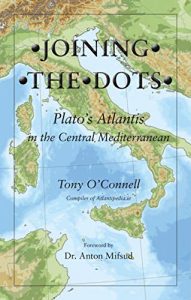
Joining The Dots
I have now published my new book, Joining The Dots, which offers a fresh look at the Atlantis mystery. I have addressed the critical questions of when, where and who, using Plato’s own words, tempered with some critical thinking and a modicum of common sense.Read More »
BBC
Holland, Tom
Tom Holland (1968- ) is the English author of a number of books on ancient and medieval history as well as a presenter of  documentaries on the BBC.
Holland along with Dominic Sandbrook has fronted an extensive series of podcasts titled, The Rest is History . Two recent (50 min) episodes(a)(b) dealt with the story of Atlantis. Thorwald C. Franke was ‘displeased’ with their content and produced a lengthy critique of the two segments in German(d) and English(c) in his Newsletter No.211. I advise that his full paper be read.
(a) (77) 314. Atlantis: The Legend – YouTube
(b) (77) 315. Atlantis: Legacy of the Lost Empire – YouTube
(c) Tom Holland on Plato’s Atlantis – Atlantis-Scout (Eng)
(d) Tom Holland über Platons Atlantis – Atlantis-Scout (Ger)
Stieglitz, Robert
Robert Stieglitz is Professor Emeritus of Ancient Mediterranean Civilisations at Rutgers University. He is  a specialist in ancient seafaring. He contends that the Sea Peoples included the Philistines(a).
He appeared on the BBC documentary, Helike – The Real Atlantis and while he is obviously an Atlantis sceptic, when pressed, he responded that since “Helike was the only city to disappear without a trace in one night, so if there’s a grain of truth at all to the story of Atlantis it’s the disappearance of Helike which inspired in Plato to write the myth of Atlantis.”(b) He subsequently developed this idea into a lecture(c).
Stieglitz has also authored a paper concerning the migrations that took place in the ancient Near East, 3500-500 BC(d).
(a) AIA Event Listings – Sea Peoples in the Promised Land – [node:field-sponsor] (archive.org)
(b) (BBC Jan 10, 2002) https://www.bbc.co.uk/science/horizon/2001/heliketrans.shtml
(c) https://smithsonianassociates.org/ticketing/tickets/reserve.aspx?performanceNumber=229270&utm_source=RAad&utm_content=FEauto&utm_campaign=featevent (link broken)
(d) https://www.researchgate.net/publication/270377741_Migrations_in_the_Ancient_Near_East
Hughes, Bettany
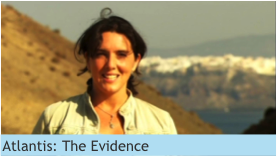
Bettany Hughes (1968- ) is a well-known historian with a high media profile. She has presented one major TV documentary on the subject of Atlantis, specifically supporting aspects of the Minoan Hypothesis. This was Atlantis: The Evidence (Timewatch BBC TWO, 2010)(a) and more recently she has been trotted out to promote a new drama series Atlantis (BBC 2013).
She wrote a preview of this BBC series, for The Telegraph(b), which together with her earlier documentary still raises questions for me about her competence to deal with this subject at all. In her article she refers to the Atlantis story as a moral fable, ignoring the fact that not only were the ‘wicked’ Atlanteans destroyed, but so also were the ‘good’ Athenians.
She then alludes to Plato’s mention of the use of red, black and white stone in Atlantis. It is well known that this combination is common in volcanic regions and has been noted at a number of proposed Atlantis sites; The Canaries, Bolivia, Morocco, Azores, Sardinia and southern Spain.
Next, Hughes tries to explain away the navigation hazard described by Plato, identifying it as pumice. Plato clearly describes mud shoals as the barrier. This would be fine, except Plato also tells us that the hazard still existed in his day, a thousand years after the eruption. It is improbable, to say the least that pumice would have lingered for a millennium!
These miserable attempts to link Thera and Atlantis are bad enough, Hughes does not explain how Plato repeatedly refers to the Atlantean invasion coming from their base in the the west (Tim.25b & Crit 114c), while Thera/Crete is north of Egypt and south of Athens. Where were the Pillars of Heracles and where were the Minoan elephants?
I would expect a professional like Hughes to offer a more comprehensive review of ALL the information provided by Plato and not dismiss whatever conflicts with her opinion as “sheer fantasy”. This picking and choosing from Plato’s text is not good enough without any justification for her selectivity.
(a) https://www.youtube.com/watch?v=O7bVIq0jNfg
(b) https://www.telegraph.co.uk/culture/tvandradio/10339254/Atlantis-secrets-of-the-real-lost-city.html
Volcanoes
Volcanoes at their most explosive have played an important part in the mythologies and histories of humans.
A recent Irish Times article (10/2/22) observed “Despite the small number of volcanoes here, European culture has been deeply influenced by volcanic activity. In ancient Greek mythology, volcanoes were where the Olympian gods had imprisoned their rivals, the Titans. When the Romans adopted the Greek religion, Mount Etna became the home of Vulcan, the god of fire and blacksmiths, who worked his forges underneath the mountain.”(u)
Volcanism is not part of the Atlantis story as related by Plato. His narrative clearly attributes the destruction of Atlantis and the Athenians to flooding and earthquake. Admittedly, flooding can be the result of some volcanic activity, but in the absence of any evidence to support this view in the case of Atlantis, the idea is only supposition. While most accept that Atlantis was named after its first king, Atlas, Frank Joseph’s fertile imagination suggests[104] that ‘the island of Atlantis was named after its chief mountain, a dormant volcano’. For those that place Atlantis in the Atlantic the idea of volcanic or seismic activity as the cause of the flooding of Atlantis AND Athens is hard pressed to suggest a location for this activity that would explain two catastrophes two thousand miles or more apart.
However, the red, white and black stone that Plato may be related to volcanic eruptions that produce rocks of tufa (red), pumice (white) and lava (black). Pumice has been found at various locations in Egypt(v) and identified as originating not only from Thera but also from eruptions on the Greek islands of Nisyros and Giali as well as the Italian Lipari Islands(o). Pumice has a chemical fingerprint which enables its source to be identified(t).
Jelle Zeilinga de Boer and Donald Sanders are the authors of Volcanoes in Human History[681] which supports the idea that the eruption of Thera was a factor in the development of the Atlantis story and also suggests a link with the Flood of Deucalion.
Nevertheless, a recent book by William Lauritzen, The Invention of God[745], makes a convincing case for accepting volcanic activity as the inspiration behind some of the imagery of ancient mythologies and most major religions. A recent article(i) on the BBC website expanded on this further. Lauritzen also suggests that the pyramids were meant to represent volcanoes.
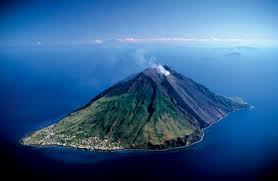
Stromboli
The most active volcanic region of Europe is to be found in Italy, where Etna and Stromboli have been continuously erupting for thousands of years(b). There is a report that a 6000 BC extreme eruption of Etna resulted in a tsunami 130 feet in height which swept the Mediterranean(c). However, the most devastating prehistoric volcanic eruption discovered so far seems to have been in Siberia 252 million years, which may have led to the most extensive mass extinction of life on earth(e). This is now rivalled by Tamu Massif in the Pacific mentioned below.
The cataclysmic volcanic eruption of Thera in the second millennium BC has had a strong level of support as the cause of Atlantis’ collapse, a view endorsed by recent television documentaries and an IMAX film. The Greek volcanologist, George Vougioukalakis, whose research is featured in the aforementioned film, is convinced that the eruption of Santorini offers the most rational explanation for the truth behind Plato’s story(a). However, he dissents from the recently expressed view that pumice found on the Northern Sinai Peninsula was transported there by a tsunami generated by the eruption of Thera and prefers to believe their transportation there was by normal sea currents.
Apart from Santorini, Jim Allen had initially proposed the Andean village of Quillacas, which lies on top of a volcano, as the site of Atlantis, but later found that the nearby site of Pampa Aullagas had a greater correspondence with the description of Atlantis. More recently Richard W. Welch has suggested the eruption of a supervolcano in the Atlantic as the cause of Atlantis’ demise. And so the idea of the volcanic destruction of Atlantis still has some support!
Since January 2011, Santorini has shown some signs of a volcanic reawakening(d).
In September 2013 studies revealed(f) what may be the location of the largest volcano ever to have erupted on our planet. It would have been the size of the British Isles and situated underwater in the northwest Pacific and known as Tamu Massif. It would have rivalled the Olympus Mons on Mars, but fortunately, has been dormant for 140 million years.
March 2014 saw a post on Dale Drinnon’s website(g) take the linkage between Atlantis and a volcano rather further with the suggestion that “the capital city of Atlantis in Plato’s description was built in the caldera of an extinct volcano and that many of the features of the description are volcanic in origin. The “Poseidon’ temple is the pyramidal volcanic neck, an erosional feature that stood out like a conical mound some hundreds of feet in diameter and possibly some hundreds of feet high on the outside. there was a tunnel bored through this aligned East and West, to allow the sunlight in at the beginning and the end of the day for certain rituals.”
In December 2014 a report from Princeton University revealed that a massive series of volcanic eruptions 66 million years ago can be aligned with the extinction of the dinosaurs and should be included as part of the cause of that extinction along with the Yucatan meteorite impact(h). However, in February 2021, a report from Harvard proposed that the Yucatan impactor was a comet rather than an asteroid or meteor(s).
In 2009, it was reported(q) that another example of contemporaneous meteorite impact and flood volcanism was identified in Belarus.
The Laki volcano in Iceland erupted in 1783, killing 9,000 local people but more dramatically causing the Nile Valley population to be cut by a sixth, according to a study published by scientists at Rutgers, The State University of New Jersey. “The study is the first to conclusively establish the linkage between high-latitude eruptions and the water supply in North Africa”(j).
A 2015 report(k) suggests that a series of North American volcanic eruptions in 536 AD had such a detrimental effect on the climate of Europe that contributed to the demise of the Roman Empire.
Furthermore, there is now evidence(m) that the eruption of El Chicon volcano in Southern Mexico around 540 AD led to the disruption of the Maya civilisation. Can there be a connection between these two events? In 2020, it was reported that the massive Tierra Blanca Joven eruption of the Ilopango volcano in El Salvador had been accurately dated to within a year or two of 431 AD, which also devastated Maya communities within an eighty-kilometre radius(r).
However, David Keys in his book, Catastrophe[1130], has proposed that a massive eruption of Krakatoa around 535 AD caused disruption on a global scale. Matthew Toohey from the GEOMAR Helmholtz Centre for Ocean Research in Kiel, Germany, has suggested the possibility of a double event involving both El Chicon and Krakatoa!
Recently the longest (1,200 miles) continental volcano chain was identified in Australia(l).
The BBC reported(n) in 2016 that “Deep-sea volcanoes are so remote until recently we did not even know they existed” and although “We do not see them erupt, yet more than half of the Earth’s crust can be attributed to their dramatic explosions” and “In fact, the mid-ocean ridges form the largest volcanic systems on Earth. But as they are largely hidden from sight, they have long remained elusive.”
In July 2017, the BBC offered an interesting article on the potential ongoing threat from supervolcanoes around our globe(p) and the inevitability of future eruptions.
(b) https://en.wikipedia.org/wiki/Volcanology_of_Italy
(c) https://www.livescience.com/1170-towering-ancient-tsunami-devastated-mediterranean.html
(e) https://www.seeker.com/the-deadliest-volcano-ever-1767374752.html
(f)https://www.nature.com/news/underwater-volcano-is-earth-s-biggest-1.13680
(j) https://news.rutgers.edu/news-releases/2006/11/icelandic-volcano-ca-20061120#.Vd2BIMtRFwE
(k) https://www.unexplained-mysteries.com/news/283466/volcanoes-hastened-fall-of-the-roman-empire
(m) (BBC April 20, 2016) https://www.bbc.com/news/science-environment-36086096
(n) https://www.bbc.com/earth/story/20160808-the-volcanoes-hiding-in-the-ocean
(o) Wayback Machine (archive.org)
(p) (BBC July 24, 2017) https://www.bbc.com/future/story/20170724-would-a-supervolcano-eruption-wipe-us-out
(q) https://www.sciencedaily.com/releases/2009/01/090107085320.htm
(r) Scientists Reveal More About Volcanic Eruption That Rocked the Ancient Maya (archive.org)
Vidal-Naquet, Pierre
Pierre Vidal-Naquet (1930-2006) was a noted French historian, political  activist and was also a fervent sceptic regarding the reality of Atlantis. He has frequently written and lectured on the subject with particular reference to the nationalistic zeal that seemed to underlie the theories of so many writers. His recent book [580] presents the radical view that Plato’s Atlantis was actually based on ancient Athens. This work was originally published in French but is now available in an English translation, The Atlantis Story [581].
Thorwald C. Franke has drawn attention to a recent (Oct. 2022) BBC interview with Classics Professor Edith Hall, whose sceptical view of the Atlantis story appears to be strongly influenced by the arguments of Vidal-Naquet. Franke has written a critique of the interview in his Newsletter No. 201(a).
>I found it interesting that Heinz-Guenther Nesselrath, another sceptic, has also written a review of Vidal-Naquet’s book and gave it very weak support, concluding with the following comment(b);
“One puts the book down with mixed feelings: There is no doubt that VN can write very well and that he really knows the things he is talking about, having occupied himself with them for half a century; on the other hand, one can only wonder why he sometimes prefers vague (though often witty) allusions to a clear exposition of things one would like to be informed of, and why he not rarely connects topics with each other that clearly do not belong together (e.g. Frau’s Atlantis theory and the Nazis, or Donnelly’s influential book and the theosophic occultists). All in all, the book could have been better; it looks like something of a missed opportunity.”<
Micropatrology
Micropatrology, or the study of small countries, is quite peripheral to the subject of Atlantis, but it is a curious fact that a number of the attempts to establish new independent states have their titles inspired by the name of Plato’s lost island. They include Atland, Atlantis, and the Principality of Atlantis & Lemuria. There was even an attempt by Leicester Hemingway, the younger brother of the famous author, to have New Atlantis established and recognised internationally(a). Its ‘territory’ just consisted of a thirty-foot barge off the coast of Jamaica and had as its primary objective the generation of revenue through the issuing of postage stamps.
The Madeira archipelago (a minor Atlantis candidate) in the Atlantic includes the tiny independent Principality of Pontinha(e), which today has bitcoin as its official currency!
Arguably one of the most attractive micronations is the Republic of Uzupis, which occupies less than one sq.km of Vilnius, the capital of Lithuania(f). The Republic of Le Saugeais, sandwiched between France and Switzerland, is also popular with tourists(g)
In East Germany, we have “Königreich Deutschland” (Kingdom of Germany) ruled by Peter the First (Peter Fitzek)(j).
Coins have been issued in the name of a non-existent ‘Kingdom of Atlantis’, by the World Proof Numismatic Association(h), which is a one-man show owned by Edward J. Moschetti.
One of the more ambitious creations is the Empire of Atlantium(b)(c), established in 1981 by three Australians when they declared their independence from the Commonwealth of Australia and proclaimed George Francis Cruickshank as its ruler with the title of His Imperial Majesty George II. Understandably, I worry about the fate of George I! Australia has a number of other micronations as recently reported by the BBC(d).
Places That Don’t Belong is a fascinating “BBC Travel series that delves into the playful side of geography, taking you through the history and identity of geo-political anomalies and places along the way”(i).
There are currently (March 2023) five micronations within the United States(k), none of which claim any association with Atlantis(k).
I was not really surprised that one of the more recent claims related to Antarctica, where Grand Duke Travis rules over Westarctica(l).
This strange subject is discussed in a book by Erwin S. Strauss [482] and additional information can be obtained from the International Micropatrological Society, 4554 McPherson Ave., Saint Louis, Missouri, 63108.
(b) See: https://web.archive.org/web/20191123080317/https://www.atlantium.org/
(c) https://en.wikipedia.org/wiki/Empire_of_Atlantium
(d) (BBC Feb.20, 2017) https://www.bbc.com/news/world-australia-38964465
(e) See: https://web.archive.org/web/20170905084632/https://principality-pontinha.com/index.html
(f) (BBC Oct.15, 2018) https://www.bbc.com/travel/story/20181014-uupis-a-tiny-republic-of-free-spirits
(g) (BBC Mar.12, 2020) https://www.bbc.com/travel/story/20200311-a-tiny-country-between-france-and-switzerland
(h) Kingdom of Atlantis Coin, Ruler and brief History (archive.org)
(i) Places That Don’t Belong – BBC Travel
(j) (BBC Dec.9, 2022) The self-proclaimed kingdom that doesn’t recognise Germany – BBC News
(k) The kingdom in my backyard: 5 micronations within the United States (msn.com) (link broken)
(l) Westarctica: The micronation with a real-world purpose – Big Think
Murex
Murex is the name of a family of sea snails that led to the ![murex[1]](https://atlantipedia.ie/samples/wp-content/uploads/2010/05/murex1.jpg) Phoenicians controlling the very lucrative trade in purple-dyed silk(b). Some have attributed the origin of the name ‘Phoenicia’ to a Greek word meaning ‘purple’.
Phoenicians controlling the very lucrative trade in purple-dyed silk(b). Some have attributed the origin of the name ‘Phoenicia’ to a Greek word meaning ‘purple’.
The dye had been extracted from the Murex snails and the resulting cloth was considered highly desirable to such an extent that in later years the colour was reserved for members of the Roman imperial family. It took 10,000 snails to produce one gram of dye, making it extremely expensive. Unfortunately, the process involved putrefaction and the use of urine, contributing to an extremely melodious operation.
Demand for this exclusive dye persisted for nearly 3,000 years. Purple was also the preserve of cardinals in the Roman Catholic Church, equating them with kings, until the 15th century when red was decreed for them, a situation that still pertains. Professor Maria Michaela Sassi of Pisa University has written an interesting paper(k) on the ancient Greek perception of colour, in the course of which she refers to the processing of the murex snail, noting that “Various nuances from yellow to green, to blue, to red could be obtained depending on how much water was added and when the boiling process was stopped“.
The link with Atlantis stems from Plato’s reference (Critias 120b) to the convention for Atlantean rulers of when meeting to wear kuanon stolen. This phrase that has been variously translated into English as ‘sable vestments’ by Robert Bury and W.R.M. Lamb, while other translations on offer are ‘dark blue‘ (Lee), ‘steel blue‘ (Wells) and ‘purple‘ (David Horan). Anton Mifsud advised me that the Greek text more correctly translates as ‘dark-blue garments’ confirming both Jowett and Thomas Taylor, who translate kuanos as ‘azure’. It is more commonly referred to nowadays as ‘Tyrian Purple‘.
The ancient Greek identification of colour, particularly the absence of references to blue, is discussed by Ashley Cowie in a March 2021 article.(q) He notes that “The story of “blue being invisible in history” begins in 1858 when William Gladstone, who later became Chancellor of the Exchequer then Prime Minister of Great Britain, read Homer’s The Odyssey. Gladstone noticed that Homer described the sea color as “wine-dark” – leading him to ask the question; why not “deep blue?” Gladstone investigated this curiosity and counted the color references in The Odyssey finding that while black was mentioned almost 200 times, and white about 100, blue did not appear once. Broadening his research he then determined that “blue” didn’t exist anywhere in Greek writing. Nowhere.”
There is some suggestion that the Phoenicians were not the first to develop this process following the discovery of mounds of Murex shells on Crete dated to the early 2nd millennium BC. It is also claimed that the Italians of the same period also knew of the procedure(g).
Over a century ago, James Baikie noted[142] that “the dyeing of robes with the renowned ‘Tyrian purple,’ must be denied to them and claimed for the Minoans. In 1903, Messrs. Bosanquet and Currelly found on the island of Kouphonisi (Leuke), off the south-east coast of Crete, a bank of the pounded shell of the murex from which the purple dye was obtained, associated with pottery of the Middle Minoan period; and in 1904 they discovered at Palaikastro two similar purple shell deposits, in either case, associated with pottery of the same date.”
It is difficult not to see a possible link between murex dye developed by the Phoenicians and the biblical injunction to Jews of the same region to wear blue (tekhelet) tassels (tzitziyots) from the corners of four-cornered garments. Recently, near the caves of the Dead Sea Scrolls, a rare 2,000-year-old fragment of cloth was discovered(c) that had been treated with the Murex dye.
Michael Hübner pointed out that apart from Murex, Northwest Africa and the Canaries were home to the Indigo plant and the Orseille lichen, which both can be used to produce blue dyes(h).
Frank Joseph notes that Berber village elders even today wear special dark blue robes when meeting in council. This is seen as an echo of the custom of the kings of Atlantis as recorded by Plato Critias (120b-c).
A similar purple dyeing process was discovered in Central America(a) adding to the suggestion of pre-Columbian contacts between Europe and the Americas. In September 2016, it was announced(e) that “a George Washington University researcher has identified a 6,200-year-old indigo-blue fabric from Huaca, Peru, making it one of the oldest-known cotton textiles in the world and the oldest known textile decorated with indigo blue.” Unfortunately, the source of the dye was not identified. Even today, in Oaxaca, Mexico, shellfish dyeing is still carried on, but using the milky liquid from the purpura patula, a marine mollusc(f), unlike the murex mollusc which is killed in the process of obtaining the ink, the purpura have always been milked alive and left to replenish their dye fluid for harvesting at another time (See: video clip(m). A similar procedure is still employed by the Boruca people of Costa Rica (l). If there was a dyeing link between the Americas and the Mediterranean, in which direction did it initially travel?
In Appendix One of Andrew Collins‘ Gateway to Atlantis [072.357] the author offers further information on the extraction of purple dye from shellfish in parts of Central and South America. He thought that “Quite clearly, the presence of purple dye processes in Costa Rica, Mexico and Ecuador, as well as in Peru, could well constitute positive proof of transoceanic contact with ancient seafarers from the eastern Mediterranean.” Collins quotes two early 20th-century commentators, Wolfgang Born and Thomas Crawford Johnston, who also reached the same conclusion.
Pliny the Elder noted that Uba, a Numidian king, intended to establish Murex farming on the Hesperides located 12,000 km from Cadiz. This comment has been linked with a mention by Diodorus Siculus regarding a large island known to the Phoenicians outside the Pillars of Heracles. Advocates of an Atlantic location for Atlantis have seized upon these two references, although the linkage is somewhat tenuous.
There is an extensive online article(d) on the history and use of ‘Tyrian Purple’.
A few years ago the BBC published a short piece(i) on the chemistry behind the Tyrian Purple. In August 2018, they returned to the subject with a more extensive article(j) outlining the mythology and history associated with the dye.(i)
In 2020, it was reported(o) that a Tunisian man, Mohamed Ghassen Nouira, claimed to have rediscovered the secret of how to produce the famous purple dye and has developed a small business selling the dye.
A 2022 paper by Sarah Holz adds further background information.(p)
In November 2023, the BBC published another article on the subject of Tyrian Purple, recycling old material and adding a few additional titbits(r).
A recent (April 2024) article has noted(s) that purple pigment was also highly prized in China 2,800 years ago which was “used in ancient artworks such as wall paintings, the famed terracotta warriors, ceramics, metalware and jewelry. A technological wonder, the pigment was made through a complex process of grinding up raw materials in precise proportions and heating to high temperatures.”
(b) https://en.wikipedia.org/wiki/Tyrian_purple
(f) https://www.clothroads.com/the-color-purple-purpura-shell-dyeing-in-oaxaca/
(h) https://web.archive.org/web/20190828035428/http://www.asalas.org:80/papers/Huebner_Atlantis_Circumstantial_Evidence_full.pdf (2.2.1.20 R120)
(i) (BBC Sept.12, 2003) https://news.bbc.co.uk/2/hi/science/nature/3103354.stm
(j) (BBC Aug.1, 2018) https://www.bbc.com/culture/story/20180801-tyrian-purple-the-regal-colour-taken-from-mollusc-mucus
(k) https://aeon.co/essays/can-we-hope-to-understand-how-the-greeks-saw-their-world
(l) https://web.archive.org/web/20150317164632/http://ballenatales.com/milking-of-the-murex-snail/
(m) (BBC Feb. 23, 2022) https://www.bbc.co.uk/reel/video/p07xm31g/the-dangerous-pursuit-of-one-of-the-world-s-rarest-colours
(n) https://www.ancient-origins.net/news-history-archaeology/ancient-purple-dye-0014035
(p) Purple Reign: The Cross-Cultural History of Murex – Sarah Holz
(q) https://www.ancient-origins.net/unexplained-phenomena/color-blue-0010720
(r) (BBC Nov.24, 2023) Tyrian purple: The lost ancient pigment that was more valuable than gold – BBC Future
Stonehenge
Stonehenge is part of what is now arguably the most extensive and complex megalithic site in Europe. It was actually purchased in 1915 for a sum equivalent today (2020) to £680,000 by Cecil Chubb, a barrister, who later gave it to the nation(aa).
Professor Howard Goldbaum’s excellent website on Irish megaliths recounts that “According to legend the monument was once situated in Co. Kildare, southwest of Dublin. As explained by Geoffrey of Monmouth (c. 1100 – c. 1155), Merlin the magician moved Stonehenge from Ireland to England to serve as a memorial for the hundreds of Britons treacherously slain by the Saxons during a truce meeting on Salisbury Plain. In this story, which Geoffrey claimed was based on an older work he had found, King Ambrosium Aurelianus (uncle of King Arthur) wanted to build a memorial for his dead warriors which would last forever, but his builders could think of no way of doing it. Merlin provided the solution: go to Ireland and bring back the one that’s there.”(bw) One explanation for this comment may stem from the fact that in ancient times parts of Wales were controlled by the Irish!(db) This comment also highlights the unreliability of Geoffrey of Monmouth as the Saxons did not arrive in Britain until at least a couple of millennia after Stonehenge was erected.
In more recent times, Emmet Sweeney has also attempted to link the Arthurian legend with Stonehenge, which he suggests had been Arthur’s ‘round table’. The blurb for his 2001 book Arthur and Stonehenge [0918]goes further, stating that “As for Arthur himself, he was the primitive bear-god ‘Artos’, the Celtic version of Hercules. Originally portrayed with a bear-skin over his head and shoulders and carrying a great oaken club, he became the prototype of the Greek Hercules when Hellenic traders, braving the wild waters of the Atlantic in search of tin, heard his story from the Britons.”
National Geographic (August 2022) relates that historian Henry of Huntingdon, writing around 1130 – offers the first known reference to Stonehenge in print (sic), declaring it to be one of the wonders of England(cj).
Two depictions of Stonehenge exist which go back as far as medieval times, with a third recently added by Professor Christian Heck(ai). Sometimes claimed to have been known in medieval times as Chorea Giganticum. Little serious study of the monument was undertaken until the 17th-century antiquarians, and predecessors of archaeologists, took an interest.
A recent paper by Austin Mardon et al, delves into the history of Stonehenge including, its excavation and restoration attempts((cy). “One of the earliest excavations to discover what is beneath Stonehenge was undertaken by the Duke of Buckingham on behalf of King James I in 1620. The Duke of Buckingham, a friend of King James I, went to Stonehenge and ordered servants to dig a deep pit in the middle. Though the Duke hoped to find interesting relics, gold or other treasures (to please the King), he was only able to find animal bones and charcoal. King James was very intrigued by the Duke of Buckingham’s discovery and asked the architect Inigo Jones to conduct his own investigation of Stonehenge. Inigo Jones was a very famous architect during this time who had studied architecture from all over the world. Upon investigation, he recognized the uniqueness of the Stonehenge monument and hence proposed that a highly-skilled architect from ancient Rome could have possibly come to England to design the structure. Jones believed that the native Britons of ancient times certainly did not build Stonehenge. Jones’s theory was later refuted in the mid-1600s by medical doctor Walter Charlton who examined Stonehenge himself. According to Charlton, Danish Viking invaders had erected stones several years ago as a place to crown their kings. Though Charlton later published a book about Stonehenge’s origin, there is very little evidence for his theory, and only a small number of people agree with it.”
“In the 17th century, archaeologist John Aubrey made the claim that Stonehenge was the work of the Celtic high priests known as the Druids, a theory widely popularised by the antiquarian William Stukeley [1696], who had unearthed primitive graves at the site” (Wikipedia)(ci).
In 1877, the British historian Frederic Harrison wanted to bury a very large ‘time capsule’ beneath Stonehenge. His bold plan envisioned this ‘capsule’ to be the size of a small museum!(dc).
Mike Parker Pearson, arguably today’s leading archaeologist working at Stonehenge, has published a paper titled Researching Stonehenge: Theories Past and Present, in which he reviews the range of opinions that the site has generated from the time of William Flinders Petrie in the 19th century until now(cq).
Dimitar Dimitrov, a Bulgarian researcher, has also published a book on the historical references to Stonehenge, but in conclusion, he thinks that the monument was simply used as a royal palace that included a ‘coronation stone’!(cr).
In the 19th century, H. S. Warleigh, Vicar of Ashchurch in England, was convinced that the biblical Nephilim had been responsible for the building of the Egyptian pyramids and Stonehenge among other ancient structures. Jason Colavito located this reference(ck).
More recently in response to the question “Who built Stonehenge? One creationist claims to have the answer: Giants. Not just any giants, either. Theologist Dr. Dennis Lindsay, president and CEO of Christ For The Nations, claims Satan created a race of giants to build the ancient megalithic site. Speaking last week on the TV show hosted by disgraced televangelist Jim Bakker, Lindsay announced that Satan had created the giants to infiltrate and destroy Israel. It’s not clear how arranging stones to align with the sun on the solstice in England would help destroy Israel, but that didn’t stop Lindsay — who has no background in archaeology listed on his website — from pressing the case.”(dd).
What is not generally known, is that the monument has been subjected to numerous ‘restorations’ over the past hundred years and what we see today is actually a 20th-century vision of the original site. One website(au) shows a large series of images recording some of these renovations. There is evidence that at least one stone was re-erected a metre and a half from its original position.
Photos from 1867 show parts of Stonehenge, before later ‘restorations’ altered their earlier positions(ax), originally released by the UK’s Ordnance Survey(ay). In the course of the 1958 restoration, Robert Phillips had to remove a cylindrical core from Stone 58, which he kept. 60 years later the core was returned, enabling geochemical tests to be carried out(cb). This was most fortunate as Stonehenge’s protected status would not permit a core to be removed today.
New technology has now revealed the existence of another henge less than a kilometre from Stonehenge (BBC Focus October 2010). We were next presented with evidence that an early form of ball bearings may have  been used to move the large stones with which the monument was constructed(d). Other recent discoveries in the vicinity include the 3,550-year-old skeleton of a teenage boy buried with a rare amber necklace – a clear indication of status. Furthermore, a dental analysis revealed that he had come from the Mediterranean region.
Paul Dunbavin has published a paper(cu) on the Academia.edu website in response to the overreaction in the British media to the DNA research by Brace et al: “Population Replacement in Early Neolithic Britain” published in Nature, April 2019 suggesting that the origins of the Stonehenge builders may have been in the Aegean.
One example is the UK’s Independent newspaper which published an article claiming that “The ancestors of the Britons who built Stonehenge were farmers who had travelled from an area near modern Turkey, arriving around 4000 BC, and who rapidly replaced local hunter-gatherer populations, according to new research”(bo). This DNA evidence is also referenced in a recent National Geographic article(cj). Dunbavin’s point was that, before DNA was discovered, it was already generally accepted that migrants from the eastern Mediterranean had arrived in Britain and Ireland via Spain during the Neolithic Period.
In 2022, Paul Dunbavin also published a paper ‘Stonehenge Blindness’, which was prompted by “Two papers published in recent academic media (that) reveal a transformation in the attitude of archaeologists towards the concept of astronomical alignments at Stonehenge and other Neolithic monuments. It may be worthwhile to look back at why it has taken them so long to reach this consensus. Part of the problem lies in the theological divide that persisted for half a century between field archaeologists and archaeoastronomers; but also, the dogma about ‘Iron Age Celts’ which held that there could be no connection between the Druid astronomy described in classical sources and the earlier ‘pre-Celts’. Now that DNA science has removed this artificial barrier we may see that Neolithic people were far more competent astronomers than was previously supposed.”(da)
Stonehenge is not the only site to have its area of interest expanded in recent years. The 2018 drought in Ireland and the UK had produced evidence of a previously unknown henge situated not too far from Newgrange, Ireland’s best-known megalithic site(az). This new location has been dubbed ‘dronehenge’. Anthony Murphy, one of its discoverers, has written about the story of its discovery.[1762] Similar sites have been revealed throughout these islands as a result of recent (2018 & 2026) dry periods.
October 2015 gave us a report(ad) that a semi-permanent structure was discovered about a mile east of Stonehenge and dated to be 1,300 years earlier than the more famous megalithic edifice.
The two big questions relating to Stonehenge are its exact purpose and the method of construction.
Allied to that is the question of how (or why) the ‘bluestones’ were transported from Wales. Was it by humans or glaciers(aj). However, an early theory proposed that the ‘bluestones’ were deposited by glaciers much closer to the Stonehenge site. This idea was quickly debunked but has once again surfaced in a new book [1565] by Brian John(bt).
This, humans or glaciers controversy, was visited again in a 2025 BBC article, which concluded that it was humans who brought the stones to Stonehenge(de).
What may have been a much earlier precursor to Stonehenge’s calendrical features, tentatively dated as 10,000 years old, has been identified in Scotland’s Aberdeenshire(f). This is now arguably the world’s oldest lunar calendar, although an incised stone found in southern Italy has now been put forward(bg) with a similar claim. I doubt that the Guinness Book of Records will be adjudicating on this one.
We were next presented with evidence that an early form of ball-bearing may have been used to move the large stones with which the monument was constructed(d). Stone balls, some intricately carved, were also discovered near megalithic monuments in Scotland, Ireland and Norway, while in Malta, stone balls have been found in the vicinity of the ancient temples there – some still in situ under the stones.
Keith Critchlow in his fully illustrated Time Stands Still [1518] claims that the carved stones found in Scotland display knowledge of Platonic solids a thousand years before Plato!
Crichton E M. Miller, who is best known for his studies of the pre-Christian ‘Celtic Cross’ and its use for navigation, surveying, and astronomy during the Bronze Age, has now turned his attention to those mysterious carved stone balls and their possible time-keeping function(co).
Michael Poynder has noted that plain balls were also found at the Loughcrew site in Ireland [1748]. Even more intriguing is that a similarly carved stone ball was discovered at Tiwanaku in Bolivia, which Hugh Newman has drawn attention to in a YouTube video(bi)!
In 2004, Gordon Pipes put forward a radical new ‘stone-rowing’ method of construction(ac), which requires minimal manpower and equipment. In 2009, Pipes expanded on this idea in book form [1126].
Some years later, Steven Tasker put forward an alternative transportation theory that he claims could have been used to move the Stonehenge monoliths from Wales and goes as far as to suggest that the ancient Egyptians may have used a similar method to move the blocks for the pyramids(cc).
The Ancient-Wisdom.com website has an interesting item regarding the use of balls and tracks in 1770 to shift very heavy weights, noting that “The largest stone ever (recently) recorded to have been moved purely by human power alone is the famous ‘Thunder Stone’ from Russia, which was moved to St. Petersburg from the Gulf of Finland. It was rolled along on small balls placed on a track (Only 100m in length) at a rate of 150m per day.”(ba)(bb).
In 2019, archaeologists at Newcastle University put forward the idea that lard (pig fat) had been used to grease the sledges that were used to transport the huge stones(bh). “Fat residues on shards of pottery found at Durrington Walls, near Stonehenge, have long been assumed to be connected with feeding the many hundreds of people that came from across Britain to help construct the ancient monument. But a new analysis by archaeologists at Newcastle University in the UK suggests that because the fragments came from dishes that would have been the size and shape of buckets, not cooking or serving dishes, they could have been used for the collection and storage of tallow – a form of animal fat.“
More discoveries are expected as investigations continue. In 2014, it was announced that although most attention is focused on the rising sun at the summer solstice, it is now thought that Stonehenge was more likely to have been concerned with the midwinter setting sun(m). This opinion has been voiced by many, including archaeologist Anthony Johnson in his Solving Stonehenge [1794.253].
Another form of solar association was put forward some years ago by John Ivimy (1911- ) in his first book The Sphinx and the Megaliths [1829], in which he proposed “that Stonehenge was in fact an Egyptian colony, established for political reasons by the priests of the sun god Ra.”
It is worth mentioning that as early as 1906, Norman Lockyer (1836-1920), a respected scientist and amateur astronomer, raised the possibility that Stonehenge had astronomical significance(bq). Wikipedia noted that “Lockyer is among the pioneers of archaeoastronomy. Travelling in 1890 in Greece he noticed the east-west orientation of many temples, in Egypt he found the orientation of temples to sunrise at midsummer and towards Sirius. Assuming the orientation of the Heel-Stone of Stonehenge to sunrise at midsummer he calculated the construction of the monument to have taken place in 1680 BC. Radiocarbon dating in 1952 gave a date of 1800 BC.”
In the 1960s, it was Gerald Hawkins who set a cat among the pigeons with the publication of his Stonehenge Decoded [1613]+. in which he proposed that the monument was in fact used as an astronomical computer. Many of the leading astronomers and archaeologists of the day offered apoplectic responses. Hawkins went as far as to suggest that the 56 Aubrey Holes at Stonehenge functioned as eclipse predictors, an idea endorsed by Fred Hoyle [1614]. How this can be achieved is outlined on the internet(by). ohn Edwin Wood in Sun, Moon & Standing Stones [1951.76] preferred Hoyle’s method over Hawkins’. A 1999 paper has proposed a simpler method than those put forward by either Hawkins or Hoyle(ap).
I am reminded that one of the suggested functions of the Antikythera Mechanism was predicting eclipses(bz).
Another theory has recently been advanced by Thomas O. Mills, which suggests that Stonehenge was aligned with the position of the North Pole as it was situated around 10,000 BC, as proposed earlier by Charles Hapgood.(u)
Conventional wisdom has it that Newgrange was built around 3200 BC, while Stonehenge was built in six stages between 3000 and 1520 BCE. Of course, there are dissenters, such as Yair Davidy, who made the following unusual claim on the Brit-Am website – “Dolmens and Megalithic Monuments originated in Ancient Israel. Jeremiah 31:21 says that the Ten Lost Tribes will construct a trail of Megalithic Monuments from Israel to their places of exile and evidence of this path will enable them to return. Such a trail exists! It is the Trail of the Dolmens from the Middle East to the West.”(cs).
Professor W.A. Liebenberg has written a longer piece(ct). on the ‘Ten Lost Tribes’ as the builders of the megaliths. However, since the megalithic building period is generally accepted to have lasted from around 4000 BC until 1500 BC, this created a problem for Davidy and Liebenberg (D & L). The disappearance of the Lost Tribes is dated to around 700 BC leading to their dispersal and proposed megalith building as they travelled. D & L include Newgrange and by extension Stonehenge) among their monuments and that is where their difficulties begin. Both claim that before 700 BC the year was 360 days in length (after Velikovsky [037.128]) rather than our present 365 days. They argue that if Newgrange (among other monuments) had been built when we had a 360-day year the sun would not still light up the interior at the winter solstice. Therefore, they conclude that most megaliths were erected AFTER 700 BC! It just shows that if you combine the Bible with a fertile imagination you can prove anything.
Paul D. Burley has published a two-part paper(q)(r) on Stonehenge, which draws attention to the fact that most commentators have focused on the solar or lunar significance of the site’s alignments which he feels is in stark contrast to other European megalithic monuments that would appear to have been designed with stellar alignments in mind. Burley is the author of Stonehenge: As Above, So Below[1045].
In 1995 Duncan Steel suggested in his book, Rogue Asteroids and Doomsday Comets [0562], that Stonehenge I had been constructed as a predictor of the Earth’s intersection with the path of a comet and its attendant debris, which had a 19-year periodicity(x).
Graham Philips in his most recent (2019) offering, Wisdomkeepers of Stonehenge [1914] has a different approach to understanding Stonehenge, as explained by the cover notes “Graham argues that, with stones aligned to the sun, stars, and positions of the moon, stone circles were not just astronomical calendars, as some scholars have proposed, but were part of an elaborate system to determine precise timings necessary for the cultivation of medicinal plants. The Druids, he reveals, had medical knowledge well beyond their time, and may even have found a cure for cancer. Graham also discovers that the Megalithic people developed phenomenal memory techniques, resulting in a priesthood that became both the guardians of the stone circles and the living libraries of inherited knowledge. Wisdom keepers of Stonehenge uncover the long-forgotten secrets of the Megalithic people and the true extent of their astonishing achievements: a vast network of monuments, as important to the ancient peoples of the British Isles as the internet is to us today. The true purpose of Stonehenge is ultimately revealed. It was not just a religious monument, but served a vital, practical function – as a prehistoric healthcare facility.”
It was a pleasant change when in March 2022 Professor Timothy Darvill of Bournemouth University offered the results of a new analysis of Stonehenge’s intended function, which is much simpler and arguably more credible than some of the suggestions noted above. Darvill claims that the site was a calendar based on a tropical year of 365.25 days. “The proposed calendar works in a very straightforward way. Each of the 30 stones in the sarsen circle represents a day within a month, itself divided into three weeks each of 10 days,” said Professor Darvill, noting that distinctive stones in the circle mark the start of each week.(ce)
Conventional wisdom has it that Newgrange was built around 3200 BC, while Stonehenge was built in six stages between 3000 and 1520 BCE. Of course, there are dissenters, such as Yair Davidy, who made the following unusual claim on the Brit-Am website – “Dolmens and Megalithic Monuments originated in Ancient Israel. Jeremiah 31:21 says that the Ten Lost Tribes will construct a trail of Megalithic Monuments from Israel to their places of exile and evidence of this path will enable them to return. Such a trail exists! It is the Trail of the Dolmens from the Middle East to the West.”(cs).
Professor W.A. Liebenberg has written a longer piece(ct). on the ‘Ten Lost Tribes’ as the builders of the megaliths. However, since the megalithic building period is generally accepted to have lasted from around 4000 BC until 1500 BC, this created a problem for Davidy and Liebenberg (D & L). The disappearance of the Lost Tribes is dated to around 700 BC, leading to their dispersal and proposed megalith building as they travelled. D & L include Newgrange and by extension Stonehenge among their monuments and that is where their difficulties begin. Both claim that before 700 BC the year was 360 days in length (after Velikovsky[037.128]) rather than our present 365 days. They argue that if Newgrange (among other monuments) had been built when we had a 360-day year, the sun would not still light up the interior at the winter solstice. Therefore, they conclude that most megaliths were erected AFTER 700 BC! It just shows that if you combine the Bible with a fertile imagination, you can prove anything.
Stonehenge, among other megalithic structures, has been linked by various writers with Plato’s Atlantis. One extreme example of this, from John Nichols, is the suggestion that if the number of Aubrey Holes, 56, is multiplied by the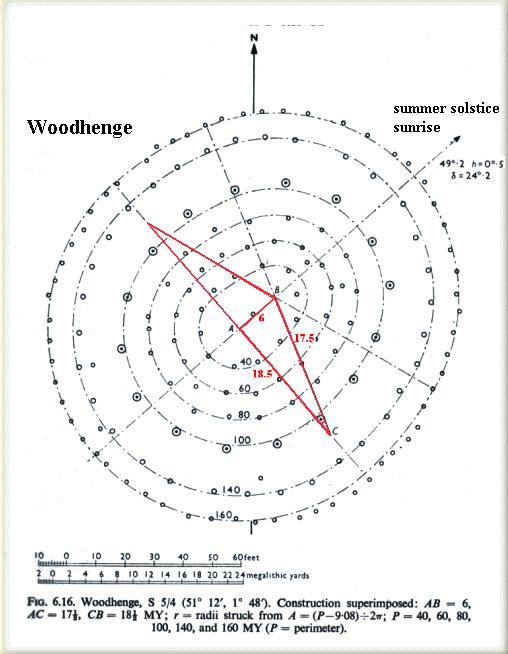 diameter of the Aubrey Circle we get 16,200 feet which is “the exact diameter of Plato’s Atlantis”.(bv) Now, a ten-minute search on the Internet reveals FIVE different figures for the diameter of the Circle, ranging from 271.6’ to 288’. Combining that with the uncertainty attached to the value of the unit of measurement employed by Plato, it is clear that any claim of a connection between the Aubrey Holes and Atlantis is at best feeble and at worst foolish.
Jürgen Spanuth suggested that the five trilithons “most probably represented five sets of twins.” [0015.85], an idea echoed later by Dieter Braasch(as). Spanuth was adamant that a commonly held view linking Stonehenge with Hyperborea was incorrect, as the Hyperboreans had come from Jutland.
Two Swedish researchers, Nils-Axel Mörner & Bob G. Lind, have proposed(bm) that the Ales Stones in Sweden were built with the same basic geometry and using the megalithic yard as a standard of measure as Stonehenge.
Harry Sivertsen has written a paper about the metrology of Stonehenge with the ingenious title of ‘The Metrology of Stonehenge’. In it, he pulls together data from Egypt, Mesopotamia, India, Welsh churches and, of course, Stonehenge(cm).
The late Philip Coppens echoed(b) the views of a fellow Belgian, Marcel Mestdagh, that there might be a connection between monuments within the Stonehenge Heritage Site and Atlantis, namely Woodhenge, which is comprised of posts arranged in six concentric circles. The suggestion is that this arrangement is in some manner a reflection of the concentric features in Atlantis described by Plato. I can only consider this to be highly speculative, somewhat akin to the suggestion(c) that Stonehenge I was an earthquake predictor.
In March 2015, the UK’s MailOnline published an article(ch) concerning some sites with unexplained concentric circles in China’s Gobi Desert. The article notes some superficial similarities with Stonehenge. Paolo Marini [0713] also claimed that the concentric circles of Atlantis are reflected in the layout of Stonehenge! In 2011, Shoji Yoshinori suggested that Stonehenge was a 1/24thscale model of Atlantis(cg). He includes a fascinating image in the pdf.
For those interested, a recently reconstructed German counterpart of Woodhenge has the original dated to 2300 BC(aq). A Portuguese ‘woodhenge’ was reported in 2020(bk), which is thought to be the work of the Bell Beaker people (3500 – 2000 BC).
However, in the meantime, we will have to be content with a recent book by Professor Mike Parker-Pearson, Stonehenge: Exploring the Greatest Stone Age Mystery [839], which includes all the discoveries revealed by the recent ten years of investigation.
A 2014 offering from Professor David P. Gregg, The Stonehenge Codes [977], throws further light on the mathematics used for the building and development of Stonehenge over a 1500-year period was consistently the same polygon geometry. Gregg has also identified an earlier Babylonian influence. His book has considerable numerical content that many will find heavy going. Some of the text of the book is available online(j). The July 2014 edition of the BBC Focus magazine offers evidence that the history of the Stonehenge location can be traced to nearer the end of the Ice Age.
It has been generally accepted for many years that the bluestones (spotted dolerites) at Stonehenge had been brought from the Preseli Mountains of Wales. Now (Nov.2013) evidence has been presented that identifies the precise outcrop, Carn Goedog, as their source(h).
However, in November 2015, a report threw doubt on the existence of a Neolithic quarry in the Preseli Hills(ag). Confusingly, the following month it was reported(ah) that studies carried out in Wales suggested that the stones had been erected there first before their transportation to Wiltshire. In May 2016, the controversial matter of the method of transportation from Wales was claimed to have been resolved when it was demonstrated by students from University College London, supervised by Parker-Pearson that the bluestones could have been mounted on a sycamore sleigh and dragged along timbers requiring far less effort than was previously expected.(ao) Parker-Pearson believes that originally the stones had been part of a Welsh tomb that was dismantled and brought to Wiltshire as the successors migrated westward(ap). There is now a search underway to locate the site of the original monument in Wales.
In 2004, Jennifer Viegas from Discovery News (June 14) suggested that Stonehenge had been built by Welshmen based on remains found in builders’ graves found close to Stonehenge(bx).
A further twist to the Welsh connection was proposed in a 2021 paper(bs), again in Antiquity, when a team of archaeologists proposed that the Stonehenge bluestones may have been taken from one or more pre-existing stone circles. One candidate is to be found at the remains of the dismantled Waun Mawn circle in the Preseli Hills(be). A few years ago Robin Heath published Proto Stonehenge in Wales [1853] which expanded on this Welsh connection.
“A century has passed since British geologist Herbert Henry Thomas published his seminal 1923 study on Stonehenge, in which he traced the origin of the “bluestones” that make up the monument’s inner circle to the Preseli Hills in western Wales. Among these bluestones — so called because they acquire a bluish tinge when wet or freshly broken and to distinguish them from the “sarsen” stones that make up the outer circle — Thomas included a 16-foot-long (4.9 meters) flat-lying, gray-green slab of stone known as the Altar Stone.
It now appears that Thomas’ assessment was flawed, Richard Bevins and his colleagues have found in a new study, published in the October (2023) issue of the Journal of Archaeological Science: Reports. While Thomas “quite rightly” pinpointed the source of some stones to outcrops in western Wales, the Altar Stone likely came from a completely different location, possibly an unknown quarry in northern Britain, Bevins said.”(cv)
Parker-Pearson published a paper in the February 2019 edition of Antiquity in which he reports on his research at the Welsh site, where he found some of the tools used to extract the pillars and determined the method of transportation(bc).
The transportation question received new attention with a study that suggested that “to move these stones such long distances, the builders likely manoeuvred them onto timber sledges and rolled these over logs,” using pig fat as a lubricant to minimise the friction between the sledge and the logs. It is suggested that ceramic vessels, with high concentrations of pig fat, found on-site at Durrington Walls, may have been used to collect fat from the carcasses as they were roasted on a spit, which was then stored as lard or tallow! (bf) My question is, how many pigs are needed to grease a path for a stone from Wales to Stonehenge?
Further investigation has produced the claim by Paul Devereux that the rock there was chosen because of its acoustic qualities(I), raising the possibility that Stonehenge was the site of the first ‘rock’ concert. A more wide-ranging essay on the subject of archaeoacoustics is available online(ak). Robert Hensey notes [1766.40] that acoustic experiments have been carried out inside Newgrange and Cairns I & L at Loughcrew, while in the Orkneys, Aaron Watson and David Keating have investigated sound effects at two passage tombs.
According to Trevor Cox, professor of acoustic engineering at England’s Salford University, the Neolithic temple (of Stonehenge) had unique properties capable of significantly altering and amplifying speech and musical sounds(cf). His theories were also explored in a June 2023 article on the BBC website(cp).
After centuries of being described as one of the wonders of the megalithic world, the construction skills of Stonehenge’s builders have been harshly criticised by Professor Ronald Hutton of Bristol University, who went as far as to describe them as ‘cowboy builders’(n).
In 2012, Gordon Freeman, a Canadian scientist, published Hidden Stonehenge [891] in which he offers an extensive study of a Native American “medicine wheel” in Alberta and compares its astronomical alignments with those of Stonehenge, revealing ‘incredible’ similarities(bu). His book highlights the use of sophisticated astronomical knowledge at both locations, in the very distant past, suggesting cultural links millennia before Columbus!
Although full scientific investigation has yet to be carried out, a circle of standing stones submerged off the shore in Lake Michigan, initial reports are intriguing(cx). However, until properly studied, wild speculation has offered some outlandish theories regarding the date, builders and purpose of these stones.
A somewhat cruder but equally effective winter solstice alignment was recently identified in the Chilean Andes(aw).
A site in Australia discovered in the first half of the last century by Frederic Slater (President of the Australian Archaeological Society) and dubbed ‘Australia’s Stonehenge’ was bulldozed in 1940 on the orders of the Australian Government! The location, obviously, never as impressive as its namesake on Salisbury Plain, has been again identified and using drawings made over seventy years ago, has enabled a computer-generated image of the site to be made(t). A father and son team, Steven & Evan Strong, have recently relocated to the damaged site(af).
In the Strait of Sicily, a ‘Stonehenge’ has been identified on the small island of Lampedusa, by Diego Ratti and described on a generously illustrated website(e). However, the application of the term to almost any megalithic monument, particularly by the media, has debased its value.
In May 2013, Melville Nicholls published a Kindle ebook, Children of the Sea God, in which he argues strongly for a Stonehenge built by Atlanteans, better known as the Bell Beaker People!
Robert John Langdon has now proposed(g) that Stonehenge was constructed by megalith builders, around 8500 BC, who had migrated from Doggerland/Atlantis as it became submerged and that the Altar Stone at Stonehenge points to Doggerland! Langdon is highly critical of the generally accepted interpretation of various features found at Stonehenge, listing 13 items that he claims “don’t make sense”(bp).
John Chaple has drawn attention to a letter from Quintus to his brother Marcus Tullius Cicero regarding the construction of Stonehenge, possibly based on information received from Druids! “The temples of the Britons are raised and constructed in a circular form, with obelisks of stone, over which are imposts, all of huge dimensions untouched by the chisel; a peace offering to Geranius, or Apollo, the sun. The huge stones of which they are composed, lay scattered by the hand of nature on the plain: these, with myriads of labourers, the high priest caused to be rolled up on the inclined planes of solid earth, which had been formed by the excavation of trenches, until they had attained a height equal to their own altitude; these pits being dug, they were launched from the terrace and sunk so as to stand perpendicular, at due and equal distances in the circle, and over these were placed others horizontally. After having completed one circle, they formed another that is concentric at some distance, and towards the extremity of the area of the inner circle, they placed a huge stone for the purpose of religious rites. When the sun enters into Cancer, [mid summer] is the greatest festival of the god; and on all high mountains and eminences of the country, they light fires at the approach of that day, and make their wives, their children, and their cattle, to pass through the fire, or to present themselves before the fire in honour of the deity. Deep and profound is the silence of the multitude during this ceremony, the appearance of the sun above the horizon, when, with loud and continued exclamations, and songs of joy, they hail the utmost of that luminary, as the supreme triumph of the symbol of the god of their adoration.”(cw)
Shoji Yoshinori has suggested that Stonehenge was intended as a model of Atlantis(k), as had also the late Philip Coppens(b).
It is quite obvious that more convincing evidence is required if any claim of a Stonehenge/Atlantis connection is to gain greater traction. In 2018, David L. Hildebrandt published Atlantis – The Awakening [1602], in which he endeavoured to do just that with a mass of material that he claims supports the idea of Atlantis in Britain and Stonehenge as the remnants of the Temple of Poseidon. He suggests that the five trilithons represent the five sets of male twins, an idea voiced by Jürgen Spanuth and more recently by Dieter Braasch. Even earlier, George H. Cooper proposed Stonehenge as the Pillars of Herakles. I am not convinced by the spirited defence of his hypothesis, as I consider his date too early and the location too far from Athens or Egypt to consider them to be within ‘easy striking distance’ for the purpose of invasion.
Jürgen Spanuth claimed that “Among the racecourses of the Bronze Age still in existence today must be counted the stone circle of Stonehenge which must have been erected by men of the Atlantean culture many centuries before the Atlantis report was written. The racecourse at Stonehenge, in its original, immense dimensions, cannot be an imitation of a Greek stadium.” [017.126]
As recently as the summer of 2014 evidence was accidentally discovered(o) that suggested that the Stonehenge megalithic stones form a complete circle. Commenting on the discovery Susan Greaney from English Heritage said, “A lot of people assume we’ve excavated the entire site and everything we’re ever going to know about the monument is known, but actually there’s quite a lot we still don’t know and there’s quite a lot that can be discovered just through non-excavation methods.” An extensive digital mapping project carried out at Stonehenge by researchers from the University of Birmingham and the Ludwig Boltzmann Institute of Vienna has revealed, “that the area around Stonehenge is teeming with previously unseen archaeology and that the application of new technology can transform how archaeologists and the wider public understand one of the best-studied landscapes on Earth.”(p)
December 2014 saw an encampment site just 1.5 miles from Stonehenge have its date confirmed at around 4000 BC(s).
Marden Henge, situated between Stonehenge and Avebury, is reckoned to be ten times bigger than Stonehenge and has now (2015) seen the start of a three-year, £1,00,000, dig by 80 archaeologists hoping to unlock its secrets(a). Dr Jim Leary, a leading archaeologist working at the site, is convinced that Marden may turn out to be more significant than Stonehenge(w).
Earlier in 2015 Tim Daw, a steward at the Stonehenge site, claimed that he had discovered a previously unknown alignment, involving a line of stones at 80 degrees to the axis of the monument. His theory is that the tallest stone at Stonehenge points towards the midsummer sunset and has been observed to be correct(v).
Some years ago, a University of Manchester team led by Professor Julian Thomas explained that “The Stonehenge Cursus is a 100-metre wide mile-long area which runs about 500 metres north of Stonehenge“, which we have now “dated at about 3,500 years BC – 500 years older than the circle itself.”(ca)
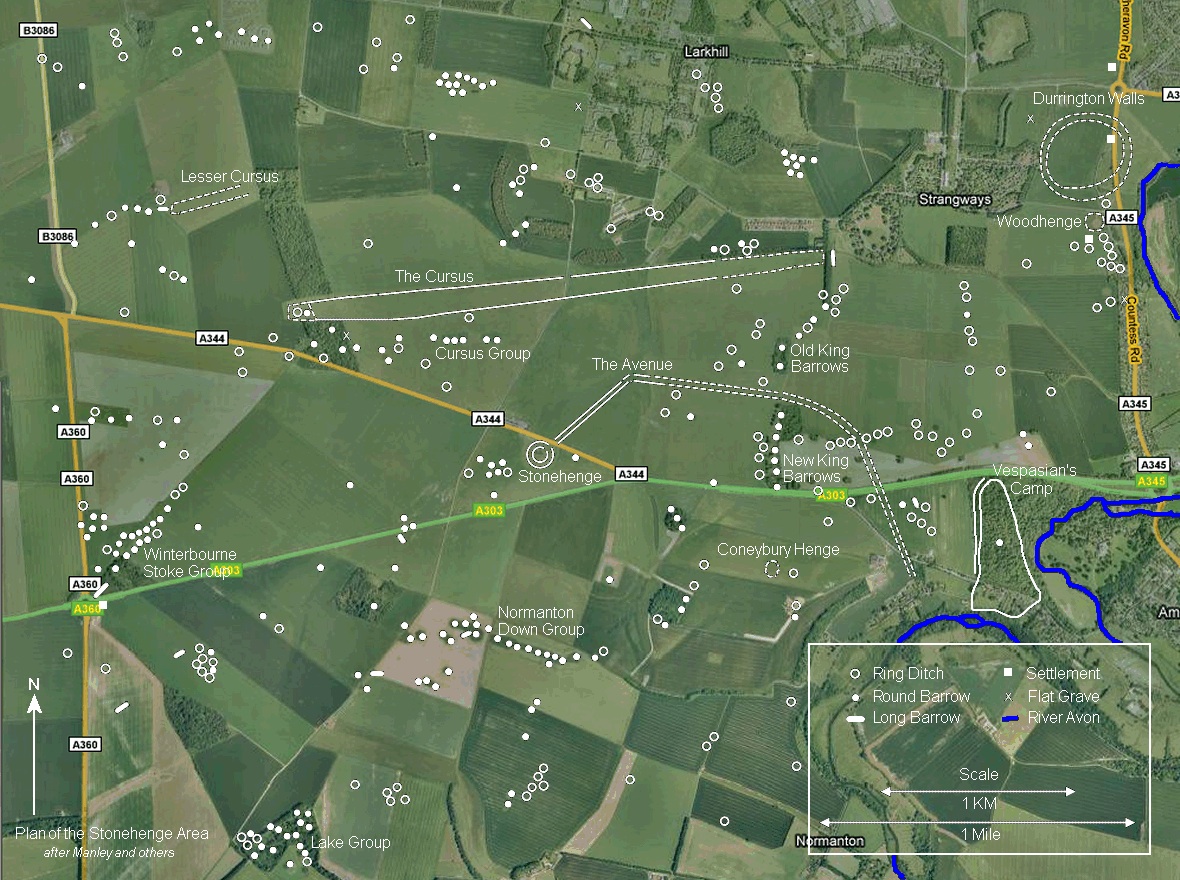
The archaeological importance of Stonehenge was boosted further in September 2015 with the announcement that a line of nearly 100 buried stones had been discovered just a mile away, beside the Durrington Walls ‘superhenge’(y). There are images available, including a short video clip relating to this new discovery(z). Subsequent excavations revealed no stones, but 90 holes that had held wooden posts.(bn)
In June 2020, the significance of Durrington was greatly enhanced by the revelation that adjacent to the ‘Walls’ is a series of shafts five metres deep and ten metres in diameter. The shafts are arranged in a circle having a diameter of 1.2 miles. The site is 1.9 miles northeast of Stonehenge(bj). Further comment was published in November 2021(cd).
In November 2015, the New York Times published an updated overview(ae) of the various excavations that have taken place in the vicinity of Stonehenge.
Sarah Ewbank has now offered us a fascinating new theory regarding the original purpose and plan of Stonehenge. In a fully illustrated website(al) she reveals that the structure was conceived as “a ‘Cathedral-like’ building with a massive oak-framed roof, and a huge hall at its centre.”
Further discoveries are listed on the Heritage England website(ab). What is not listed there is the information that Stonehenge was constructed by giants on the instruction of the Devil! This b.s. titbit was imparted to us in April 2016 by Dr Dennis Lindsay on the TV show of disgraced US evangelist Jim Bakker(am). Another blog from Jason Colavito exposed further Stonehenge nonsense, this time from New Zealander Ted Harper, who has recently claimed that the Wiltshire monument, together with the Great Pyramid, both warn of a meteor strike in 2020!
Theories relating to Stonehenge and Atlantis seem to proliferate at comparable rates. In a new book, The Memory Code [1258], by Lynne Kelly, she proposes that the Wiltshire monument is a giant mnemonic(ar) and that other megalithic sites also were.
July 2017, saw a BBC review of the recent acceptance of Stonehenge as just a part of a huge complex of monuments, with a hint of more to come(at).
In June 2019, Dr Christophe Snoeck, a Belgian archaeological scientist, offered evidence for the origins of some of the cremated human remains discovered at Stonehenge. “During his doctoral research, he developed a method to extract information about the geographical origin of cremated individuals.“ This method, he says, “was applied to 25 cremated individuals from Stonehenge and our results show that 40% (10 out of 25 analysed individuals) did not live near Stonehenge in the last decade or so prior to their deaths but came from further away. Some might actually have originated from west Wales, where the bluestones came from, some 250 km away,” he adds. “This shows the importance of the site in the British landscape during the Neolithic period”.(bd) Italian scientists have also been working on new ways of gleaning information from cremated remains(be).
In 2020, it was announced that acoustic engineers from the University of Salford had demonstrated that Stonehenge had acoustic qualities that allowed “any sounds produced inside the temple would have been much less audible to anybody outside the circle, despite the monument almost certainly not having a roof.
The findings, therefore, suggest that any sounds generated by activities carried out inside the circle were not intended to be shared with the wider community. This reinforces theories suggesting that the potential religious activities conducted inside Stonehenge were reserved for an elite of practitioners, rather than for a wider communal congregation.”(bl)
In May 1922, NG published its first photo of Stonehenge; now, a century later, it returned to this remarkable monument for its cover story in a 2022 edition(cj). It highlights how the use of new technologies has greatly enhanced our knowledge of the site and the people who built it. Jim Leary, a lecturer in field archaeology at the University of York, admits that “a lot of the things we were taught as undergraduates in the 1990s we know now simply aren’t true.” This beautifully illustrated article is a useful update on developments at this huge UNESCO World Heritage Site.
In the February 2023 edition of the Antiquity journal, it published a paper by Giulio Magli and Juan Antonio Belmonte that effectively debunked many of the various theories relating to Stonehenge put forward over the past seventy years. “All in all, the alleged “Neolithic” solar-precise Stonehenge calendar is shown to be a purely modern construct whose archaeoastronomical and calendrical bases are flawed.”(cn)
“English Heritage announces today [15/4/2024] a ground-breaking project to explore the connection between Stonehenge and the Moon during the ‘major lunar standstill’ which occurs this year, and into next.
Along with experts from Oxford, Leicester and Bournemouth Universities and the Royal Astronomical Society, the charity will embark on a series of investigations to research the alignment of the ancient stones with the moonrise and moonset during this almost once-in-a-generation period.
During a major lunar standstill, the northernmost and southernmost positions of the Moon are at their furthest apart along the horizon, and it is believed that these distinct lunar movements may have been observed during the early phase of Stonehenge, potentially influencing the later monument’s design and purpose. With a major lunar standstill occurring only every 18.6 years, Professor Clive Ruggles of University of Leicester, Dr Fabio Silva of Bournemouth University and Dr Amanda Chadburn of Bournemouth University and the University of Oxford have seized the rare chance to research the phenomena.”(cz)
[1613]+ Available online: https://archive.org/details/stonehengedecode00gera/mode/2up
[1696]+ https://archive.org/details/b30448554/page/n8/mode/2up
(a) Daily Express, Fri. June 19, 2015
(b) http://web.archive.org/web/20200215123200/https://atlantipedia.ie/samples/archive-2140/
(c) https://lunaticoutpost.com/showthread.php?tid=11497
(d) https://www.sciencedaily.com/releases/2010/11/101130010931.htm
(e) http://web.archive.org/web/20220722074021/https://atlantipedia.ie/samples/archive-2211/ (text only)
(f) (BBC July 15, 2013) https://www.bbc.co.uk/news/uk-scotland-north-east-orkney-shetland-23286928
(h) (BBC Nov.19, 2013) https://www.bbc.co.uk/news/uk-wales-25004282
(j) https://old.world-mysteries.com/gw_DavidGregg.htm
(k) https://www.pipi.jp/~exa/kodai/kaimei/stonehenge_is_small_atrantis_eng.pdf
(m) BBC Focus Magazine, July 2014, p.51
(n) https://www.dailymail.co.uk/sciencetech/article-2671664/Stonehenge-built-cowboys-lasted-well.html
(p) https://lbi-archpro.org/cs/stonehenge/
(q) https://www.ancient-origins.net/ancient-places-europe/solving-enigma-stonehenge-001616
(s) (BBC Dec.19, 2014) https://www.bbc.com/news/uk-england-wiltshire-30540914
(t) https://www.grahamhancock.com/forum/StrongSE2.php
(u) https://www.mondovista.com/stone.new.html
(v) (BBC June 21, 2015) https://www.bbc.com/news/uk-england-wiltshire-33205212
(x) http://web.archive.org/web/20170709152338/https://atlantipedia.ie/samples/archive-2657-n/
(z) https://www.lbiarchpro-imagery.at/stonehenge2015 (link broken) See (p)
(aa) (BBC Sept. 21, 2015) https://www.bbc.com/news/magazine-34282849
(ab) https://heritagecalling.com/2015/09/23/7-new-discoveries-about-stonehenge/
(ac) https://heritageaction.wordpress.com/2016/05/26/how-did-they-move-the-bluestones/
(ae) Stonehenge Begins to Yield Its Secrets – The New York Times (archive.org)
(ai) http://web.archive.org/web/20170709143258/https://atlantipedia.ie/samples/archive-2832/
(aj) https://www.walesonline.co.uk/news/wales-news/stonehenges-bluestones-were-moved-wales-10591475
(al) https://www.ancient-origins.net/ancient-places-europe/architect-presents-radical-new-theory-stonehenge-was-two-storey-wooden-020722 http://web.archive.org/web/20200215124035/http://sunhenge.uk/
(ar) https://www.thecourier.com.au/story/4104488/the-palace-of-memory/
(at) (BBC Feb.25, 2022) https://www.bbc.com/travel/story/20170713-why-stonehenge-was-built
(au) The images of Stonehenge they don’t want you to see – Ancient Code (archive.org)
(av) https://www.livescience.com/62619-did-glaciers-carry-stonehenge-bluestones.html
(ax) https://www.atlasobscura.com/articles/victorian-stonehenge-picnic-photos
(ay) Stonehenge by os012 – Issuu (archive.org)
(az) https://www.rte.ie/news/leinster/2018/0711/977969-newgrange/
(ba) https://web.archive.org/web/20190601213915/https://www.ancient-wisdom.com/extremasonry.htm
(bb) https://en.wikipedia.org/wiki/Bronze_Horseman
(bc) https://www.livescience.com/64801-stonehenge-temporary-monument.html
(be) https://www.latimes.com/science/new-way-to-decode-burned-bones-story.html
(bf) https://www.sciencemag.org/news/2019/07/ancient-people-may-have-used-pig-fat-build-stonehenge
(bg) https://www.ancient-origins.net/news-history-archaeology/lunar-calendar-0012340
(bh) Moving the stones of Stonehenge
(bi) https://www.bibliotecapleyades.net/arqueologia/esp_esferas_costarica05.htm
(bk) https://www.ancient-origins.net/news-history-archaeology/perdigoes-neolithic-woodhenge-0014084
(bn) ‘New Stonehenge’ was made of WOOD | Daily Mail Online
(bp) The Post Glacial Flooding Hypothesis: The Great Stonehenge Hoax (archive.org)
(bq) Stonehenge Astronomically Considered Index (sacred-texts.com)
(bt) (BBC June 13, 2006) http://news.bbc.co.uk/2/hi/uk_news/wales/south_west/5072664.stm
(bu) Alberta sun temple has 5,000-year-old calendar
(bv) https://jjswn35.wordpress.com/article/atlantis-eden-how-to-find-2vfxjftuay98o-9/
(bw) Stonehenge – Voices from the Dawn
(bx) http://web.archive.org/web/20221001151751/https://atlantipedia.ie/samples/archive-6480/
(by) PREDICTING ECLIPSES WITH THE STONEHENGE (archive.org)
(bz) https://www.nature.com/articles/s41599-018-0210-9
(ca) https://www.sciencedaily.com/releases/2008/06/080610095001.htm
(cb) https://www.livescience.com/stonehenge-pillars-mesozoic.html
(cc) (BBC July 6, 2021) Stonehenge: Did ancient ‘machine’ move stones from Wales? – BBC News
(ce) https://www.sciencedaily.com/releases/2022/03/220301192407.htm
(cg) http://www.pipi.jp/~exa/kodai/kaimei/stonehenge_is_small_atrantis_eng.pdf
(ci) https://www.sacred-texts.com/neu/eng/sac/index.htm
(cj) National Geographic, August 2022
(ck) The Victorian Vicar Who Thought the Nephilim Built Stonehenge and the Pyramids – JASON COLAVITO
(cl) https://ui.adsabs.harvard.edu/abs/1999AAS…195.9201C/abstract
(cm) (99+) The Metrology of Stonehenge 2020 | Harry Sivertsen – Academia.edu
(cn) https://phys.org/news/2023-03-stonehenge-calendar-shown-modern.html
(co) Neolithic Stone Balls: The Northern Rosetta Stone? | Ancient Origins (ancient-origins.net)
(cp) (BBC June 2, 2023) What did Stonehenge sound like? – BBC Travel
(cq) https://www.academia.edu/64551399/Researching_Stonehenge_Theories_Past_and_Present
(cr) https://www.academia.edu/75967939/New_Theory_About_Stonehenge_Stonehenge_Royal_Palace_Author_Dimitar_Alekseev_Dimitrov (link broken)
(cs) https://www.britam.org/Proof/Attributes/roleDolmen.html
(cu) https://www.academia.edu/96803677/The_Stonehenge_Builders_came_from_Turkey_so_whats_new
(cw) How Stonehenge was Really Built (archive.org)
(cy) (PDF) What in the World is Stonehenge? | Austin A Mardon – Academia.edu (archive.org)
(cz) Moon may have influenced Stonehenge builders says English Heritage | News | University of Leicester (see near end of page)
(da) e5604c_e9edea4f2c6f4777ae3928593180a77a.pdf (third-millennium.co.uk)
(db) Irish Conquests in Wales (libraryireland.com)
(dc) (BBC July 9, 2024) https://www.bbc.com/future/article/20240709-if-a-victorian-historian-had-his-way-thered-be-a-giant-time-capsule-under-stonehenge
(dd) Stonehenge Was Built By Satan’s Giants, Creationist Claims | HuffPost Weird News
(de) (BBC July 24, 2023) https://www.bbc.com/news/articles/cx2g25j71pxo