Latest News
Joining The Dots
I have now published my new book, Joining The Dots, which offers a fresh look at the Atlantis mystery. I have addressed the critical questions of when, where and who, using Plato’s own words, tempered with some critical thinking and a modicum of common sense.Read More »
Tiwanaku (Tiahuanaco)
Tiwanaku (Tiahuanaco) is an ancient city whose remains are located over two miles above sea level near the southern end of Lake Titicaca on the Altiplano of Bolivia. It was first encountered by Spanish conquistadors in 1549. Tiwanaku has all the features of a harbour, which has led some to describe it as the seaport of nearby Puma Punku another remarkable ancient site(o).
 The ruins are scattered over a number of square miles through which the Guayqui-La Paz railway was constructed, which was responsible for the breaking up of many monuments to provide ballast. Before that, stone from the site was used in the construction of nearby homes and a church.
Belisario Díaz Romero believed that Tiwanaku had been built by a race of people he calls Homo atlanticus, who had come to America from Atlantis over a landbridge from the east, outlined in his 1906 book Tiahuanacu[1235]. Heather Pringle notes(t) that before Romero, “Francis de Castelnau (1810-1880), for example, proposed in the mid-19th century that Tiwanaku was the work of wandering Egyptian pharaohs, as opposed to the ‘imbecilic race that inhabits the country today’.”
The controversial Arthur Posnansky, who linked Tiahuanaco with Aztlan, the mythical “white” island homeland of the Aztecs investigated them in the early 20th century. The similarity of Aztlan with the name of Plato’s city has excited some straw-clutching Atlantis seekers into claiming a definite connection between the two.
Posnansky also noted that the expected alignments of structures at Tiwanaku were offset by an amount that suggested their construction at a time when they would have been correctly aligned to the cardinal points. He, after many years of study, was convinced that Tiahuanaco was the oldest civilisation on Earth [516] dating it to around 15,000 BC, which he later reduced to 10,000 BC.
In the 1920s, Edmund Kiss studied the ruins of Tiwanaku and concluded that it had been constructed by Nordic refugees from Atlantis which had been destroyed by a falling moon! His ideas were enthusiastically received back in Nazi Germany. A further expedition was planned but never materialised because of the start of World War II.(u)
Dr Graham Holton, an Australian commentator has written about the pseudo-science practised in the early 20th century at Tiwanaku by the likes of Posnansky and Kiss and endorsed by Hörbiger and Hans Bellamy(al)(am).
Although, as you can see below, Posnansky’s work and particularly his dating of Tiwanaku has been rejected by many, he still has supporters. In Graham Hancock‘s 1995 book Fingerprints of the Gods [275], he supported Posnansky’s date, referring to his work throughout the book. Ian Alex Blease, a devout sceptic took issue with this endorsement (aa). For my part, I note that Hancock was happy to support Posnansky in ‘Fingerprints’, but in America Before [1680], despite its title, he gives Posnansky’s date no mention, perhaps because it clashed with his new date for the destruction of his ‘Lost Civilisation’!
Hancock has been highly critical of Carbon-14 as a dating method, particularly for megalithic sites and specifically Tiwanaku. The late Garrett Fagan took issue with Hancock regarding the dating of Tiwanaku in a 2000 post on Hancock’s site(ar). Hancock responded with a challenge to Fagan that led to a further article from him(aq). The temperature rose with a further article from Hancock(as).
Charles Orser Jnr. debunked Posnansky’s dating in a 2001 article(k) as did Paul Heinrich(n).
Marin, Minella & Schievenin [972.97] “Between 1927 and 1930 several scientists, including Hans Ludendorf, at the time director of the Astronomical Observatory of Potsdam; astronomer Arnold Kohlshutter, University of Bonn; Dr Rolf Muller, University of Potsdam and Dr Friedrich Becker, Specula Vatican, meticulously checked the archaeological-astronomical research of Posnansky for accuracy. After three years of work these scientists corroborated his thesis.”
Before retirement, R. Cedric Leonard supported Posnansky’s early date for Tiwanaku citing a number of atronomers who endorsed his chronology. “Between 1927 and 1930 Prof. Posnansky’s conclusions were studied intensively by a number of authorities. Dr. Hans Ludendorff (Director of the Astronomical Observatory of Potsdam), Friedrich Becker of the Specula Vaticana, Prof. Arnold Kohlschutter (astronomer at Bonn University), and Rolf Müller (astronomer of the Institute of Astrophysics at Potsdam) verified the accuracy of Posnansky’s calculations and vouched for the reliability of his conclusions.
The conventional practice of dating Tiahuanacu as beginning c. 200 A.D. and collapsing c. 1000 A.D. started with Wendell Bennett’s excavations, which turned up numerous examples of pottery, small statues and other artifacts. Since it is common for later arrivals to be awed by massive ruins (sometimes attributing their origin to supernatural beings, thus replicating the “sacred” images on their own pottery and textiles), I think it is a mistake to fuse the two cultures into one, implying that the later arrivals were the same people who built the original ruins. I believe Bennett and his successors are all guilty of such an error.” (ap)
R. Cedric Leonard believed that Posnansky’s date addressed all of the mysteries associated with the site and “Thus I think it likely that Tiahuanaco was built at sea level c.15,000 B.C. as an Atlantean port.”(z)
The American archaeologist, Neil Steede, while reviewing Posnansky’s date, thought that a date of 7000-5000 BC was more appropriate(aj).
At the other end of the spectrum, Emmet Sweeney, an ardent chronology revisionist claimed that “most probably, Tiahuanaco was built around the same time as pharaoh Djoser’s Step Pyramid at Sakkara in Egypt. It can thus claim to be among the oldest of human monuments [700.208].” Tiwanaku is conventionally dated between 200 BC and 100 AD, while the Step Pyramid is thought to have been constructed around 2650 BC.
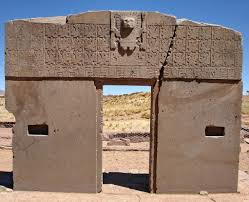
Some researchers, including Jim Allen, have studied Tiwanaku’s remarkable Gate of the Sun and identified the figures carved on it as a sophisticated calendar(v).
A paper from Marco Antonio Cabero regarding the ‘Gate’ throws a modicum of doubt on its possible use as a calendar. Instead, he focused on the other side of the monument where he claims there is evidence that the ancient people of Tiwanaku knew the ‘golden number’, phi.
“The composition of the front face of the Gate of the Sun in Tiwanaku presents, anthropometric, and bilateral symmetry. On the back side, there are also harmonic proportions but with less significance. These proportions were not found before because the study of the content of its engraving frieze was believed to be a calendar, an idea that has been so widely extended, that any other interpretations were ignored (however, the presence of these proportions does not exclude the possible existence of some type of calendar). The Gate of the Sun may not be part of a temple, but its content could also be considered as the expression of a monument in itself; a work that testifies to the importance of knowledge, art, and science “(ac).
Ashley Cowie has recently proposed that Tiwanaku was located on an ancient Prime Meridian(w).
Also eye-catching is the claim(l) by Roger Elefant that later construction at Tiwanaku was carried out by the Vikings!
However, a more recent, but catastrophic, explanation is offered by Stephen Smith(d) on the Thunderbolts.info website. Perhaps Smith’s ideas might be combined with the studies of George Dodwell to produce a more comprehensive hypothesis. Posnansky’s date is greatly at variance with conventional dating that puts the flourishing of Tiwanaku from 1200 BC until 1200 AD. The latter part of that period roughly coincides with the existence of the Wari Empire, a possible rival of Tiwanaku(e).
In 2013, Jason Yaeger and Alexei Vranich published a detailed study of the chronological development of Tiwanaku and Puma Punku. This is now available on the Academia.edu website(ao). Anyone seeking support for ancient astronauts, giants or Atlantis will be greatly disappointed. The authors confirmed a starting date for monumental construction at the site of no earlier than 200 BC, which continued intermittently until the arrival of the Spanish invaders. Their report is the result of the ‘hard slog’ required by real archaeology.
Several claims attempting to link Tiahuanaco with Atlantis have been made, with one anonymous blog(y) insisting that it was the capital of Atlantis. James Bailey was an early advocate [149] of a Peruvian Atlantis with its capital at Tiwanaku or Chan Chan, which was probably the largest pre-Colombian city in South America.
The claim of a direct connection between Tiahuanaco and Atlantis is hard to accept on a number of grounds; for example, the idea of an army travelling from the west coast of South America to attack Greece in the east of the Mediterranean is not tenable. That there was an advanced culture in the Andes is undeniable but to link it to Plato’s story is stretching credibility to extremes. Lake Titicaca and Tiahuanaco have plenty of mysteries still to be explained. In 1980 the Bolivian scholar, Hugo Boero Rojo, aided by one of the local natives, Elias Mamani, located underwater ruins off the coast of Puerta Acosta[576]. His discoveries included megalithic temples, flights of stairs and stone roads.
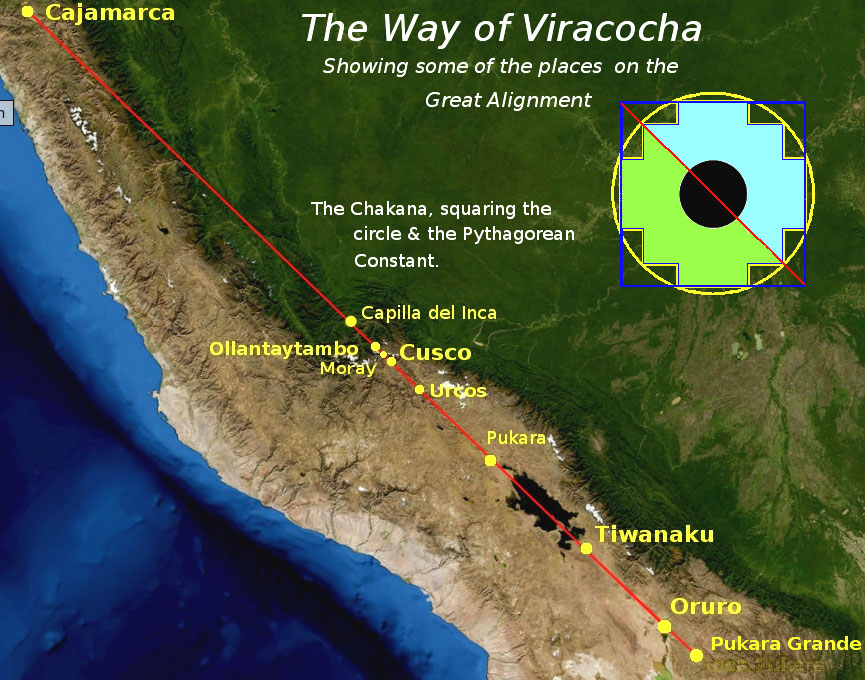 More recently, Dave Truman has written about an alignment known as ‘The Way of Viracocha’ that runs from Cajamarca in the north, through Cuzco and Tiwanaku and finishing at Pukara Grande(p), oriented exactly 45° west of true north. Truman has built on the work of Maria Sholten d’Ebneth (1926-2007), who wrote of the La Ruta de Wiracocha[1236] in the 1970s(q). Others have expanded on her work, but usually in Spanish. Truman has speculated on whether “Viracocha, the great teacher and restorer of civilisation in the Andes, in some way embodied the scientific knowledge of a sophisticated, but long-forgotten high culture?”Truman also discusses the ‘chakana’ or Andean stepped cross (see left) and its possible meaning.
It was reported in October 2013(g) (that a team of Belgian and Bolivian archaeologists had found an assortment of ceramics, gems and gold objects at an apparent ceremonial site beneath the waters of Lake Titicaca, which was sacred to the Incas and Tiwanakus. It was not until 2019 that images of some of the artefacts recovered from the lake were widely published(x).
We cannot leave the matter of mysterious Tiahuanaco without referring to the fact that some miles further south is Lake Poopó beside which Jim Allen is convinced that the city of Atlantis was located. Allen claims that the large plain to the west of the lake is the plain mentioned by Plato as being adjacent to the city of Atlantis. In a recent documentary “Atlantis in the Andes” broadcast by ‘Discovery Civilization’, Allen identified Tiahuanaco as one of the ten kingdoms of Atlantis. However, I cannot help noticing that while Tiwanaku, claimed to be 17,000 years old, provides us with an astonishing wealth of structures and finely dressed stone, Allen’s chosen Atlantis site, Pampa Aullagas, offers little more than rubble!
Another supporter of an Andean Atlantis is Sean Bambrough, who has been developing a theory since 1999 that identifies Tiwanaku as the city of Atlantis(h). He has now published his magnum opus on the academia.edu website(ae).
In February 2015, Marcelo Ozorio also suggested a link with Plato’s Atlantis and most interesting is the huge number of images included on his site(i). There is also a large collection of related images on a YouTube clip(m).
In 2022, Marco Vigato‘s book, Empires of Atlantis [1830] was published, which included Tiwanaku as part of the evidence for his hyperdiffusionist Atlantis(ab).
In 2008, David E. Flynn brought to public attention an astonishing series of satellite photos(a) that show a vast network of the remains apparently of man-made structures that extend for many miles around Lake Titicaca. These ‘geoglyphs’ encompass Tiahuanaco.
The most remarkable collection of early photos of the Tiwanaku site can be found on the Above Top Secret website(b). The accompanying text makes a strong case for treating the location as archaeologically contaminated and as a consequence that many of the dates proposed for the site should be considered suspect. Other mysteries are the fact that saltwater Lake Titicaca contains known sea life and that old waterlines are slanted(c).
In late March 2015, the Bolivian government announced(j) that ground-penetrating radar had identified what appeared to be a buried pyramid in the Tiwanaku complex as well as other ‘anomalies’ and that excavations may start in May or June.
A mixed Spanish and English website(f) offers a number of interesting papers including a chapter from Posnansky’s book Tiahuanaco: The Cradle of American Man.
Archaeology magazine has an interesting Q & A paper relating to the history and current state of preservation at the Tiwanaku site(s).
A May 2017 report(r) confirmed that the entire Tiwanaku complex is much more extensive than previously thought, covering an area of at least 650 hectares (1,675 acres).
Joseph Davidovits who controversially proposed that Giza’s Great Pyramid stones had been cast rather than carved has also claimed that other well-known structures had been created in a similar manner, such as at Tiwanaku and Puma Punku in Bolivia(ah) and Easter Island(ai). He offers scientific evidence to support this claim in a very interesting video(ak). My objection to his ‘cast rather than carved’ hypothesis, particularly in relation to Easter Island, is that partially finished statues are visible today in a quarry still attached at the back to the rock from which they were carved as well as some of the tools used for the job. Images of these can be seen in Thor Heyerdahl’s Aku-Aku [1938].
Brien Foerster is an American writer who now lives in Cuzco, the former Inca capital in Peru. He has studied the ancient cultures of the Andes and believes that many predated the Incas and had advanced technologies that permitted the precise drilling of stone(af), the quality of which he has compared with examples found in Egypt and like Chris Dunn concluded that their level of accuracy could not have been achieved without possession of a high technology, now lost(ag). He has expanded on this in his 2014 book, Lost Ancient Technology of Egypt [1487].
A fully illustrated guide to the intriguing monuments of Tiwanaku/Puma Punku is now available which is an excellent introduction to the site including a map by Javier Escalante Moscoso(an).
(a) https://www.freerepublic.com/focus/f-chat/1977971/posts
(b) Tiahuanaco, Puma Punku the real mystery…, page 1 (archive.org) *
(c) https://www.thunderbolts.info/wp/2012/04/30/tiwanaku/
(d) https://www.thunderbolts.info/wp/2013/04/03/tiwanaku-3/
(e) http://www.sci-news.com/archaeology/science-wari-tiwanaku-rival-empire-01473.html
(f) https://www.bibliotecapleyades.net/arqueologia/esp_tiahuanaco5.htm
(h) https://2rbetterthan1.wordpress.com/atlantis-south-americatiahuanaco/
(i) Tiwanaku, pre-columbian archaeological and world heritage site at Bolivia (viagem.space)
(l) https://atlantide-mu.over-blog.com/2013/12/terre-creuse.html
(m) https://www.youtube.com/watch?v=PkuoXm9uafI (unavailable)
(n) The age of Tiwanaku (Tiahuanaco) Site, Bolivia (archive.org)
(o) See: https://web.archive.org/web/20170601230717/https://www.atlantisquest.com/prehistcity.html
(p) https://grahamhancock.com/trumand1/
(q) https://puri-aprendiendovida.blogspot.ie/2013/02/la-ruta-de-viracocha-camino-de.html
(s) https://interactive.archaeology.org/tiwanaku/qanda.html
(t) https://archive.archaeology.org/blog/the-fantasy-world-of-tiwanaku/
(u) https://theappendix.net/issues/2013/4/andean-atlantis-race-science-and-the-nazi-occult-in-bolivia
(v) https://blog.world-mysteries.com/science/the-gate-of-the-sun-calendar-from-ancient-tiwanacu/
(w) https://www.ancient-origins.net/events/unearthing-lost-meridian-tiwanaku-s-temple-builders-0010322 (link Broken)
(y) https://grahamhancock.com/phorum/read.php?1,1063585,1063585#msg-1063585
(z) https://web.archive.org/web/20161107001948/https://www.atlantisquest.com/prehistcity.html
(aa) https://www.oocities.org/debunkinglc/tiwanaku.html (link broken)
(ab) https://www.amazon.com/Empires-Atlantis-Civilizations-Traditions-throughout/dp/1591434335
(ad) (PDF) Mathematics in Tiwanaku-The gold number in the gate of the sun (researchgate.net)
(ae) https://www.academia.edu/61088843/Atlantis_Found_in_the_Andes_by_V_Sean_Bambrough
(af) https://www.youtube.com/watch?v=xR7of1Lkef0
(ag) https://ahotcupofjoe.net/
(ah) https://www.geopolymer.org/archaeology/tiahuanaco-monuments-tiwanaku-pumapunku-bolivia/
(ai) https://www.geopolymer.org/library/video/they-came-from-america-to-build-easter-island/
(aj) QC2K – Neil Steede (archive.org)
(ak) https://www.geopolymer.org/library/video/they-came-from-america-to-build-easter-island/
(am) (99+) 2007 Chapter 3 Tiwanaku.doc | Graham Holton – Academia.edu
(an) Tiwanaku, the mysterious pre-Inca capital – mapaymochila.es
(ap) Tiahuanacu, The Mysterious City (archive.org)
(aq) https://www.hallofmaat.com/methodological/an-answer-to-graham-hancock/