Latest News
Joining The Dots
I have now published my new book, Joining The Dots, which offers a fresh look at the Atlantis mystery. I have addressed the critical questions of when, where and who, using Plato’s own words, tempered with some critical thinking and a modicum of common sense.Read More »
José Pellicer
Doñana Marshes *
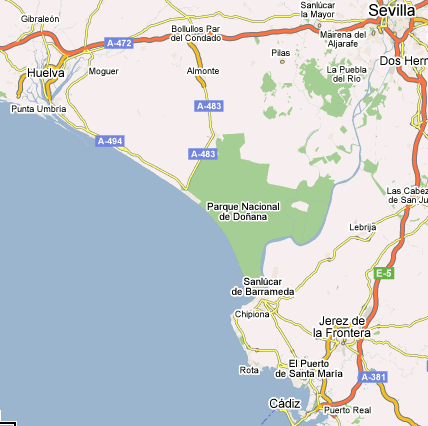 The Doñana Marshes, a National Park in the valley of the Andalusian Guadalquivir River was linked with Atlantis over 400 years ago by José Pellicer. During the 1920’s George Bonsor and Adolph Schulten searched the area for evidence of Tartessos. After that interest in the marshes waned until a few years ago when Werner Wickboldt identified circular and rectangular features in the Park from satellite images, which he claimed a possibly Atlantean.
Richard Freund, a professor from the University of Hartford, claims to have led a team to study the area and has had work included in a March 2011 National Geographic documentary, Finding Atlantis. However, Spanish anthropologist Juan Villarias-Robles who has worked on the site for some years has declared(a) that Freund did not lead the investigations on the site and in fact spent less than a week there. Wickboldt’s images turned out to be either smaller than expected or were from the Muslim period. Evidence for Tartessos or Atlantis has not been found.
(a) Muddying up Atlantis – Roger Catlin | TV Eye (archive.org) or see Archive 2122*
Atlantis in Andalusia
Atlantis in Andalusia: A Study of the Ancient Sun Kingdoms of Spain [053] by Mrs E.M. Whishaw is an account of her 25-year search for Tartessos, which she believed she had found under the city of modern Seville.
An association of Andalusia with Atlantis goes back more than 400 years, when José Pellicer linked Atlantis with the Doñana Marshes, an idea that received considerable attention in the 20th century, leading to extensive unsuccessful excavations in an area where satellite imagery suggested buried structures.
Despite of the original title of her book, her view was that Tartessos itself was not Atlantis but one of its colonies. The book describes in detail Mrs Whishaw’s excavations in the town of Niebla, where she lived and the evidence she found, which indicates an early culture that she claimed was Atlantean and which was brought from Libya following the drying of the Sahara around 10000 BC. She also investigated the pre-Roman mining that was carried out in the region and concluded that the copper extracted there was the ‘orichalcum’ of Plato’s narrative.
Mrs Whishaw established a museum in Niebla.
Whishaw’s book was reprinted as Atlantis in Spain (Adventures Unlimited Press, Illinois, 1994)
Pellicer de Ossau Salas y Tovar, José
José Pellicer de Ossau Salas y Tovar (1602-1679), a Spanish writer, was probably the  first in 1673[1315] to identify an Andalusian location for Atlantis, proposing that Tartessos was identical with Atlantis and that it was located on the Guadalquivir River in southern Spain near Seville. He specified the Doñana Marshes, where, coincidentally, Kühne and Wickboldt had identified ground features using satellite images, which they claimed corresponded with Plato’s description of Atlantis.
However, subsequent excavation there showed Wickboldt’s images to be smaller than expected or to be were from the Muslim period. Evidence for Tartessos or Atlantis has not been found.