Latest News
Joining The Dots
I have now published my new book, Joining The Dots, which offers a fresh look at the Atlantis mystery. I have addressed the critical questions of when, where and who, using Plato’s own words, tempered with some critical thinking and a modicum of common sense.Read More »
Thera
Thera is an ancient name for today’s Aegean archipelago of Santorini, which are the remains of a volcanic island.
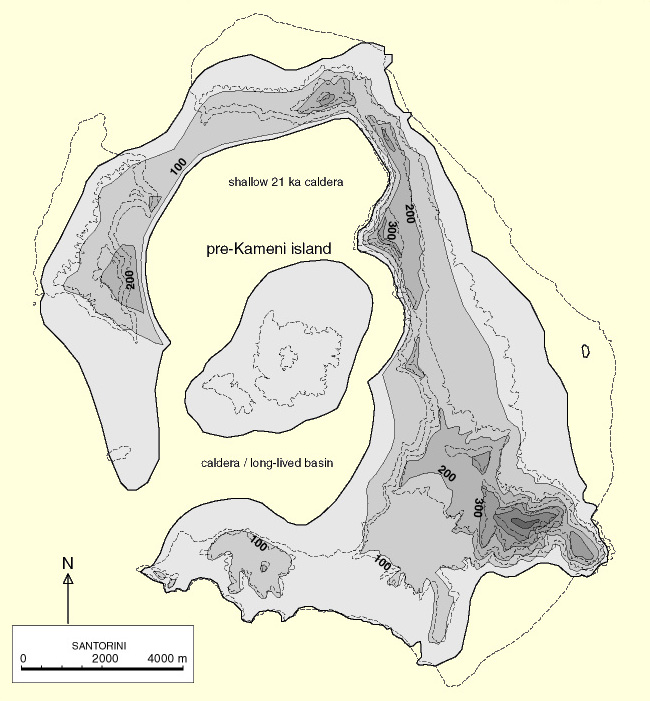
Only two of the islands are inhabited, the main island, Santorini and Therasia, which had been joined before the 16th century BC eruption. Recent excavations have revealed a pre-eruption settlement on Therasia(x).
Pre-eruption Thera
Although it exhibited low-level activity in 1939-41 and 1950-51, it was in 1926 when it last erupted violently, destroying many hundreds of buildings in less than a minute. Eruptions of similarity intensity occurred in 1650, 1707 and 1866. Although Thera is thought to have violently erupted around 54,000 & 18,500 BC, it was not until the middle of the sixteenth century BC that it provided what was probably the most powerful and destructive volcanic explosion in the Mediterranean during the Bronze Age. Although the exact date of this event is still the subject of some controversy, the most recent evidence(a) indicates a date around 1613 BC ±13years, while archaeologists are more supportive of a date circa 1500 BC.
Professor Floyd McCoy of the University of Hawaii has written and broadcast extensively on the matter of the Late Bronze Age eruption of Thera, including a paper delivered to the 2005 Atlantis Conference. In it, he noted that “New finds of tephra – ash and pumice – both on land and on the seafloor indicate a far larger eruption than previously assumed, suggesting a volume of at least 100 km3 of tephra (bulk volume) ejected, perhaps more. Such a volume ranks the eruption on the Volcanic Explosivity Index (VEI) at 7.0, equivalent or larger than the 1815 eruption of Tambora (‘the year without a summer’), ten times larger than the eruption of Krakatau in 1883, and approximately 100 times that of Mt. St. Helens in 1980.”[629.311]
The 1500 BC date was supported by David A. Warburton who edited the Acts of the Minoan Eruption Chronology Workshop in 2007(af). The workshop provided a good overview of the Theran eruption dating debates, Warburton’s comments are to be found in the Epilogue.
While the eruption of the 2nd millennium BC undoubtedly caused extensive damage and disruption in the Eastern Mediterranean, its effect may have been felt much further afield. “Some scientists correlate a volcanic winter from the Minoan eruption with Chinese records documenting the collapse of the Xia dynasty in China. According to the Bamboo Annals, the collapse of the dynasty and the rise of the Shang dynasty (independently approximated to 1618 BC) was accompanied by ‘yellow fog, a dim sun, then three suns, frost in July, famine, and the withering of all five cereals’.”(at)
There was a series of eruptions that ended with a final enormous explosion that has been linked to the ending of the Minoan civilisation on Crete, the Plagues of Egypt and agricultural failures throughout the Eastern Mediterranean. For a geologist’s view of the island’s dramatic history, Walter Friedrich’s book[428] is hard to beat. His book supports a 1640 BC date for the eruption although he has subsequently revised this to 1613 BC. Sturt W. Manning supported[957] a 1628 BC date and Mike Baillie offered dendrochronological evidence for the same eruption date at the 2011 Quantavolution conference in Athens(j). This converges with McCoy’s date above. However, the dating of the eruption continues to be controversial as this December 2012 link(i)demonstrates. At the heart of the problem is that acceptance of an early 17th century BC date for the event conflicts with established Egyptian chronology. While the exact year of the eruption continues to be debated, there is now scientific evidence that it occurred in early summer(s).
A 2014 paper published in Antiquity by Paolo Cherubini would appear to confirm the 16th century BC as the date of the catastrophic eruption ruling out an earlier date as untenable(o). In the same year, the University of Birmingham published a report(u) that supported the 1625 BC date. The earlier Antiquity paper prompted a response by a group, led by Sturt Manning later in 2014(y).
In August 2018, an interdisciplinary group led by dendrochronologist Charlotte L. Pearson published a paper(ab)(ad), which concluded that the eruption of Thera took place in the 16th century BC. This conclusion was the result of using a combination of ‘dendro’ along with high-resolution radiocarbon dating methods. In April 2020, a new report in the journal Proceedings of the National Academy of Sciences explained how a new study of “the wood of an ancient grove of juniper trees, which suggested that the volcano blew its top around the year 1560 B.C.”(ae)
October 2018 saw further evidence for an early 16th century BC date for the eruption emerge after the radiocarbon dating of some olive wood found on Therasia, one of the Santorini island groups (z). The same month saw the publication of a paper on the ResearchGate(aa) website dating the event to 1727-1600 BC!
Pearson published another paper in 2023(ar) in which she highlighted the difficulties attached to using dendrochronology and olive wood, with particular reference to the dating of the olive shrub found on Therasia. “However, this sample has proved highly controversial because olive trees do not necessarily produce annual growth rings in the way that pine or oak trees might. While some studies have shown that annual growth rings in olives are possible, others have shown that the nature of olive growth may mean that a stem or branch with bark may have actually ceased to accumulate growth bands several decades before the death of the tree.”
William Austin, an American researcher, offers, with great insistence, the precise date of 1612 BC for the eruption of Thera, in a lengthy 2016 paper (updated 2022) paper that begins with an open letter to Manfred Bietak and Sturt Manning. “The conclusion is that the radiocarbon date c.1613 BC was spot on. The Minoan eruption was in the spring of 1612 BC, via astronomy, via ice cores, via tree rings, via a stalagmite, via Babylonian chronology; all arrows point to the same exact year.” This is a carefully thought-out argument and useful addition to the literature on the subject(ap).
Nevertheless, in 2022, another report(aq) from Pearson, of the University of Arizona and her team claim that they have narrowed the eruption date to three possible dates – 1611 BC, 1562-1555 BC and 1538 BC!
After the eruption, we learn from Herodotus that Thera was resettled in the thirteenth century BC by the Phoenicians and around a century later by the Dorians(am).
The doctoral thesis of Dr David Sewell explores the cultural effects of the Theran eruption and can be read online(h).
Many centuries later the volcanic ash deposited by the Theran eruption was used in huge quantities to manufacture cement for the construction of the Suez Canal. It was during the mining of this material that workmen encountered large stone blocks under the layers of pumice, indicating buildings of great age.
Luana Monte has written a rather ‘forced’ argument in which she claims that Thera can be identified as biblical Tarshish(ac).
It is claimed by many that a garbled Egyptian description of this devastating event was the basis for the story of the destruction of Atlantis. Louis Figuier was the first, in 1872, to publicly link the demise of Atlantis with the explosion on Thera. Opponents of this theory counter it by pointing out that Plato describes the inundation of an island much larger than Santorini or Crete, located in the Atlantic following an earthquake, not a volcanic eruption many thousands of years earlier. Various attempts have been made to reconcile this Minoan Hypothesis and its obvious inconsistencies with Plato’s text. They are discussed separately under
It was announced at the end of February 2010 that the BBC was about to air a dramatisation of the Theran disaster as well as a documentary on the eruption and its influence on the development of Plato’s story of Atlantis. June 2010 saw the historian, Bettany Hughes, front a disappointing BBC Timewatch Special, which also promoted the idea of the eruption on Thera as the inspiration for Plato’s story of Atlantis. The material introduced as evidence was highly selective and, for me, unconvincing. A few parallels between Thera and Plato’s description were trotted out, while the more numerous differences were ignored!
Alain Moreau has written a highly critical review(v) of the idea that the island of Thera/Santorini had been home to Atlantis.
Dr Dora Constantinidis who studied under Prof. Christos Doumas delivered a lecture in Melbourne on May 29th 2014 with the inviting title of Unravelling the Atlantis Myth at Akrotiri. However, the primary purpose of the talk was not to advance our knowledge of Atlantis but to encourage the sale of Bronze Age-inspired merchandise(p). Nevertheless, in late 2020, one commentator did speculate that Akrotiri may originally have been Atlantis!(aj)
It is noteworthy that “Unlike Pompeii, no human remains have been found at Akrotiri, and only one gold object was found on the site, suggesting that the Minoans performed an orderly evacuation before the eruption, and they had time to take their valuables before they fled.”(ak)
Another twist on the Thera explosion is offered by Andis Kaulins who suggests that there is a connection  between that event and the Biblical story of Sodom and Gomorrah(g), while Riaan Booysen has linked two separate Theran eruptions with two Exodus events in the Bible(k), offering as evidence, the existence of two distinct Theran ash fallout areas, caused by different wind directions at the time of the events.
Vulcanologist Haraldur Sigurdsson of the University of Rhode Island following a 2006 study of Santorini estimated that the eruption of Thera was 120 times more powerful than the 1980 eruption of Mount St. Helens. Sigurdsson expressed his personal view that “the mythology born out of this largest eruption must be responsible for the Atlantis legend.”(au)
Initially, it was thought that the collapse of the Theran caldera generated very destructive tsunamis, but new studies have concluded(w) that instead of that it was the violent entry of pyroclastic flows into the sea that triggered the tsunamis. Dale Dominey-Howes has published a paper suggesting that some claims relating to tsunamis generated by the Theran eruption(s) are exaggerations. However, a 2022 report indicates that a series of four tsunamis resulting from the eruption hit the Turkish coast at Çesme-Baglararasi, with one known fatality.(ao)
In July 2023, National Geographic published an article on its website offering further information regarding the tsunamis generated by the eruptions of Thera and the evidence for it being investigated at a site in the resort town of Çesme on the coast of Turkey 100 miles north-northeast of Santorini. Archaeologist Vas?f ?aho?lu of Turkey’s Ankara University has worked there since 2009(aw).
A further possible consequence of the Theran eruption(s) was proposed after the discovery of the Nebra Sky Disk(n), which was buried about 3,600 years ago. This is suggested  to have resulted from the volcanic ash generated by the eruption blotting out the sun for up to 25 years. It is thought that the Disk had been used to synchronise the lunar and solar calendars(l) and when this was no longer possible the Disk was buried as some form of offering. A contrary view is offered elsewhere on the Internet(m), as well as further controversy(t) led by Peter Schauer from the University of Regensburg.
Andis Kaulins has also written an extensive paper on the Nebra Sky Disk. A 2014 update(r) on the Disk was posted by Claudia Bracholdt.
2020 brought further debate with the claim, in a lengthy paper, that the date of the Disk should be brought forward to the 1st millennium BC(ag). This was followed by a shorter but vehement rebuttal(ah)(al).
In December 2020, the Discovery Channel aired a new documentary, which attempted to revive the Minoan Hypothesis, placing Atlantis on today’s Santorini. This recycled claim adds little that is new and has been taken up by several media outlets(ai), repeating an old error that claims that Plato said that Atlantis was destroyed by a volcanic eruption, when in fact he clearly states that it was the result of an earthquake.
Paul Dunbavin in Prehistory Papers [1758] discusses the Minoan Hypothesis and the extent to which it is inconsistent with the details provided by Plato. Despite the support from some academics for the idea that the story of Atlantis is linked to the Theran eruption, Dunbavin reiterates that “whenever you find a conflict between the opinion of a modern expert and that given in an ancient text then you should always prefer the source closest to the events.” [p160] The relevant chapter 15 is available as a separate paper online(av).
Before he retired, R. Cedric Leonard published a paper listing 18 reasons why he does not support the Minoan Hypothesis(as).
Erik Kiley published a short paper(ax) in 2025 endorsing the Theran city of Akrotiri as the location of Plato’s Atlantis. Kiley also claims to have deciphered three scripts that have puzzled experts for decades, namely Indus Valley, Linear A and Rongorongo(ay).
An extensive bibliography of books and articles on the subject of Thera can be found on the Internet(b).
(a) https://www.news.cornell.edu/stories/April06/Bronze.age.AK.html
(b) http://web.archive.org/web/20220518104632/https://atlantipedia.ie/samples/archive-2196/
(f) (BBC Sept. 24, 2014) https://www.bbc.co.uk/pressoffice/pressreleases/stories/2010/02_february/26/atlantis.shtml
(g) Sodom & Gomorrah & The Age of Thera and the Volcano Santorini (archive.org)
(h) http://web.archive.org/web/20191017000547/https://atlantipedia.ie/samples/archive-2199/
(i) http://web.archive.org/web/20191216194318/https://atlantipedia.ie/samples/archive-2200/
(j) https://www.qconference-athens-2011.grazian-archive.com/michaelbaillie/index.html
(k) https://www.riaanbooysen.com/thera
(l) https://www.megalithic.co.uk/article.php?sid=2146413876
(m) Nebra Speculation | Society for Interdisciplinary Studies (archive.org)
(n) https://www.dw.de/bronze-age-sky-disc-deciphered/a-1915398-1
(p) https://neoskosmos.com/news/en/akrotiris-link-to-atlantis
(q) Wayback Machine (archive.org)
(r) The Amazing Sky Calendar That Ancients Used to Track Seasons – Nautilus
(s) Fossil Insects Tweak Date of Deadly “Atlantis” Eruption (archive.org)
(t) (BBC June 25, 2007) https://news.bbc.co.uk/2/hi/science/nature/6722953.stm
(u) https://www.sciencedaily.com/releases/2014/10/141009100924.htm
(w) https://www.livescience.com/56791-santorini-tsunamis-caused-by-volcanic-flow.html
(y) Wayback Machine (archive.org)
(z) https://www.archaeology.org/news/7086-181022-greece-thirasia-wood
(ac) http://web.archive.org/web/20200225071041/https://atlantipedia.ie/samples/document-120612/
(ad) https://uanews.arizona.edu/story/dating-ancient-minoan-eruption-thera-using-tree-rings
(ae) (Smithsonian April 6, 2020) https://www.smithsonianmag.com/smart-news/ancient-volcanic-eruption-dated-through-rings-dead-trees-180974603/
(ag) Wayback Machine (archive.org)
(ah) Landesamt für Denkmalpflege und Archäologie (archive.org)
(ai) New Findings on Santorini Point to “Lost Island of Atlantis” Origins | GreekReporter.com
(aj) The Prehistoric Buried City of Akrotiri – Discovered in 1860 (thevintagenews.com)
(ak) https://www.atlasobscura.com/places/prehistoric-town-of-akrotiri
(am) https://www.santorini-view.com/history-of-santorini/
(an) https://www.sciencedirect.com/science/article/abs/pii/S0377027303002841
(ao) First victim of the tsunami that trashed the Eastern Mediterranean found | Ars Technica
(ap) https://www.academia.edu/30389193/Astronomy_date_of_the_Minoan_eruption_part_II
(aq) https://www.sciencedaily.com/releases/2022/05/220502142621.htm
(ar) https://www.nature.com/articles/s41598-023-33696-w
(as) Could the island of Santorini be Atlantis? (archive.org)
(at) https://www.flickr.com/photos/guano/472552606
(au) https://www.travel-to-santorini.com/article.php?article_id=50
(av) https://www.academia.edu/80337025/Catastrophes_from_Atlantis_to_the_Aegean
.