Latest News
Joining The Dots
I have now published my new book, Joining The Dots, which offers a fresh look at the Atlantis mystery. I have addressed the critical questions of when, where and who, using Plato’s own words, tempered with some critical thinking and a modicum of common sense.Read More »
Mike Baillie
Younger Dryas, The (YD)
The Younger Dryas, also known as Dryas III, was a mini Ice Age that lasted from about 10,700 BC until around 9600 BC. It is named after a wildflower called Dryas octopetala that flourished during this relatively short timespan. In Ireland, the event is known as the Nahanagan Stadial and in Britain as the Loch Lomond Stadial. In 2015, a paper constraining the date of the event to within 100 years, using Bayesian statistical analyses, proposed a period between 12,835 and 12,735 years ago(h).
For about thirteen hundred years the glaciers had been slowly retreating until within a short time-span temperature dropped and they began to advance again. The cause of this cooling is not entirely clear.
CAUSES
One view is that a sudden release into the North Atlantic of vast quantities of freshwater that had been contained by huge ice dams is assumed to have closed down the Gulf Stream, resulting in a twelve hundred year lowering of global temperatures. There is evidence that the change only took one or two decades. The same threat is said to exist today with the possibility of the melting of the Greenland ice cap. It also seems that this YD cooling ended with the same rapidity.
The most popular and controversial theory is that YD was caused by an extraterrestrial encounter. This is now known as the Younger Dryas Impact Hypothesis (YDIH) and can trace is origins back to 2006 (see below). This impact has been attributed to various bodies such as a large asteroid or comet, with Halley’s(ay) or Encke’s Comets and even a second Moon have sometimes been specified as possible culprits! Others have suggested reduced solar activity(ag) or volcanism on a global scale.
The November 2013 issue of the BBC Focus magazine [p.30] had a brief article on the impact theory, citing evidence that the northern hemisphere saw a drop of as much as 15°C around 11,000BC. In the absence of a suitable impact crater of the right age, there is still much scientific scepticism(b).
A recent application of archaeoastronomy by Martin Sweatman and Dimitrios Tsikritsis led them to conclude that the carved symbols at Göbekli Tepe recorded an encounter, involving the explosion or impact with part of Encke’s Comet around 13,000 years ago, which triggered the Younger Dryas Event, (sometimes referred to as the 13kya event) that provided the impetus for the Neolithic Revolution. Sweatman later expanded their work in his book Prehistory Decoded [1621] and an article on the Ancient Origins website(k). In June 2021, Sweatman had a paper entitled ‘The Younger Dryas impact hypothesis: review of the impact evidence’ published in the journal ‘Earth Science Review’ of the University of Edinburgh(u).
Kevin A. & Patrick J. Casey also maintain that a globally catastrophic event occurred 13,000 years ago(j). The kernel of their theory is that originally the Earth had two moons that at some later point collided, producing our current Moon, while the remnant of the second one eventually exploded over North America kick-starting what we refer to as the cooler Younger Dryas period. They are adamant that it was not a comet or asteroid that caused the devastation, and so clash with the conclusions of Richard Firestone and his colleagues.
A somewhat technical paper, published in July 2020, challenges the comet impact theory because of geochemical anomalies, Instead, they argue that the YD event was a consequence of widespread volcanic activity(s), rather than an impact! Martin Sweatman refutes this in a paper on Graham Hancock’s website(i).
A completely different view is expressed in Rod (Carl) Martin‘s latest book [1623], where he proposes that the Younger Dryas ended as a result of a catastrophic event. Is it possible that there were two cataclysmic episodes with opposite effects?
John Ackerman, a keen follower of Immanuel Velikovsky did claim that there were two such events related to “the capture of the Moon into its current orbit,” marking the beginning and the end of the Younger Dryas period(q).
Coincidentally, Professor Emilio Spedicato independently concluded that it was a cometary impact in the North Atlantic that was responsible for the Younger Dryas. Subsequently, when temperatures rose again it resulted in the flooding of vast areas of low-lying landmasses that in Spedicato’s opinion included Atlantis, which he locates in Hispaniola.
In 2020, Tony Petrangelo argued that the Younger Dryas event did not destroy Atlantis, but that it was more compatible with the story of Phaeton(ac).
A 2014 paper(ak) entitled Nanodiamond-Rich Layer Across Three Continents Consistent with Major Cosmic Impact at 12,800 Cal BP by Charles R. Kinzie et al., has developed further the idea of this event being associated with the Younger Dryas. In a similar vein is an article(ai) from Megan Gannon.
Additionally, in early 2017, further possible evidence of an impact at the start of the Younger Dryas was offered by a team led by Christopher Moore of the University of South Carolina, when they identified a distinct layer of platinum in the soil that coincided with the start of YD. Commenting on this anomaly Moore noted that “Platinum is very rare in the Earth’s crust, but it is common in asteroids and comets.”(e) In 2019, Moore published further data(m) supporting the extraterrestrial impact theory, based on studies carried out on sediments, which date back 20,000 years, from White Pond Lake, situated in southern Kershaw County, South Carolina. “Other examples of excessive platinum grains have been found across Europe, western Asia, Chile, South Africa(r) and North America.” (n)
The previous year saw two papers published online(i), reinforcing the YD impact theory as a global event and adding evidence that the event resulted in a conflagration that “may have consumed ?10 million km2, or ?9% of Earth’s terrestrial biomass.”
Related to this is a paper by Andrew Collins that draws attention to the ‘Usselo horizon’, a charcoal-rich layer of between 1 and 8 inches, found on all continents, indicating widespread fires, now dated to 12,900 years ago(l). An additional paper by Hans Kloosterman offers additional background information on the charcoal-rich layer(ab).
Ice cores from Greenland indicate a further cooling period circa 6200 BC that may be related to the abandonment of many Neolithic settlements during this period. Other periods of abrupt climate change have been identified from 3800 BC to 3500 BC and 2800 BC to 2000 BC.
The fact that Plato’s apparent date for the demise of Atlantis, circa 9600 BC, roughly corresponds with the current, best estimate for the date of the Younger Dryas is interesting but unfortunately not conclusive proof of any direct connection. On the contrary, the fact that Athens did not exist until millennia later would have made it rather difficult to have been attacked by Atlanteans at that early date. In the absence of any supportive archaeological evidence, a linkage between Atlantis and the Younger Dryas will have to remain a matter of faith rather than fact. Interesting but inconclusive.
In December 2014 Graham Hancock raised the issue of a cometary encounter as the cause of the Younger Dryas and its possible association with ancient Egypt(ah). In 2017, he reviewed the Younger Dryas debate over the previous decade in a lengthy essay(v). This was prior to the publication of America Before. He finished with the the following comment. “Perhaps the lost civilization that I have spent the last quarter of a century trying to track down had its most significant outpost, possibly even its heartland, in North America in the period BEFORE the Younger Dryas cataclysms of 12,800 to 11,600 years ago?” Hancock is inferring here that there was a single global civilisation, a hyperdiffusionist stance that I consider indefensible.
A short paper by John Patrick Hill offers a theory that requires more than faith to accept it; he wrote “Just over 12 thousand years ago, the world was struck by an immense meteor group. It destroyed all of North America and much of Europe and went weIl beyond……… I found proof to support that the creators of the Giza Three and Stonehenge used the Barringer Crater in Arizona as part of the geometry for their for their massive structures.” Later he reveals that at “Giza, when one takes the distance between the outside corners of the three large pyramids there, that distance is equal to 0.72 miles, the exact distance (diameter) at Barringer.” An extended version of Hills’s paper is available online(t).
In another paper, Hill(aa) says that “the Younger Dryas Meteor Event struck 12.8 thousand years ago and it was so large, it is wrote down not only in geologic records but also in holy books, as Noah’s Flood.”
Recent discoveries in northern Sudan of dozens of skeletons, the majority of whom were killed by flint-tipped arrows, have led to the suggestion(c) they were the result of food shortages resulting from the Younger Dryas that in turn led to warfare over diminished food availability.
In 2020, James Lawrence Powell (1936- ), a noted geologist, author, former college president and museum director entered the Younger Dryas debate with the publication of Deadly Voyager[1911]. In it, Powell offers wholehearted support to the Younger Dryas Impact Hypothesis (YDIH), understandably generating a favourable review from Graham Hancock(w). Even more important, is that Powell’s book induced a number of heavy-duty critics of YDIH, including Michael Shermer to change their opinion(x). In 2022 Powell concluded a paper reviewing the YDIH debates with the following; “Finally, we can now assess Sweatman’s suggestion that the YDIH may be ready for promotion from hypothesis to the status of theory. If we combine the definitions of “theory” from the National Academy of Sciences and the American Association for the Advancement of Science, it would read something like this:
‘A scientific theory is a well-substantiated explanation of some aspect of the natural world, based on a body of facts that have been repeatedly confirmed through observation and experiment. It refers to a comprehensive explanation of some aspect of nature that is supported by a vast body of evidence. One of the most useful properties of scientific theories is that they can be used to make predictions about natural events or phenomena that have not yet been observed.’
Those who have read this article and Sweatman’s have the information to decide whether the YDIH meets this definition. In this author’s opinion, there is a strong case that it does. Moreover, it should not be forgotten that no other single theory can explain the YD and its associated effects.”(y)
The YDIH is based on the claim that around 12,800 years ago the Earth had an encounter with a very large asteroid or comet that broke up in an airburst over North America and of which some fragments possibly hit the ground directly(ad).
Many effects have been linked with this event with varying levels of enthusiasm including a suggested association with the demise of Atlantis. Elsewhere, megafaunal extinctions, cataclysmic floods, the disappearance of the Clovis people and the creation of the Carolina Bays(aj), have all been proposed as consequences of this episode.
In 2006, Richard Firestone, Allen West & Simon Warwick-Smith published the foundations of the YDIH in The Cycle of Cosmic Catastrophes [110]. A year later the hypothesis had a more public airing at the American Geophysical Union Press Conference, Acapulco, Mexico, May 23(ag). This was followed the same year by the publication of a formal paper in the Proceedings of the National Academy of Sciences of the United States of America(ai).
Since then volumes have been written on the subject, both pro and con(af).
Martin Sweatman brought further evidence to bear on this debate in an article(al)on the Graham Hancock website. This focuses on the investigations at Hall’s Cave in Texas described in a paper by N.Sun et al, where the team concluded that the trace elements found there could indicate a volcanic rather than an impact as the cause of the Younger Dryas cooling! Sweatman disagrees with their conclusions claiming that there seems to be an element of selectivity in choosing data, leading to a wrong conclusion.
2019 also gave us a paper that included an extensive bibliography and overview of the YDIH debate(an). A Thai site also offers a wide-ranging look at the YDIH(ae). Conflicting evidence regarding the possibility of the Younger Dryas being caused by such an impact is impartially outlined on many internet sites(a).
I note that Robert Schoch claims that there is no evidence to support the Younger Dryas impact theory, instead, he believes that “it was most likely due to reduced solar activity at that time, a solar shut-down.”(aq) Schoch’s wide-ranging critique has been refuted by the Comet Research Group.(ar)
In 2012, Jennifer Marlon et al published a paper, now made available by her on the Academia website, in which they presents “arguments and evidence against the hypothesis that a large impact or airburst caused a significant abrupt climate change, extinction event, and termination of the Clovis culture at 12.9 ka. It should be noted that there is not one single Younger Dryas (YD) impact hypothesis but several that conflict with one another regarding many significant details.”(ap)
In 2011, an article by Nicholas Pinter et al offered a critical review of the evidence available at that time, which, from its perspective, did not fully support the YDIH(ax).
Scienceopen.com is a website offering “A peer-reviewed open-access journal collection covering all aspects of airbursts and impacts on Earth by comets and asteroids”. October 2023 brought the publication of five papers on the subject(as).
In March 2024, The New York Times Magazine published an updated overview of the history and current status of the YDIH(at). The sceptical tone of the article includes an interesting look at the psychological drivers behind the popularity of the hypothesis with the general public. It concludes noting that “In a sense, what West and his collaborators think now hardly matters. The hypothesis has already penetrated deeply, and perhaps indelibly, into the public imagination, seemingly on its way to becoming less a matter of truth than a matter of personal and group identity. Nobody I spoke with seemed to think it would go away soon, if ever. West, though, took a measured view. “All we can say is this is a hypothesis,” he said. “It’s still a debate. We may be wrong; we may be right. But only time will tell.”
In April 2024, geoarchaeologist Marc Young published a lengthy article(au) on Graham Hancock’s website, rebutting arguments put forward by YDIH sceptics.
Sweatman’s support for the YDIH has been challenged twice by archaeologist and geologist Vance T. Holliday and his associates(aw), the latest in December 2024, which was reviewed by Jason Colavito(av).
>>Although the 21st century has seen the YDIH gain widespread popular support, it has obscured the work of George Dodwell and Mike Baillie who have offered evidence of a more recent encounter with a comet or some other large extraterrestrial body around 2345 BC. This idea was also expressed by Willam Whiston in his 1696 book, A New Theory of the Earth [1162], where he contended that an encounter with a comet, in 2346 BC, caused the biblical Deluge, which in turn led to the destruction of Atlantis [p262 5th ed]. His book is now freely available online as a pdf file(az). Edmond Halley and Isaac Newton expressed similar opinions. We can conclude that it is possible that a number of cometary impacts have occurred over the millennia and may do so again.<<
(b) http://www.livescience.com/39362-younger-dryas-meteor-quebec.html
(d)
(f) http://www.space.com/17676-comet-crash-ice-age.html
(i) https://www.dailygrail.com/2018/02/a-comet-impact-13000-years-ago-set-fire-to-10-of-the-planet/
(j) https://www.academia.edu/38380799/13k_Theory_Atlantis_Revisited.pdf
(k) https://www.ancient-origins.net/history-important-events/younger-dryas-0012216
(l) http://www.andrewcollins.com/page/articles/Lommel.htm
(n) https://edition.cnn.com/2019/10/29/world/ice-age-extraterrestrial-impact-scn/index.html
(o) https://www.robertschoch.com/plasma_iceage.html
(p) Comet Research Group responds to Robert Schoch – The Cosmic Tusk (archive.org)
(q) Firmament and Chaos (archive.org)
(s) https://advances.sciencemag.org/content/6/31/eaax8587
(t) Archive 6555 | (atlantipedia.ie)
(u) The_Younger_Dryas_impact_hypothesis_MBS.pdf (ed.ac.uk)
(v) The Younger Dryas Impact research since 2007 – The Cosmic Tusk (archive.org) *
(w) https://grahamhancock.com/deadly-voyager/
(x) In praise of intellectual honesty – The Cosmic Tusk
(y) https://journals.sagepub.com/doi/full/10.1177/00368504211064272
(aa) Migration & Diffusion (migration-diffusion.info)
(ab) Catastrophist Manifesto (archive.org) *
(ac) https://atlantis.fyi/blog/atlantis-and-the-younger-dryas-impact-hypothesis
(ad) https://humanoriginproject.com/evidence-younger-dryas-impact-hypothesis/
(ae) YDIH: Younger Dryas Impact Hypothesis | Thongchai Thailand (archive.org)
(af) https://cometresearchgroup.org/publications/
(ag) https://www.youtube.com/watch?v=f1GCgOI3B1o
(ah) http://www.grahamhancock.com/forum/HancockG13.php
(a1) http://www.ncbi.nlm.nih.gov/pmc/articles/PMC1994902/
(aj) Carolina bays….in the Midwest? – The Cosmic Tusk (archive.org)
(an) YDIH: Younger Dryas Impact Hypothesis | Thongchai Thailand (tambonthongchai.com)
(ao) https://journals.sagepub.com/doi/full/10.1177/00368504211064272
(ap) (99+) Arguments and Evidence Against a Younger Dryas Impact Event | Jennifer Marlon – Academia.edu
(aq) https://www.robertschoch.com/plasma_iceage.html
(ar) Comet Research Group responds to Robert Schoch – The Cosmic Tusk (archive.org)
(as) https://blog.scienceopen.com/2023/10/introducing-comet-research-group-on-scienceopen/
(at) The Comet Strike Theory That Just Won’t Die – The New York Times (nytimes.com)
(au) The Younger Dryas Impact Hypothesis: A Guide For The Perplexed – Graham Hancock Official Website
(ax) https://www.sciencedirect.com/science/article/abs/pii/S0012825211000262
(az) https://gallica.bnf.fr/ark:/12148/bpt6k61715d/f14.item.r=.langEN *
2345 BC
2345 BC is a specific date offered by George Dodwell to identify the time for which there was consistent evidence that the tilt of the Earth’s rotational axis was altered(c). He believed that this event caused the Flood of Noah.
Coincidentally, in his 1696 book, A New Theory of the Earth [1162], William Whiston contended that an encounter with a comet, in 2346 BC, caused the biblical Deluge, which in turn led to the destruction of Atlantis (p262 5th edition).
More recently, Reinaud de Jonge proposed(b) a similar linkage between the 2345 BC cosmic encounter and the biblical Deluge. He wrote a series of six papers on the 2345 BC catastrophe(d). “It appears the Disaster was caused by a cosmic collision with a huge Comet. Probably, the Earth was in the tail of this Comet (or Comet Swarm) for a period of two months. After that, the whole climate was disrupted for another two months. The calamity is described in the Bible as the Deluge or the Flood. More than half of the world’s population perished: 2.6 million men (54%). It happened at the start of the Sixth Dynasty of Egypt (c.2370-2189 BC), which led to the end of the Old Kingdom.”
Also possibly related is the year 2350 BC when “there was a ‘near-simultaneous’ collapse which saw great societies crumble and the Middle East plunged into a dark age”, according to a December 2019(a) “paper published in the Monthly Notices of the Royal Astronomical Society, researcher W.M. Napier of Armagh University, Northern Ireland, wrote: ‘Studies of Earth’s history over the last 150,000 years have revealed that the climate is subject to sudden temperature changes, with transitions often taking place within decades or even a few years.”
The collapse of the Akkadian civilisation is specifically mentioned as a possible consequence of an encounter with fragments from a disintegrating Encke’s Comet hitting the Earth, creating a ‘meteor hurricane’. This impact idea was endorsed by W. Bruce Masse in a paper(e) now available on the academia website, although he did not specify Encke’s Comet.
Mike Baillie, a leading dendrochronologist, presented to a Quantavolution Conference in Athens in 2011 compelling evidence for a catastrophic event in 2345 BC.
What has become known as ‘the mid-24th century BC climate anomaly’ or ‘2350 BC Middle East Anomaly’ occurred between 2354–2345 BC. I find it hard to believe that there is no connection between this event and the data on offer from Dodwell and Baillie. Atlantisforschung also offers an article on the subject(f).
In 2026, C.R. Sant published a new book [2134] addressing the Atlantis mystery and dating its demise to 2346 BC..
(b) https://web.archive.org/web/20191230033527/http:/barry.warmkessel.com/2345BC.html
(c) https://www.barrysetterfield.org/Dodwell/Dodwell_Manuscript_1.html
(d) https://web.archive.org/web/20191229071342/http://barry.warmkessel.com/dejonge.html
(e) (99+) The Archaeology and Anthropology of Quaternary Period Cosmic Impact | Agustin Domingo – Academia.edu (2.2.4.1.)
Laoupi, Amanda
Adamantia (Amanda) Laoupi (1968- ) is a Greek archaeologist(a) responsible for defining a new interdisciplinary field of study – Disaster Archaeology, which is concerned with a  range of subjects that includes earthquakes, tsunamis, volcanic eruptions and asteroidal/cometary impacts, together with their local, regional and global effects. Laoupi has now expanded her views on disaster archaeology with the publication of her 2016 book, Pushing the Limits [1233], which can now be read online(j). She followed that with Disaster Archaeology: The Science of Archaeodisasters [1963] in 2019. She has also written a book about disaster archaeology for younger readers.
A number of her papers are available on the Internet(f), one(b) deals with comets and diseases, echoing some of the conclusions of Mike Baillie[892] as well as those of Fred Hoyle & Chandra Wickramasinghe [2099]. 2013 saw further evidence published that suggested that comets may have seeded life on Earth(d). Additional confirmation came from data transmitted from comet Churyumov-Gerasimenko 67P in 2015 that revealed the existence of sixteen organic compounds(e).
Laoupi has also touched on the subject of Atlantis in a technical paper on catastrophist mythology[0629.9] presented at the 2005 Atlantis Conference. In her Disaster Archaeology website(c) she has 14 discussion headings relating to Atlantis. She concludes that the Atlantis story is a mixture of fact and fiction and perhaps is best related in her own words: “The worldwide legend of Atlantis is a multi-layered ‘anthropological’ myth with strong cross-cultural parallels that echoes humanity’s experiences on mega-archaeodisasters, that had been filtrated through different symbolic languages. So, in this point of view, Atlantis as described by Plato didn’t exist exactly as a whole, but as hidden information of different origins (chronological, topographic, environmental, archaeological, astronomical, etc), like the Homeric Epics and other famous literature of the ancient world.”
Laoupi has also identified Homer’s Hephaestos as a comet or meteor god(g)(h).
(a) https://www.qconference-athens-2011.grazian-archive.com/amandalaoupi/index.html
(b) https://www.2010-q-conference.com/cometsanddisease/index.html
(c) https://archaeodisasters.blogspot.com
(d) https://phys.org/news/2013-03-evidence-comets-seeded-life-earth.html#ajTabs
(e) (BBC July 30, 2015) https://www.bbc.com/news/science-environment-33720951
(f) https://archaeodisasters.blogspot.ie/
(g) http://www.drgeorgepc.com/DisasterArchHephaeLaoupi.html
(h) Gods in Heaven, Havoc on Earth by Amanda Laoupi – Issuu (archive.org)
(j) Adamantia (Amanda) Laoupi archaeodisaster book by Amanda Laoupi – Issuu (archive.org)
Holocene Impact Working Group
The Holocene Impact Working Group (HIWG)(a) was created by researchers into different aspects of geosciences, who believe that cometary impacts were more frequent during the recent past than generally accepted. It is concerned with the growing number of impact craters being discovered and the evidence of consequent mega-tsunamis. Its membership includes Mike Baillie, Richard Firestone and Bruce Masse(b).>>The Burckle Crater in the Indian Ocean is considered by some to be one such impact crater.<<
I note that the idea of such a Holocene impact is denied by some, such as Jennifer Marion who presents in a 2012 paper “arguments and evidence against the hypothesis that a large impact or airburst caused a significant abrupt climate change, extinction event, and termination of the Clovis culture at 12.9 ka. “(d)
The New York Times reviewed the work of the HIWG in 2006(c).
(a) https://planetarydefense.blogspot.com/2009/02/holocene-impact-working-group-hiwg.html
(c) https://www.nytimes.com/2006/11/14/science/14WAVE.html?pagewanted=all&_r=0
(d) (99+) Arguments and Evidence Against a Younger Dryas Impact Event | Jennifer Marlon – Academia.edu
Whiston, William *
William Whiston (1667-1752) was an English historian and theologian. In his  1696 book, A New Theory of the Earth [1162]+, he contended that an encounter with a comet, in 2346 BC, caused the biblical Deluge, which in turn led to the destruction of Atlantis (p.262, 5th edition). His book is now freely available online as a pdf file(a).
Immanuel Velikovsky, in his unpublished book, In the Beginning(d), has pointed out that Whiston conclusions were strongly influenced by several earlier writers, particularly mentioning Abraham Rockenbach (1536-1611).
Both George Dodwell and Mike Baillie have also offered evidence for a globally catastrophic event in 2345 BC. The ancient Chinese document, Huai-nan Tzu, recounts a legend of ten suns appearing in the sky, an account which might be related if the suggested(b) date of 2345 BC for the event could be verified.
Reinoud de Jonge offered a paper(c) linking petroglyphs found at Mougau-Bihan in Brittany with a cosmic catastrophe circa 2345 BC. He associated the event with the biblical Deluge.
He had the idea that the antediluvian population had been much greater than the present continents could accommodate and he reasoned that an additional landmass was required to cater for these extra people. Whiston took Plato’s description, of the submerged Atlantis being greater than Libya (North Africa) and Asia combined, at face value and assumed that such a large piece of extra territory would have been adequate to meet the needs of his presumed enlarged world population.
[1162]+ https://archive.org/details/newtheoryofearth0000whis/page/n417/mode/2up
(a) https://gallica.bnf.fr/ark:/12148/bpt6k61715d.r=.langEN
(b) UFO – Historical Sightings 45,000 BC – 9 BC, page 1 (archive.org) *
Thera
Thera is an ancient name for today’s Aegean archipelago of Santorini, which is the remains of a volcanic island.
Only two of the islands are inhabited: the main island Santorini and Therasia, which had been joined before the 16th century BC eruption. Recent excavations have revealed a pre-eruption settlement on Therasia(x).
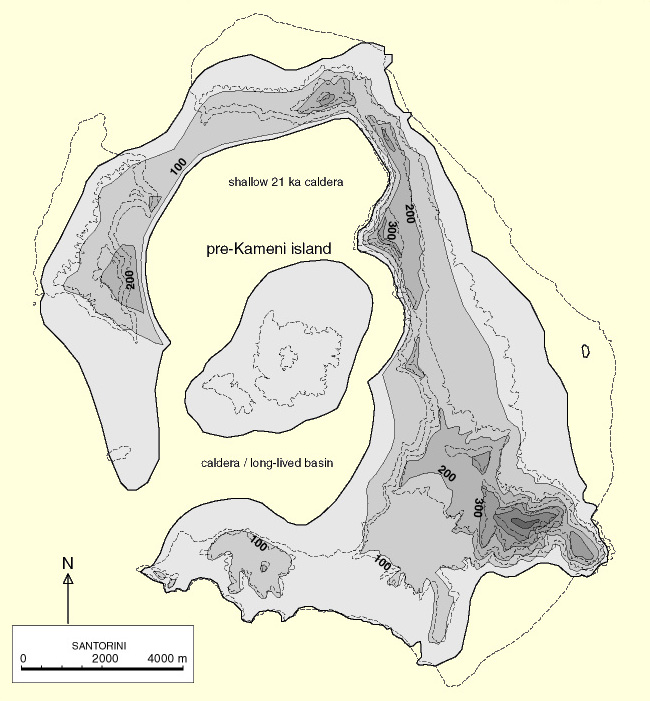
Pre-eruption Thera
Although it exhibited low-level activity in 1939-41 and 1950-51, it was in 1926 when it last erupted violently, destroying many hundreds of buildings in less than a minute. Eruptions of similar intensity occurred in 1650, 1707 and 1866. Although Thera is thought to have violently erupted around 54,000 & 18,500 BC, it was not until the middle of the sixteenth century BC that it provided what was probably the most powerful and destructive volcanic explosion in the Mediterranean during the Bronze Age. Although the exact date of this event is still the subject of some controversy, the most recent evidence(a) indicates a date around 1613 BC ±13years, while archaeologists are more supportive of a date circa 1500 BC.
Professor Floyd McCoy of the University of Hawaii has written and broadcast extensively on the matter of the Late Bronze Age eruption of Thera, including a paper delivered to the 2005 Atlantis Conference. In it, he noted that “New finds of tephra – ash and pumice – both on land and on the seafloor indicate a far larger eruption than previously assumed, suggesting a volume of at least 100 km3 of tephra (bulk volume) ejected, perhaps more. Such a volume ranks the eruption on the Volcanic Explosivity Index (VEI) at 7.0, equivalent or larger than the 1815 eruption of Tambora (‘the year without a summer’), ten times larger than the eruption of Krakatau in 1883, and approximately 100 times that of Mt. St. Helens in 1980.”[629.311]
The 1500 BC date was supported by David A. Warburton who edited the Acts of the Minoan Eruption Chronology Workshop in 2007(af). The workshop provided a good overview of the Theran eruption dating debates. Warburton’s comments are to be found in the Epilogue of the Acts.
While the eruption of the 2nd millennium BC undoubtedly caused extensive damage and disruption in the Eastern Mediterranean, its effect may have been felt much further afield. “Some scientists correlate a volcanic winter from the Minoan eruption with Chinese records documenting the collapse of the Xia dynasty in China. According to the Bamboo Annals, the collapse of the dynasty and the rise of the Shang dynasty (independently approximated to 1618 BC) was accompanied by ‘yellow fog, a dim sun, then three suns, frost in July, famine, and the withering of all five cereals’.”(at)
There was a series of eruptions that ended with a final enormous explosion that has been linked to the ending of the Minoan civilisation on Crete, the Plagues of Egypt and agricultural failures throughout the Eastern Mediterranean. For a geologist’s view of the island’s dramatic history, Walter Friedrich’s book[428] is hard to beat. His book supports a 1640 BC date for the eruption, although he has subsequently revised this to 1613 BC. Sturt W. Manning supported[957] a 1628 BC date and Mike Baillie offered dendrochronological evidence for the same eruption date at the 2011 Quantavolution conference in Athens(j). This converges with McCoy’s date above. However, as the dating of the eruption continues to be controversial as this December 2012 link(i)demonstrates. At the heart of the problem is that acceptance of an early 17th century BC date for the event conflicts with established Egyptian chronology. While the exact year of the eruption continues to be debated, there is now scientific evidence that it occurred in early summer(s).
A 2014 paper published in Antiquity by Paolo Cherubini would appear to confirm the 16th century BC as the date of the catastrophic eruption ruling out an earlier date as untenable(o). In the same year, the University of Birmingham published a report(u) that supported the 1625 BC date. The earlier Antiquity paper prompted a response by a group, led by Sturt Manning later in 2014(y).
In August 2018, an interdisciplinary group led by dendrochronologist Charlotte L. Pearson published a paper(ab)(ad), which concluded that the eruption of Thera took place in the 16th century BC. This conclusion was the result of using a combination of ‘dendro’ along with high-resolution radiocarbon dating methods. In April 2020, a new report in the journal Proceedings of the National Academy of Sciences explained how a new study of “the wood of an ancient grove of juniper trees, which suggested that the volcano blew its top around the year 1560 B.C.”(ae)
October 2018 saw further evidence for an early 16th century BC date for the eruption emerge after the radiocarbon dating of some olive wood found on Therasia, one of the Santorini island groups (z). The same month saw the publication of a paper on the ResearchGate(aa) website dating the event to 1727-1600 BC!
Pearson published another paper in 2023(ar) in which she highlighted the difficulties attached to using dendrochronology and olive wood, with particular reference to the dating of the olive shrub found on Therasia. “However, this sample has proved highly controversial because olive trees do not necessarily produce annual growth rings in the way that pine or oak trees might. While some studies have shown that annual growth rings in olives are possible, others have shown that the nature of olive growth may mean that a stem or branch with bark may have actually ceased to accumulate growth bands several decades before the death of the tree.”
William Austin, an American researcher, offers, with great insistence, the precise date of 1612 BC for the eruption of Thera, in a lengthy 2016 paper (updated 2022) paper that begins with an open letter to Manfred Bietak and Sturt Manning. “The conclusion is that the radiocarbon date c.1613 BC was spot on. The Minoan eruption was in the spring of 1612 BC, via astronomy, via ice cores, via tree rings, via a stalagmite, via Babylonian chronology; all arrows point to the same exact year.” This is a carefully thought-out argument and useful addition to the literature on the subject(ap).
Nevertheless, in 2022, another report(aq) from Pearson, of the University of Arizona and her team claims that they have narrowed the eruption date to three possible dates – 1611 BC, 1562-1555 BC and 1538 BC!
After the eruption, we learn from Herodotus that Thera was resettled in the thirteenth century BC by the Phoenicians and around a century later by the Dorians(am).
The doctoral thesis of Dr David Sewell explores the cultural effects of the Theran eruption and can be read online(h).
Many centuries later the volcanic ash deposited by the Theran eruption was used in huge quantities to manufacture cement for the construction of the Suez Canal. It was during the mining of this material that workmen encountered large stone blocks under the layers of pumice, indicating buildings of great age.
Luana Monte has written a rather ‘forced’ argument in which she claims that Thera can be identified as biblical Tarshish(ac).
It is claimed by many that a garbled Egyptian description of this devastating event was the basis for the story of the destruction of Atlantis. Louis Figuier was the first, in 1872, to publicly link the demise of Atlantis with the explosion on Thera. Opponents of this theory counter it by pointing out that Plato describes the inundation of an island much larger than Santorini or Crete, located in the Atlantic following an earthquake, not a volcanic eruption many thousands of years earlier. Various attempts have been made to reconcile this Minoan Hypothesis and its obvious inconsistencies with Plato’s text. They are discussed separately under
It was announced at the end of February 2010 that the BBC was about to air a dramatisation of the Theran disaster as well as a documentary on the eruption and its influence on the development of Plato’s story of Atlantis. June 2010 saw the historian, Bettany Hughes, front a disappointing BBC Timewatch Special, which also promoted the idea of the eruption on Thera as the inspiration for Plato’s story of Atlantis. The material introduced as evidence was highly selective and, for me, unconvincing. A few parallels between Thera and Plato’s description were trotted out, while the more numerous differences were ignored!
Alain Moreau has written a highly critical review(v) of the idea that the island of Thera/Santorini had been home to Atlantis.
Dr Dora Constantinidis, who studied under Prof. Christos Doumas, delivered a lecture in Melbourne on May 29th 2014 with the inviting title of Unravelling the Atlantis Myth at Akrotiri. However, the primary purpose of the talk was not to advance our knowledge of Atlantis but to encourage the sale of Bronze Age-inspired merchandise(p). Nevertheless, in late 2020, one commentator did speculate that Akrotiri may originally have been Atlantis!(aj)
It is noteworthy that “Unlike Pompeii, no human remains have been found at Akrotiri, and only one gold object was found on the site, suggesting that the Minoans performed an orderly evacuation before the eruption, and they had time to take their valuables before they fled.”(ak)
Another twist on the Thera explosion is offered by Andis Kaulins who suggests that there is a connection  between that event and the Biblical story of Sodom and Gomorrah(g), while Riaan Booysen has linked two separate Theran eruptions with two Exodus events in the Bible(k), offering as evidence the existence of two distinct Theran ash fallout areas, caused by different wind directions at the time of the events.
Vulcanologist Haraldur Sigurdsson of the University of Rhode Island, following a 2006 study of Santorini, estimated that the eruption of Thera was 120 times more powerful than the 1980 eruption of Mount St. Helens. Sigurdsson expressed his personal view that “the mythology born out of this largest eruption must be responsible for the Atlantis legend.”(au)
Initially, it was thought that the collapse of the Theran caldera generated very destructive tsunamis, but new studies have concluded(w) that instead of that it was the violent entry of pyroclastic flows into the sea that triggered the tsunamis. Dale Dominey-Howes has published a paper suggesting that some claims relating to tsunamis generated by the Theran eruption(s) are exaggerations. However, a 2022 report indicates that a series of four tsunamis resulting from the eruption hit the Turkish coast at Çesme-Baglararasi, with one known fatality.(ao)
In July 2023, National Geographic published an article on its website offering further information regarding the tsunamis generated by the eruptions of Thera and the evidence for it being investigated at a site in the resort town of Çesme on the coast of Turkeyx, 100 miles north-northeast of Santorini. Archaeologist Vas?f ?aho?lu of Turkey’s Ankara University has worked there since 2009(aw).
A further possible consequence of the Theran eruption(s) was proposed after the discovery of the Nebra Sky Disk(n), which was buried about 3,600 years ago. This is suggested  to have resulted from the volcanic ash generated by the eruption blotting out the sun for up to 25 years. It is thought that the Disk had been used to synchronise the lunar and solar calendars(l) and when this was no longer possible the Disk was buried as some form of offering. A contrary view is offered elsewhere on the Internet(m), as well as further controversy(t) led by Peter Schauer from the University of Regensburg.
Andis Kaulins has also written an extensive paper on the Nebra Sky Disk. A 2014 update(r) on the Disk was posted by Claudia Bracholdt.
2020 brought further debate with the claim, in a lengthy paper, that the date of the Disk should be brought forward to the 1st millennium BC(ag). This was followed by a shorter but vehement rebuttal(ah)(al).
In December 2020, the Discovery Channel aired a new documentary, which attempted to revive the Minoan Hypothesis, placing Atlantis on today’s Santorini. This recycled claim adds little that is new and has been taken up by several media outlets(ai), repeating an old error that claims that Plato said that Atlantis was destroyed by a volcanic eruption, when in fact he clearly states that it was the result of an earthquake.
Paul Dunbavin in Prehistory Papers [1758] discusses the Minoan Hypothesis and the extent to which it is inconsistent with the details provided by Plato. Despite the support from some academics for the idea that the story of Atlantis is linked to the Theran eruption, Dunbavin reiterates that “whenever you find a conflict between the opinion of a modern expert and that given in an ancient text then you should always prefer the source closest to the events.” [p160] The relevant chapter 15 is available as a separate paper online(av).
Before he retired, R. Cedric Leonard published a paper listing 18 reasons why he does not support the Minoan Hypothesis(as).
Erik Kiley published a short paper(ax) in 2025 endorsing the Theran city of Akrotiri as the location of Plato’s Atlantis. Kiley also claims to have deciphered three scripts that have puzzled experts for decades, namely Indus Valley, Linear A and Rongorongo(ay).
An extensive bibliography of books and articles on the subject of Thera can be found on the Internet(b).
(a) https://www.news.cornell.edu/stories/April06/Bronze.age.AK.html
(b) http://web.archive.org/web/20220518104632/https://atlantipedia.ie/samples/archive-2196/
(f) (BBC Sept. 24, 2014) https://www.bbc.co.uk/pressoffice/pressreleases/stories/2010/02_february/26/atlantis.shtml
(g) Sodom & Gomorrah & The Age of Thera and the Volcano Santorini (archive.org)
(h) http://web.archive.org/web/20191017000547/https://atlantipedia.ie/samples/archive-2199/
(i) http://web.archive.org/web/20191216194318/https://atlantipedia.ie/samples/archive-2200/
(j) https://www.qconference-athens-2011.grazian-archive.com/michaelbaillie/index.html
(k) https://www.riaanbooysen.com/thera
(l) https://www.megalithic.co.uk/article.php?sid=2146413876
(m) Nebra Speculation | Society for Interdisciplinary Studies (archive.org)
(n) https://www.dw.de/bronze-age-sky-disc-deciphered/a-1915398-1
(p) https://neoskosmos.com/news/en/akrotiris-link-to-atlantis
(q) Wayback Machine (archive.org)
(r) The Amazing Sky Calendar That Ancients Used to Track Seasons – Nautilus
(s) Fossil Insects Tweak Date of Deadly “Atlantis” Eruption (archive.org)
(t) (BBC June 25, 2007) https://news.bbc.co.uk/2/hi/science/nature/6722953.stm
(u) https://www.sciencedaily.com/releases/2014/10/141009100924.htm
(w) https://www.livescience.com/56791-santorini-tsunamis-caused-by-volcanic-flow.html
(y) Wayback Machine (archive.org)
(z) https://www.archaeology.org/news/7086-181022-greece-thirasia-wood
(ac) http://web.archive.org/web/20200225071041/https://atlantipedia.ie/samples/document-120612/
(ad) https://uanews.arizona.edu/story/dating-ancient-minoan-eruption-thera-using-tree-rings
(ae) (Smithsonian April 6, 2020) https://www.smithsonianmag.com/smart-news/ancient-volcanic-eruption-dated-through-rings-dead-trees-180974603/
(ag) Wayback Machine (archive.org)
(ah) Landesamt für Denkmalpflege und Archäologie (archive.org)
(ai) New Findings on Santorini Point to “Lost Island of Atlantis” Origins | GreekReporter.com
(aj) The Prehistoric Buried City of Akrotiri – Discovered in 1860 (thevintagenews.com)
(ak) https://www.atlasobscura.com/places/prehistoric-town-of-akrotiri
(am) https://www.santorini-view.com/history-of-santorini/
(an) https://www.sciencedirect.com/science/article/abs/pii/S0377027303002841
(ao) First victim of the tsunami that trashed the Eastern Mediterranean found | Ars Technica
(ap) https://www.academia.edu/30389193/Astronomy_date_of_the_Minoan_eruption_part_II
(aq) https://www.sciencedaily.com/releases/2022/05/220502142621.htm
(ar) https://www.nature.com/articles/s41598-023-33696-w
(as) Could the island of Santorini be Atlantis? (archive.org)
(at) https://www.flickr.com/photos/guano/472552606
(au) https://www.travel-to-santorini.com/article.php?article_id=50
(av) https://www.academia.edu/80337025/Catastrophes_from_Atlantis_to_the_Aegean
.
Maya
The Maya of ancient Mexico and Guatemala have generated much controversy regarding their origins(w). Recent studies indicate that the story of the development of this remarkable civilisation may be more complex than previously thought(k). The decline of a number of Classic Maya centres between 800 snd 950 AD) has often been attributed to persistent drought, particularly in the southern lowlands(o).
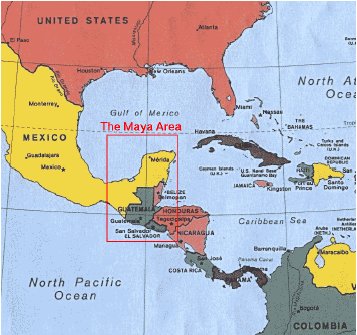
Maya Area of Occupation
Nevertheless, a recent (Sept.2021) article(ac) with contributions from several authorities highlights the complexity referred to above, while one area might be collapsing, another could be flourishing – “A number of Maya cities rose and fell at different times, some within that 800 to 1000 time period, and some afterwards, according to scholars. For example, while areas in southern Mesoamerica, such as Tikal in what is now Guatemala, declined in the eighth and ninth centuries due to environmental problems and political turmoil, populations rose in other areas, such as Chichén Itzá, in what is now the Mexican Yucatán Peninsula,” and “When Chichén Itzá declined, largely because of a lengthy drought during the 11th century, another Yucatán Peninsula city, called Mayapán, started to thrive.”
“We should always remember, the last Maya state, Nojpetén, fell only in 1697 — pretty recent,” said Guy Middleton, a visiting fellow at the School of History, Classics and Archaeology at Newcastle University in the U.K. “It is really important to get the message out there that though classic Maya cities and states did collapse, and culture did transform, the Maya in no way disappeared,” said Middleton, adding that “we should pay attention to the story, the state and status of the Maya descendent population in Mesoamerica now.”
The commonly held idea that the Maya were destroyed by drought is now disputed(ah).
The Maya of Central America today are estimated to number seven million.
Inevitably, the Maya have been linked with Atlantis by some writers, such as Lewis Spence and E.H. Thompson who claimed that the Maya were descendants of Atlanteans. The maverick, Augustus Le Plongeon, was alone in identifying Atlantis as a colony of the Maya and that their language was, in fact, Greek! Others, such as Jean-Frédérick Waldeck, included an Egyptian linkage as well.
Richard Cassaro has published a fascinating collection of parallels between the Mayan and Egyptian cultures on Graham Hancock’s website (ag).
The controversial American politician Charles Gates Dawes was convinced that there had been a connection between Atlantis and the Maya.
Joachim Rittstieg claimed that the Maya and the Vikings had contact for nearly 500 years (754-1224 AD)(ae).
However, trumping all that is a recent claim that the Maya had contact with extraterrestrials and that a documentary providing evidence is planned(b). In a similar vein is the latest English language publication from Erich von Däniken entitled: Astronaut Gods of the Maya[1422]. Semir Osmanagic, of Bosnian pyramid fame, added a twist to this proposed linkage when he claimed[0519] that the Maya had come from Atlantis, which in turn had been founded by visitors from the Pleiades!
For some comic relief, I can suggest a 1976 book[833] by brothers Eric & Craig Umland, which ‘reveals’ that the Maya ‘are remnants of space explorers whose attempts to colonise our solar system went awry more than 40,000 years ago.’ Nearly every page is full of hilarious nonsense and almost worth the £0.01 currently quoted on Amazon.co.uk. A website(i) dealing with ‘unreason’ uses extracts from the Umlands as good examples! If you wish to read about the Maya in Antarctica, the Canaries, as well as the Moon, this is the book for you.
The Maya had a sophisticated writing system that occupied the attention of some 19th-century writers, including Abbe Brasseur de Bourbourg and Le Plongeon. Unfortunately, de Bourbourg followed the work of the 16th-century bishop of Yucatán, Diego de Landa, whose interpretation was seriously erroneous. It was Constantine Rafinesque who partially deciphered some of the Mayan numerals in 1832.
A report in 2013(l) indicated that substantial progress has been made in the decipherment of any outstanding difficulties in the translation of the Mayan script, through Internet cooperation.
July 2012 saw a report(j) on the discovery of the largest Mayan man-made dam at Tikal in Guatemala, which was 33ft high and 260ft long and included sand filters. Ten years later, it was discovered that the Maya also had the ability to engineer a water fountain in their city of Palenque(v) and had advanced water management systems(z). A recent BBC article(ab) took an in-depth look at the remarkable hydrological capabilities of the Maya.
Since Tikal was first seen by a European, probably in 1696, it became recognised as Guatemala’s largest archaeological site. In 2021, the use of lidar revealed that the city was four times more extensive than previously thought. The March 2024 edition of National Geographic has an article highlighting the wonderful discoveries regarding the sophisticated society of the Maya revealed by lidar. Unfortunately, looting continues to be a serious problem, compounded by a lack of funds to properly exploit the tourism potential of places like Tikal.
In 2020, the largest and oldest Mayan monument in Mexico was identified. It is in the form of a ceremonial platform between 33 and 50 feet tall and is nearly a mile long(x). The structure, dated to around 3,000 years ago and discovered with the help of LIDAR in the state of Tabasco.
James O’Kon, an engineer, has investigated Mayan technology for decades, including the discovery of a suspension bridge at the ancient Mayan city of Yaxchilan in Mexico, in 1995, which is believed to be the longest bridge of the ancient world(r). He explores this and other aspects of Mayan technology in his book, The Lost Secrets of Maya Technology[1490].
One of those technological secrets was the unusual acoustics found at Mayan sites, particularly Chichen Itza(ad). In 1931, Leopold Stokowski, the renowned conductor, spent four days at the site to determine the acoustic principles that could be applied to an open-air concert theatre he was designing. He failed to learn the secret.
More recently, Lorraine Stobbart has written Utopia: Fact or Fiction[0476], which suggests that the ‘Utopia’ of Sir Thomas More was inspired by the Mayan culture although his text was written before Mexico was ‘officially’ discovered. Stobbart recently revealed that she is now revising her views.
However, a more serious claim relates to the idea that Mayan inscriptions revealed that a global catastrophe was to occur in 2012. This nonsense(g) turned into a minor publishing industry. Some even tried to link this daft idea to Atlantis. Fortunately, May 2012 saw evidence from excavations in Guatemala that shows the Mayan calendar extending well beyond 2012(h).
The Mayan calendar has provoked speculation and controversy ever since its discovery. Its origins are obscure, but one interpretation is that the world we live in was created on this day, in 3114 B.C. A quite different view was proposed over seventy years ago by Georg Hinzpeter of the German Hoerbiger Society, who claimed that our Moon was captured by the Earth in June of 8498 BC and that it became the zero date for the Maya.(y)
Aloys Eiling, the German researcher, commented on the accuracy of the Mayan calendar “The Mayan calendar even surpasses the precision of the Gregorian calendar in use today. Not only did the Mayan calendar measure the duration of the Earth’s orbit around the sun more accurately than our current calendar, but the Maya gave an even more precise value for the average duration of the Moon’s orbit around Earth. The precision achieved is all the more remarkable as the Moon in deserts or regions with clear skies may have played an important role in everyday life as a nightly source of light. But of what use is its dull light in the rainforest or cloudy regions of the world?”(af)
The accuracy of the Mayan calendar is so precise that it loses just one day in 6,000 years(ap)!
In 2012, it was reported that Mike Baillie, the renowned dendrochronologist, had discovered a correlation between ice core chemistry spikes and the Mayan Long Count calendar(al)(m).
The late David H. Kelley, a Harvard-educated archaeologist and epigrapher at Canada’s University of Calgary, had been investigating ancient links between Asia and pre-Columbian America. In that regard, he published a paper outlining similarities between the Mayan and ancient Chinese calendars, too numerous to be explained by independent development(p). A more sceptical view is offered(an)by Jason Colavito, who traces the idea back to Alexander von Humboldt(q).
In a paper entitled, On the Mayan Chronology(ao), Emilio Spedicato offers several ideas regarding ancient Meso-American chronologies. For example, he proposes that the large numbers used by the Maya and Toltecs record days rather than years. Many of his ideas stem from the work of Immanuel Velikovsky, John Ackerman and the Tollmans.
The work of Teobert Maler at the end of the 19th century was invaluable in the advancement of Mayan studies. Subsequent researchers have seized upon his discovery of a frieze at Tikal, which he interpreted as a depiction of the destruction of Atlantis, as evidence of the existence of Atlantis in the Atlantic. Apart from Maler’s conjectural ideas, no tangible link has been found between the Maya and Atlantis apart from the use in their glyphs of elephants, an animal that features in Plato’s narrative.
The authenticity of the photo of the frieze has been called into question by Jason Colavito and his related blog(n) is worthy of consideration.
Otto Muck overstated it somewhat when he wrote: “If Atlantis had not existed there would be no way of explaining the origins of the Maya civilisation”[098.243]
In late 2011 controversy erupted when it was claimed that the Itza Maya had migrated to North America, more specifically, Georgia(c). It was also suggested that earthen pyramids in Georgia and Florida can be attributed to the Maya(e). Richard Thornton led the charge with this claim, which understandably generated considerable controversy. This led to a frosty exchange between Thornton and Jason Colavito(ai).
Among their other accomplishments is the claim that the Maya were capable of predicting meteor showers(s).
Gene Matlock, the well-known advocate of Atlantis in Mexico, is certain that the Maya were originally Tamils from Sri Lanka(a) and Sumerians!
Kurt Schildmann’s 2003 book [1759], was reviewed by Dr Horst Friedrich who commented that “One of the provisional results of Schildmann’s decipherment of the Maya script, and study of the Maya language, is the rather sensational discovery that words from several Old World languages (Sumerian, Accadian, Indo-Iranian, Phoenician, Hebrew and Basque) have somehow found their way into the Maya language.”(aa) I’m sure this will be disputed!
A recent article(f) gives an interesting firsthand account of encountering the important Mayan city of Calakmul deep in the Yucatan jungle. Potentially even more important are recent LiDAR surveys carried out in Guatemala that have revealed an astounding number of previously unidentified Mayan structures. The number of additional Mayan sites identified through the use of LiDAR continues to grow at an incredible rate(u). It was estimated in 2022 that “researchers using laser technology have located nearly 1,000 previously unknown Maya settlements in Guatemala – the sites include ceremonial centers, sporting facilities, roads, and reservoirs“(ak).
In June 2023, it was announced that once again LiDAR had enabled another forgotten Mayan city to be located in the Yucatan(aj). In fact, thanks to the use of this technology, hundreds of Maya sites have been rediscovered(aq).
Muddying the waters further is an Islamic site that claims that the Maya were Atlantean(m).
(a) https://viewzone2.com/ancientturksx.html
(b) Mayan Filmmaker Offers Photo as Proof of Aliens, Says Hawking Agrees (Exclusive) (archive.org)
(c) http://www.billdawers.com/2011/12/22/is-there-an-1100-year-old-mayan-site-in-north-georgia/
(e) http://www.mayainamerica.com/2012/01/pyramids-in-florida-and-georgia.html
(f) Deep in the Jungle: Puerta Calakmul, Yucatan Mexico – Travel 4 Wildlife (archive.org)
(g) https://web.archive.org/web/20140811054919/https://2012hoax.wikidot.com/oldstart
(h) https://www.christianpost.com/news/earliest-mayan-mural-contradicts-dec-21-2012-doomsday-74788/
(i) https://web.archive.org/web/20200925184903/https://www.jfk-online.com/exploring.html
(k) https://www.sciencedaily.com/releases/2013/04/130425142343.htm
(l) https://www.guardian.co.uk/science/2013/may/28/maya-script-glyph-language-decoding?INTCMP=SRCH
(m) https://mashiyah.blogspot.ie/ (offline 1/8/14)
(n) https://www.jasoncolavito.com/1/post/2014/02/did-the-maya-depict-the-end-of-atlantis-at-tikal.html
(r) The Lost Secrets of Maya Technology (archive.org)
(s) Ancient Maya May Have Foreseen Meteor Showers – Eos
(t) https://arstechnica.com/science/2018/02/lasers-shed-some-light-on-the-maya-snake-kingdom/
(v) https://content.usatoday.com/communities/sciencefair/post/2010/03/maya-pyramid-plumbing-unearthed-by-archaeologists/1#.Xm-Nb2BFBVc (link broken)
(w) Mexico and atlantis | Truth Control (archive.org)
(x) (Smithsonian June 5, 2020) https://www.smithsonianmag.com/smart-news/largest-and-oldest-maya-structure-found-mexico-lidar-180975037/
(y) Atlantean Research, Vol 3, No.1, May, 1950
(z) Maya Water System Discoveries Show the Ancient Civilization in a New Light | Discover Magazine
(aa) https://www.migration-diffusion.info/books.php
(ab) (BBC Aug. 8, 2021) The Maya’s ingenious secret to survival – BBC Travel
(ac) https://www.livescience.com/why-maya-civilization-collapsed.html
(ad) https://www.nature.com/articles/news041213-5
(ae) http://atlantisorschung.de/index.php?title=Joachim_Rittstieg
(af) https://grahamhancock.com/eilinga3/
(ag) The Ancient Egyptians and Mayans: Ten Unexplained Parallels – Graham Hancock Official Website
(ai) Richard Thornton and the “Maya” of Georgia – JASON COLAVITO
(aj) https://www.livescience.com/archaeology/lost-maya-city-discovered-deep-in-the-jungles-of-mexico
(am) Wayback Machine (archive.org)
(an) Atlantis, Mu, and the Maya – JASON COLAVITO
(ao) ON THE MAYAN CHRONOLOGY – Ruggero Marino – Cristoforo Colombo
(ap) Celestial and Mathematical Precision in Ancient Architecture (redicecreations.com)
(aq) Lost Maya Cities Revealed Through Cutting-Edge Lidar Technology (anthropology.net)
Krakatoa
Krakatoa, the Indonesian volcano that erupted so violently in 1883, produced many recorded effects that are frequently used as yardsticks when discussing the possible consequences of similar events in the past, particularly the second millennium BC destruction of Thera, a leading contender in the Atlantis stakes.  The Krakatoan eruption had a detrimental effect on global climates for some years.
However, this was not the first time that the eruption of Krakatoa had calamitous global consequences. David Keys (image below), an archaeological journalist, details the effects of an eruption of Krakatoa in 534/5 AD, in his book, Catastrophe[1330]. This book was the subject of a documentary on the UK’s Channel Four(d). A few years before his book was published Keys wrote an article entitled: Comet may have caused catastrophe on Earth(e), in which he dismissed a volcanic eruption as the cause of the 6th century crop failures, plagues, wars, social unrest and widespread deaths, yet his subsequent book advocates[p.269] a massive eruption of Krakatoa as the culprit. Around the same time, Mike Baillie was about to publish his Exodus to Arthur [0111] in which he argued

David Keys
strongly that the mid-6th century range of catastrophes was caused by a cometary impact. Five years later, Baillie co-authored, with Patrick McCafferty, another book linking comets with Irish mythology, The Celtic Gods, in which they point out that Keys’ proposed huge eruption has not been reflected in any of the various Greenland ice cores in the form of a volcanic-acid spike[0112.164]!
This debate regarding the cause of the global catastrophes in the mid-6th century would appear to be far from over. A 2015 report(f) suggests that a series of North American volcanic eruptions in 536 AD had such a detrimental effect on the climate of Europe that it contributed to the final demise of the Roman Empire. Furthermore, there is now evidence(g) that the eruption of the El Chicon volcano in Southern Mexico around 540 AD led to the disruption of the Maya civilisation. Matthew Toohey from the GEOMAR Helmholtz Centre for Ocean Research in Kiel, Germany, has suggested the possibility of a double event!
Early in the 19thcentury, the eruption of Tambora, also in Indonesia, was even more powerful(a). However, the most violent eruption of the last two million years also took place in Indonesia 74,000 years ago, when Mt. Toba erupted with devastating consequences for the Indian sub-continent and further afield(b). The Toba caldera is now Lake Toba.
The devastation caused by the Toba eruption led some, such as George Weber and the author of Supervolcano [2085], John Savino, to propose that the event created a genetic evolutionary bottleneck. Although a number of articles(c) in recent years have supported the ‘bottleneck’ theory that led to the near extinction of humans,(i) the idea has been strongly opposed in other quarters(h) .
The Theran eruption was equivalent to the 19th century Krakatoa event when measured according to a volcanic explosivity index (VEI), based on quantitative criteria, as discussed in Walter Friedrich’s book on Thera[428]. Within a decade, the explosivity figure for Thera was reassessed by Professor Floyd McCoy of the University of Hawaii, who has written and broadcast extensively on the matter of the Late Bonze Age eruption of Thera. This included a paper delivered to the 2005 Atlantis Conference. In it, he noted that “New finds of tephra – ash and pumice – both on land and on the seafloor indicate a far larger eruption than previously assumed, suggesting a volume of at least 100 km3 of tephra (bulk volume) ejected, perhaps more. Such a volume ranks the eruption on the Volcanic Explosivity Index (VEI) at 7.0, equivalent or larger than the 1815 eruption of Tambora (‘the year without a summer’), ten times larger than the eruption of Krakatau in 1883, and approximately 100 times that of Mt. St. Helens in 1980.” [629.311]
When we watched the 20th century eruption of Mt. St. Helens or the Montserrat volcanoes on our televisions, it gave no real notion of the incredible power of these events or the absolute terror that was experienced by those living close by.
(a) https://www.volcanodiscovery.com/tambora.html
(b) https://creativesystemsthinking.wordpress.com/2014/10/24/did-humans-almost-die-out-70000-years-ago/
(d) https://www.davidkeys.co.uk/davids-documentaries/ (Link broken Nov. 2018)
(f) (BBC April 20, 2016) https://www.bbc.com/news/science-environment-36086096
(g) https://www.unexplained-mysteries.com/news/283466/volcanoes-hastened-fall-of-the-roman-empire
(h) Toba catastrophe theory – Wikipedia
(i) https://www.youtube.com/watch?v=I9IyFz5VLRM
Dodwell, George F.
 George F. Dodwell (1879-1963) was a leading Australian astronomer, who made an extensive study of ancient gnomons and discovered that they deviated from what had been anticipated. A gnomon is the part of a sundial that casts the shadow. He concluded that there was consistent evidence that the tilt of the earth’s rotational axis was altered around 2345 BC. This view supported those that have claimed that the poles shifted within the memory of man, possibly as a result of a close encounter or impact with an extraterrestrial body such as a comet. Some have gone further and attribute the destruction of Atlantis to this clash. Dodwell’s complete work on the subject can now be read on Barry Setterfield’s website(a).
Dodwell, a devout Christian, concluded that it was this sudden shift of the earth’s axis that led to the Flood of Noah. Reinaud de Jonge proposed a similar linkage between the 2345 BC cosmic encounter and the biblical Deluge. He also claimed that a large collection of petroglyphs at Mougau-Bihan in Brittany were inspired by this event.
Rene Noorbergen (1928-1995) mentions in his Secrets of the Lost Races [612.20] that Dodwell wrote to Professor Arthur J. Brandenberger of Ohio State University, outlining his theory in the following manner; “I have been making during the last 26 years an extensive investigation of what we know in astronomy as the secular variation of the obliquity of the ecliptic. From a study of the available ancient observations of the position of the sun at the solstices during the last three thousand years, I find a curve which, after allowing for all known changes, shows a typical exponential curve of recovery of the Earth’s axis after a sudden change from a former nearly vertical position to an inclination of 26½ degrees, from which it was returned to an equilibrium at the present inclination of 23½ degrees during the interval of the succeeding 3,194 years to A.D. 1850. The date of the change in the Earth’s axis, 2345 B.C., is none other than that of the flood recorded in the Bible, and the resulting conclusion is that the Biblical account of the flood as a universal one, together with its story of Noah’s Ark, is historically true.”
Dodwell was also impressed by the work of the creationist, George McCready Price (1870-1963), who had also concluded[1616] that the Earth’s axial tilt had been altered as a result of an impact with a celestial body. Price also linked the event with the biblical Deluge.
Dodwell referred to a paper of F.S.Richards on the orientation of the Temple of Ammon at Karnak(b), which indicated an anomalous obliquity of the ecliptic of 25°9’55”. This led to considerable debate regarding the age of the temple. William Fix drew attention[871.264] to the widespread reuse of very ancient sacred sites by successive cultures, which might explain the incompatibility between the apparent age of the most recent temple and the greater antiquity suggested by the obliquity of the ecliptic. Alternatively, it might also indicate an encounter with an extraterrestrial body that affected the Earth’s axis and caused widespread destruction, including, according to some theories, the destruction of Atlantis!
S.F. Wells published a paper(h) on Graham Hancock’s website in which he investigated the Avebury stone circle and its associated monuments and found evidence that they “show knowledge of past Polar positions”.
In the interests of balance, I must refer readers to an extensive 2013 paper(f) by a creationist, Dr Danny Faulkner, who has cast doubts on Dodwell’s conclusions. More recently Paul Dunbavin also published a positive critique of Dodwell’s work in Prehistory Papers [1758.71]. This essay was written a few years ago and is now available on his website(k) as well as the academia.edu website(l).
Another interesting comment is offered by Barry Setterfield, who wrote(a) that “ Dodwell has assumed here that the original axis tilt of the earth, before 2345 B.C., was nearly upright. For that reason, he supposed a very strong impact was necessary to jolt the earth from that position to its current 23.5-degree tilt. This is why a number of astronomers have rejected Dodwell’s work in this area. However, if the axis tilt was greater than its current axis tilt before 2345 B.C., then an impact of much less force would have been required to restore the earth to a slightly more upright position. The evidence for this greater axis tilt may be seen in the evidence of the ice age which covered most of Europe prior to 2345 B.C.”
Malcolm Bowden, the author of True Science Agrees with the Bible[1612], also wrote a pamphlet[590] supporting Dodwell’s findings and later produced a YouTube video explaining in detail Dodwell’s axial tilt theory(g). Paul D. Ackerman offers another review of Dodwell’s work from a creationist viewpoint(j). Ackerman is an ardent supporter of the concept of a young Earth [1727].
In 2011, Mike Baillie, the renowned dendrochronologist, gave a PowerPoint presentation(d) at the Quantavolution Conference in Athens, which offered tree-ring evidence that clearly demonstrated an ‘event’ in 2345 BC, which has counterparts in early Chinese and Middle East records suggesting a cometary encounter/impact! Baillie also notes that Isaac Newton and Edmund Halley both thought that Archbishop Ussher’s Flood of 2349 BC was due to an encounter with a comet.
As early as 1696, William Whiston claimed that the earth’s encounter with a comet led to the biblical Deluge.
More recently, in 2000, Andrew Bourmistroff, a Russian researcher, has determined that the orientation of the Great Pyramid at Giza is off by 9.85 degrees west of true north(e). The full significance, if any, of all these details has yet to be fully determined.
Comet Dodwell–Forbes, formally designated as C/1932 Y1, is a long-period comet discovered independently by Alexander F. I. Forbes and George F. Dodwell in late 1932. It was Dodwell’s only comet discovery, while it was Forbes’s third overall(m).
A 2026 book [2134]. by C.R. Sant offered his support for a change in the Earth’s axial tilt in 2346 BC, leading to the destruction of Atlantis.
(b) Wayback Machine (archive.org)
(d) https://www.qconference-athens-2011.grazian-archive.com/the2345topicmbai/index.html
(e) https://web.archive.org/web/20150909160031/https://www.world-mysteries.com/andb1.htm
(f) https://answersingenesis.org/astronomy/earth/an-analysis-of-the-dodwell-hypothesis/
(g) https://www.youtube.com/watch?v=21WvVH4CXR4
(h) https://grahamhancock.com/wellssf1/
(i) THE COMET CATASTROPHE OF c.2345 BC – 1 (archive.org)
(j) https://creationism.org/csshs/v07n4p02.htm
(k) Updating George F Dodwell | pauldunbavin (third-millennium.co.uk)
(l) (96) Updating George F. Dodwell | Paul Dunbavin – Academia.edu
(m) https://en.wikipedia.org/wiki/C/1932_Y1_(Dodwell%E2%80%93Forbes) *
Dendrochronology
Dendrochronology is the science of dating the age of timber by comparing the sequence of its tree-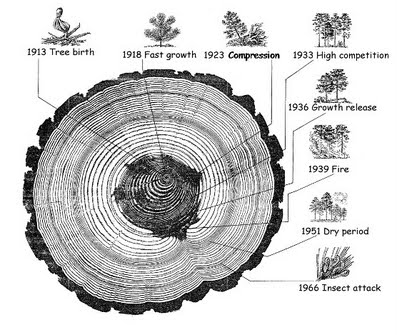 ring width variations with that of timbers of a known date, ideally belonging to the same species and from the same location. As with any science, it is not without its difficulties(c), but is generally considered to be more accurate than radiocarbon dating, which is frequently calibrated using dendrochronology. Fully anchored chronologies now exist for river oaks in parts of Germany dating back over 10,000 years and a similar chronology extending back 9000 years exists for the bristlecone pine of California’s White Mountains(j). A new project(b) involving the Kauri trees of New Zealand has commenced, which should give an accurate climate record for the past 30,000 years. Some of these trees are dated to 130,000 years ago.
Professor Mike Baillie, one of the leading dendrochronologists in Europe, has written[111] about ‘dendro’ evidence of cometary impacts. One such impact has been suggested by a number of commentators, as the possible cause of the demise of Atlantis.
While the science of dendrochronology is perfectly sound, there can be a need for fine-tuning to take account of unexpected factors, like the nibbling of tree trunks by animals such as sheep. Recent studies in Norway(d) over a nine-year period provided data enabling appropriate calibration to be achieved.
In 2014, Gunnar Heinsohn, a German chronology revisionist, questioned the value of dendrochronology, which was followed by a rebuttal from Mike Baillie(e). This debate continues, with many specific details far from resolved (f).
Professor Henri D. Grissino-Mayer, of the University of Tennessee, has a most informative website(a) on dendrochronology, which, along with a 2020 paper from Nate Loper, brings the subject more up-to-date(g).
An International Conference on Dendrochronology and Climate, was held in Amsterdam in February 2022, that was aimed at bringing together leading academic scientists, researchers and research scholars to exchange and share their experiences and research results on all aspects of Dendrochronology and Climate.
A report in The International Journal of Wood Culture, published in January 2023(i) detailed an unusual application of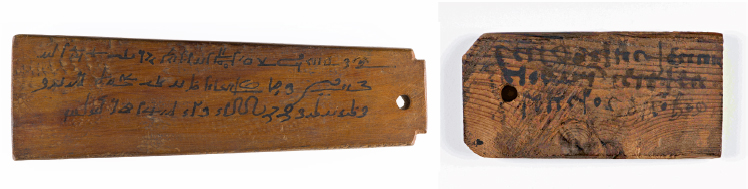 dendrochronology, involving the study of what are known as ‘mummy labels’ that are made of wood, which were attached to Egyptian mummies during the Graeco-Roman period. It appears that there are thousands at various locations worldwide that offer invaluable climate information from tree-rings visible on the labels.
For the sake of balance, I have included a link to a creationist website debunking dendrochronology.(h)
(a) https://web.archive.org/web/20180810120352/http:/web.utk.edu:80/~grissino/
(b) https://www.sciencedaily.com/releases/2010/04/100405103837.htm
(c) See Archive 3046
(d) https://wattsupwiththat.com/2011/07/26/tree-ring-widths-more-affected-by-sheep-than-temperature/
(e) https://www.q-mag.org/the-1st-millennium-ad-chronology-controversy.html
(f) Deranged Dating: The Roman Problem | MalagaBay (archive.org)
(h) How Dendrochronology disproves the flood [Debunked] : Creation (reddit.com)
(j) Dendrochronology (archive.org)