Latest News
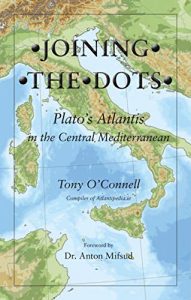
Joining The Dots
I have now published my new book, Joining The Dots, which offers a fresh look at the Atlantis mystery. I have addressed the critical questions of when, where and who, using Plato’s own words, tempered with some critical thinking and a modicum of common sense.Read More »
Monthly Archives: October 2012
Alexander, John B.
John B. Alexander (1937- ) retired from the US Army with the rank of Colonel in 1988. He has lectured on pre-cataclysmic civilisations and as an underwater demolition expert with the Green  Berets he was highly qualified to undertake exploratory diving in the vicinity of Bimini in 1971. He discovered a series of regularly shaped underwater features extending over a considerable area. Alexander was convinced that they were the product of a very ancient civilisation. However, he considered his views compatible with the ‘revelations’ of Edgar Cayce! For me, even more disturbing was his claim in an interview with Brad Steiger[874.59]that he used hypnotic regression to obtain “quite a bit of information on what we call Atlantis.” Plato does not get a look in. Cazeau & Scott[878.10] are even more critical, concluding that the interview shows Alexander to be neither archaeologist nor geologist and that his opinions regarding Bimini are “useless.” Frankly, it seems that Alexander was just one more trying to get on board the Bimini bandwagon.
LaBorde, Jean Benjamin de
Jean-Benjamin De LaBorde (1734-1794) was best known as a musician 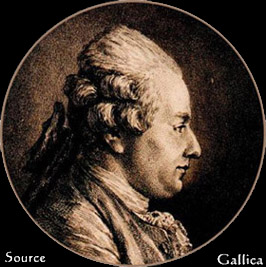 from the age of 14 but was also a historian and cartographer(a). In his Histoire abregeee de la Mer du Sud [1266]+, it appears he was the first to suggest a sunken continent in the South Pacific with New Zealand and other island groups being today’s remnants>of a lost land comparable with Plato’s Atlantis.
However, Atlantisforschung suggests that LaBorde was more inclined to associate America with Atlantis(b).
Unfortunately, his musical and scientific interests were curtailed when his association with Louis XV led him to the guillotine.
[1266]+ https://books.google.com.vc/books?
(a) Wayback Machine (archive.org)

(b) Jean Benjamin de La Borde – Atlantisforschung.de (atlantisforschung-de.translate.goog)
Caroli, Kenneth
Kenneth Caroli is a researcher from Florida and a regular contributor to Ancient American and Atlantis Rising magazines, as well as The New Archaeology Review. He has tackled subjects such as, the age of the Bimini Wall (AA vol.1.4), the date of Atlantis’ destruction (AA vol.7.43) and speculates on the possibility of a Celtic Atlantis (NAR June 2006). In Frank Joseph’s book, Atlantis and 2012, a map drawn by Caroli was included, showing the Azores as Atlantis and Lemuria as a number of islands in the South Pacific(a).
.
(a) Kenneth Caroli – Atlantisforschung.de (atlantisforschung-de.translate.goog)
Fix, William R.
William R. Fix (1941- ) graduated from Canada’s Simon Fraser University with degrees in Behavioural Science, History and Philosophy. Although he is not a creationist, Fix is opposed to the theory of evolution and has produced his own account of man’s origins in his 1984 book, The Bone Peddlers.
His earlier book, Pyramid Odyssey[871], presents a case for reappraising the history of civilisation demanded by the existence of structures such as the Great Pyramid and the story of Atlantis as related by Plato. He, rather conventionally, places Atlantis in the Atlantic based on his interpretation of Plato’s text, combined with the rather dubious corroboration of Edgar Cayce. He continued his pyramid studies in his next book, Star Maps[872], moving on to the subject of reincarnation, from the beliefs of the ancient Egyptians to the ideas of Cayce and Rudolf Steiner.
Most interesting for me were Fix’s comments on the Ibn Ben Zara Map (p.161) which is claimed to reflect Europe at the end of the Ice Age and his observations on the orientation of the Temple at Karnak (p.267) which may suggest a greater than accepted antiquity for “the sources of Egyptian civilisation.”
Ivan Petricevic refers to the Ben Zara Map in similar terms(b) – “ Created in 1487, the map displays remnants of glaciers in Britain, but also extremely detailed depictions of islands in the Mediterranean and Aegean seas. Today, these islands still exist, but due to rising water levels, they are now underwater.”
Jean-Pierre Lacroix has written a paper arguing that the location of the temples at Karnak and Thebes are a physical representation of the constellation of Aries(a).
(a) https://www.ancientcartography.net/index1.html
(b) 9 Extremely Ancient Maps That Should Not Exist | Ancient Code (archive.org)*
Turolla, Pino (L)
Pino Turolla (1922-1984) was an Italian Count and a recognised expert in underwater exploration and photography. He also held a US patent for an improved parachute(a).
He carried out an investigation of sunken ‘pillars’ at Bimini in the late 1960’s. Turolla identified forty-four such pillars and suspected that more were still to be discovered. He was of the opinion that these pillars were not composed of stone native to the Bahamas, but had been brought from the Andes. Photos taken by Turolla were used by Robert Ferro and Michael Grumley in their book Atlantis: The Autobiography of a Search[594].
Turolla later published his own book, Beyond the Andes; My Search for the Origins of Pre-Inca Civilization.
(a) https://www.google.com/patents/US3141215?printsec=abstract#v=onepage&q&f=false
Lilliu, Giovanni
Giovanni Lilliu (1914-2012) was a highly respected Sardinian archaeologist and politician. He was  also a recognised expert on the Nuraghic culture of Sardinia. His contribution to the Atlantis debate is to locate the Pillars of Heracles at the Strait of Sicily, or more precisely, at Cape Bon in Tunisia and Lilybaeum in Sicily.
Troy Towns
Troy Towns is the name given to turf mazes in Britain and their counterparts, the many stone lined labyrinths to be found in Scandinavia, the Baltic countries and as far east as Russia, where Arkaim is considered by some to be a form of troy town(d).
>A German website (in English) offers a detailed review of Troy Towns in Sweden(f).<
W.H. Matthews (1882- ) listed a total of thirty-seven extant English turf labyrinths in his 1922 book [1686], noting that there were once many more, including some in Scotland and Wales. Today, only eight historic turf labyrinths survive in England, only two of which still bear the name of Troy: The City of Troy in Dalby, North Yorkshire, and Troy at Troy Farm, Somerton, Oxfordshire. Saffron Walden is home to the largest, and some maintain oldest, surviving English turf labyrinth.(e)
All these are supposedly inspired by the ‘original’ labyrinth on Crete. To suggest(c) that labyrinths or Troy Towns are in any way intended to memorialise Plato’s description of the layout of Atlantis is just unbridled conjecture.
(a) https://www.mymaze.de/trojaburg_en.htm
(b) https://en.wikipedia.org/wiki/Troy_Town
(c) The mystery of the labyrinth (archive.org) *
(e) https://www.dailygrail.com/2017/07/the-labyrinths-of-troy/
Falzon, Kevin
Kevin Falzon is a Maltese writer who has written seven books(a) including two on the subject of ancient astronauts and their interaction with humans. He closely follows the theories of the late Zecharia Sitchin and blends them with the even more outlandish ideas of Hubert Zeitlmair. However, his credibility as a serious researcher is further damaged by his support for a conspiracy theory that has the ‘Illuminati’ responsible for the killing of celebrities such as Kurt Cobain, Princess Diana, James Dean, Marilyn Monroe and Amy Winehouse, among many others[869.381]!
Falzon is apparently unaware of Adam Weishaupt (1748-1830) who founded the ‘Illuminati’ in the 18th century(b) also witnessed its demise early in the 19th century. There is no evidence that it lasted in any meaningful way after that.
Falzon identifies Malta as a key part of Atlantis.
2023 saw Falzon in trouble with the authorities for allegedly speaking out against migrants in Malta on his Facebook page(c).
In March 2025, Falzon has twice demanded that I remove all the information I wrote about him from this website!
(b) Meet the Man Who Started the Illuminati (archive.org)
Vega, Manuel
Manuel Vega (1967- ) was born in Spain and studied Chemistry there and later worked as a research scientist in America and Japan. He travelled widely in the Far East before returning to the United States where he spent five years training a Buddhist monk before resuming a more secular life.
In 2012 he published Sailors of Stonehenge[868] in which he reviews the principal megalithic sites of Western Europe, including some interesting speculation. For example he describes the English Avebury complex as a site of ‘monarchical renewal’ and proposes related ceremonies at Stonehenge. Another of what I consider his more fanciful ideas is his suggestion that Ireland’s Boyne Valley, which includes Newgrange, was used as a ‘royal funerary complex’ for dead English kings! He maintains that the location of many of these sites was determined by the position of astronomical features in the night sky.
Vega ends the book with a chapter on Atlantis, which he locates in the Atlantic and identifies the Atlanteans as the Megalith Builders. “By the end of the 4th millennium BC they designed a huge celestial mirror over the Atlantic territories, which served to regulate themselves politically and religiously (implementing Heavens on Earth). The largest and most unique constructions, such as those at Carnac, Avebury, Stonehenge and Newgrange, were royal monuments erected at key sites of this celestial mirror according to a megalithic technology designed to attain the rebirth of the sacrificed kings again as princes, keeping an unbroken royal lineage.”
* Vega returned to the subject of the megalith builders in 2015 with the publication of Voyage Zero[1443]. However, in 2017 he became even more contentious in Madrid is Atlantis[1444], which as the title implies, claims that Atlantis was located in the vicinity of the author’s native city.*
I found it very hard to accept most of his claims.
Those interested in reading more of Vega’s ideas can read his blogs(a).
Toltecs, The

The Toltecs were the predecessors of the Aztecs in central Mexico. It is generally accepted that they ruled between the 10th and 12th centuries AD. Some rather pathetic attempts by Theosophists and New Agers have been made to link the Toltecs with Atlantis. Annie Besant, the theosophist, informed us that the Toltecs were 27 feet tall!
William Scott-Elliot, also a theosophist, described the Toltecs as “averaging about eight feet during the period of their ascendency, but of course dwindling, as all races did, to the dimensions that are common today.”(a)
In the Toltec city of Tula, in the Mexican state of Hidalgo are 15-foot high statues known as Atlantes, which is also an architectural term used to describe supporting columns carved in the shape of a man.(b)
Nevertheless, Dominique Görlitz has written two-part article for Atlantisforschung in which he offers the suggestion that the Toltecs had been influenced by Basque visitors(c). “In addition to the well-known cultural parallels between the peoples of the Old and New Worlds, many Native American cultures have old myths about foreign culture bringers that relate to the beginnings of their culture and agriculture.”
John B. Newman, writing [0488.31] decades before Ignatius Donnelly and drawing on comments by Marco Polo, speculated that what became known as Toltecs had originally been part of a Chinese fleet intent on invading Japan that had been blown off course and ended up on the western shores of what is now Mexico. The settled there although in regular conflict with the native Aztecs. Unfortunately, Newman and Marco Polo have their chronologies mixed up as the the fleet in question was dispatched by Kublai Khan, long after the Toltecs arrived in Mexico.
(a) https://www.sacred-texts.com/atl/soa/soa17.htm
(b) Tula – Mysterious City of the Toltecs – The Maritime Explorer (archive.org)