Latest News
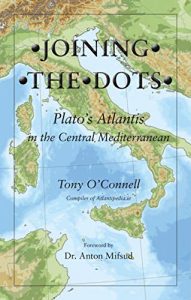
Joining The Dots
I have now published my new book, Joining The Dots, which offers a fresh look at the Atlantis mystery. I have addressed the critical questions of when, where and who, using Plato’s own words, tempered with some critical thinking and a modicum of common sense.Read More »
Antarctica
Antarctica takes its name from the Greek Anti Arktos, which means opposite the Arctic. Edward Bransfield, an Irishman, led an expedition that discovered the northwestern shore of the Antarctic Peninsula in January 1820(af), just three days after a Russian expedition found what was later to be known as the Fimbul Ice Shelf. However, a recent study suggests that an earlier discovery took place over a thousand years before that by Polynesians(ai).
The earliest literary reference to a city in Antarctica seems to have come from the pen of Edgar Allan Poe in his only full novel, The Narrative of Arthur Gordon Pym’ (z). The idea of an Antarctic civilisation was also part of another novel, A Strange Manuscript Found in a Copper Cylinder[1532], by the Canadian author, James De Mille (1833-1880), published posthumously in 1888. In 1897, Jules Verne published An Antarctic Mystery(ab), which has been described as a response to Poe’s novel.
The earliest media claim of an Antarctic location, that I have found, is in The Boston Sunday Globe of April 11 1897, which regaled its readers with the following headline – “Mouse Reveals Atlantis”. It tells the story of a small marsupial discovered in South America related to an Australian species. The ‘experts’ of the day decided that this could only be explained by a landbridge linking the two landmasses. “A direct line joining Australia with Patagonia runs through the South Pole. In all probability, then, our new-found Atlantis must have been an Antarctic continent.” If you fail to see the logic in this, you are not alone.ca).
Antarctica first entered the Atlantis debate as far back as 1923 when René-Maurice Gattefossé maintained that Atlantis had been located in the Atlantic and culturally influenced by an even earlier civilisation that had existed on Antarctica. In the same year, another Frenchman, Dominique Sévriat, published a novel with the backdrop of an Atlantean Antarctic. H.P. Lovecraft published a short novel in 1931, At the Mountains of Madness[1522], which also used an Antarctic-Atlantis link.

Antarctica – without ice
Many other exotic claims have been made relating to Antarctica, including that it was a UFO base(i) and that a refuge for Hitler had been built there in an area that was known as Neuschwabenland(h).
An even more astounding claim was made in the title of a recent book – Earth’s First Civilization, Antarctica, 55 Million B.C.[2123] (aj). Books like this lead me to question the wisdom of allowing unbridled free speech!
However, the earliest suggestion of Antarctica as the home of Atlantis seems to have come from a Chilean professor, Roberto Rengifo, who also proposed, in 1920, that Antarctica was the original home of mod[2123]ern man until a catastrophic pole shift forced migration northward into the Americas and eventually worldwide! According to R.V.Eissmann, Arthur Posnansky made a similar suggestion around the same time.
Half a century was to pass before Antarctica itself was again promoted as the probable site of Atlantis by Flavio Barbiero in his book[061] published in Italian, Una civilta sotto ghiaccio (A Civilisation under the Ice).
Twenty years later Rand & Rose Flem-Ath[062], supported by a well-designed website(a), published a similar theory that received widespread exposure in the English-speaking world. Subsequently, Rand Flem-Ath co-authored with Colin Wilson a second book[063] that added more background to the theory. Colin Wilson has more recently abandoned his support for Antarctica, as he eventually found the idea of Atlantis based here waging war against Athens,14,000 km away, untenable and then transferred his support to Robert Sarmast’s idea of Cyprus as the location of Atlantis.
Andrew Collins is another writer who was initially attracted to the Antarctica hypothesis but eventually opted for Cuba as the location of Atlantis. He later wrote a brief refutation of the Antarctic theory(aa).
In 2005, Gernot L.Geise & Reinhard Prahl published Auf der Suche nach der Mutterkultur (In Search of the Mother Culture) [730], in which they also opted for Antarctica as the location of Atlantis.
In 2007, David Stewart Jnr. a prominent Mormon writer, offered support for Flem-Ath’s theory in an article on his scripture history website.
The Antarctic theory is dependent on the acceptance of a number of hotly debated fundamentals, among which are: earth crust displacement (Pole Shift), a 10,000 BC date for Atlantis, Posnansky’s dating of Tiahuanaco and a particular interpretation of the Piri Reis Map.
The late Robert Solàrion produced his own ‘pole shift’ theory of Polar Axial Displacement that he outlined on the website(ah). The Flem-Aths have cited the Solar Typhoon Hypothesis(y) of Jared Freedman in support of their Atlantis location theory. Nevertheless, I must point out that even if there had been some sort of Pole Shift, it does not prove that Antarctica had been home to Atlantis, as it still conflicts dramatically with the geographical pointers offered by Plato.
An ice core, 3 km long, which was recently recovered from Antarctica, has shown a continuous record stretching back 740,000 years. This would appear to indicate that the region was never without ice cover during that period, fatally weakening the Flem-Ath theory of Plato’s Atlantis being in Antarctica. This argument is tackled in Appendix 6 of The Atlantis Blueprint.
Another author who claims that the Antarctic ice sheet is not more than 6,000 years old is the Australian archaeologist Peter ‘Mungo’ Jupp. He has expanded on his views in a DVD(d). His principal claim is that ice core data has been misinterpreted as it is based on a false assumption that there is a layer per year, while there is evidence that more than one layer has been created annually(e). He does not directly enter the Atlantis debate, but the evidence he adduces to support his thesis is more usually employed to support the Atlantis in Antarctica viewpoint.
Two German writers, Fritz Nestke & Thomas Reimer, have also supported the idea of Atlantis in Antarctica with their own 1988 book[064]. Patrick Geryl & Gino Ratinckx have predicted[066] a catastrophic pole reversal in 2012 and are ‘certain’ that an earlier pole change resulted in Atlantis being situated under the ice of the South Pole.
The controversial Nigel Appleby in his Hall of the Gods[0076] expressed the view that there had been a previous worldwide civilisation and “that a major portion of this civilisation still remains practically intact beneath the ice of Antarctica.“
Although not directly connected to the Antarctic-Atlantis debate, the late French mariner Robert Argod has given us a fascinating book[065] that supports the idea that the Polynesians originated in Antarctica and that their influence is to be found further afield.
The French science-fiction writer, René Barjavel, used the Antarctic Atlantis location in his 1968 novel, La Nuit des temps.
Arguments against the idea of the ‘Atlantis in Antarctica’, by Paul V. Heinrich can be found on the Internet(c).
Those that still have the temerity to support the concept of an Antarctican Atlantis may find this recent (March 2013) image of the continent ice-free(f) published by Scientific American(f) interesting. An overview of the Antarctic Hypothesis published in July 2014(g) may be of use for anyone new to the idea.
2013 also saw the publication of The Three Ages of Atlantis[972] by Marin, Minella & Schievenin, in which they proposed the existence of three Atlantises, with the original Atlantis situated in Antarctica and destroyed 15,000 years ago!
Around the same time, there was a media report claiming the discovery of three pyramids in Antarctica! Naturally, the story did not stand up to scrutiny(k) and slowly melted away.
In 2015, Britt du Fournet published an extensive blog reviewing the range of Atlantis theories on offer. In conclusion, she found the Antarctic location the most credible(j). 2016 saw two French researchers, Jean Seimple(l) and Fabien Pardo(v) join the Antarctic Supporters Club and thrill us with the even more bizarre claim that an Antarctic Atlantis is ‘clearly’ indicated by the features and the dimensions in the Great Pyramid(r)!
Another ‘off the wall’ suggestion is that Atlantis = Aztlan = Antarctica’(t).
In June 2016, an anonymous article(m) also supporting the Atlantis in Antarctica idea was being recycled around the Internet. It trotted out the usual ambiguous ‘evidence’ – the Piri Reis and the Oronteus Finaeus maps, fine-grained sediments, ancients forests, combined with a huge dollop of speculation. The purveyors of this nonsense know that they will be long dead before the icecap melts, if ever, and the irrationality of their claims are finally exposed. Apart from that, an Antarctic location seriously conflicts with Plato’s description of Atlantis, which he describes as extending from Libya (North Africa) to central Italy.
Conspiracy theorist David Wilcock has managed to weave the Atlantis in Antarctica story into his twisted idea that the world is controlled by a cabal of evil aliens and human conspirators. Jason Colavito has highlighted that Wilcock has even tried to charge for his particular brand of male cow effluent(s). There is also the report that Wilcock claimed to be the reincarnation of Edgar Cayce and wished to have a position in A.R.E., where he would also offer ‘readings’. He was questioned by Cayce’s son and grandson “for a little over an hour and quickly realized that he couldn’t answer a single question. They felt he was full of crap within minutes but to give him a fair chance they entertained him by asking him the questions that Cayce prepared while still alive to test the people who would come forward claiming to be his reincarnation.”(ae)
An overview, including a video, of the origins of Antarctica commencing when it was part of the Gondwana, the supercontinent, can be viewed online(n).
The British tabloid The Daily Star(o) and many others(q) offered further recycling of the Atlantis in the Antarctic theory in December 2016 in a pathetic attempt to breathe new life into it. One site(p) in particular, demonstrates its lack of research, describing this theory, with a near century-old pedigree, as the “newest” Atlantis location.
Further claims emerged in May 2017 that “some scientists think that they’ve found Atlantis, and it’s underneath Antarctica. They’ve discovered a series of gigantic structures buried underneath this South Pole ice cap”.(u) Fake News!
This recent flurry of media interest in Antarctica and Atlantis has been milked by attention-seeking ‘researchers’ such as Joseph P. Farrell, who went further and managed to tie it all in with flying saucers, Edgar Cayce and the Kennedy assassination(w)(x). Farrell has studied Patristics, which is concerned with the study of the early church Fathers and, in my opinion, he should have stuck with that subject.
As I have alluded to above, it seems to me that those who promote the daft idea of an Antarctic Atlantis do so in the knowledge that the icecap there is unlikely to disappear within their lifetime, which might reveal evidence for or against the proposition. However, the most telling argument against this polar location is the nonsensical idea that any civilisation situated there would launch an attack on Athens and/or Egypt, situated over 14,000 km away. It was the realisation of this, however belatedly, by the late Colin Wilson that led him to withdraw his support for the Antarctic location.
My view on the subject is, that even if the controversial degree of axial shift advocated by the likes of the Flem-Aths was proven correct and then if the remains of an ancient civilisation were to be found in the Antarctic, it could not be the Atlantis of Plato which attacked Athens and Egypt, as they were 14,000 km away from Antarctica – not within what you could call an ‘easy striking distance’. I prefer to accept the words of Plato, who unambiguously noted on two occasions that Atlantean territory stretched from southern Italy to North Africa, providing more rational launching pads for attacks on Greece and Egypt.
Late February 2020 saw a further attempt to breathe life into the silly ‘Atlantis in Antarctica’ idea. An Indian commentator, Piyush Gupta, on seeing some anomalous features on Google Earth, proceeded to link them to Plato’s Atlantis(ag). This impetuous suggestion leaves me wondering if unfettered free speech is such a good idea after all.
Also in 2020, Barbiero published A Frozen Civilisation: Atlantis in Antarctica [1746] and The Bible without Secrets [1745], both in English, which appear to be translations of earlier works. As an engineer, he takes a scientific approach to the question of Atlantis’ location and where necessary, throws in a formula or two to support his thesis.
Shane Leach added his support to the idea of an Antarctic Atlantis in his 2023 Kindle book, Prehistory Explained [2007], in which he recycles many of the ideas of Charles Hapgood and Rand Flem-Ath. The entire book is contaminated with lots of nonsense about ancient astronauts á la Erich von Däniken, Zechariah Sitchin and Richard Hoagland.
(a) https://web.archive.org/web/20171115013204/https://www.flem-ath.com/nn
(c) MOM and Atlantis, Mammoths, and Crustal Shift (archive.org)
(d) https://www.youtube.com/watch?v=BA73tcg5yYc
(e) Antarctica — Once a Tropical Paradise – The Thunderbolts Project™ (archive.org)
(f) https://www.scientificamerican.com/article/what-antarctica-looked-like/
(h) https://atlanteangardens.blogspot.ie/2014/05/antarctica-and-lost-land-of-thule.html
(i) https://www.bibliotecapleyades.net/antarctica/antartica11.htm
(j) https://brittnearfm.wordpress.com/2015/03/13/atlantis-re-investigated-atlantis-defrosted/
(k) Debunking the Pyramids of Antarctica Myth | Owlcation (archive.org)
(l) https://www.youtube.com/watch?v=spVVCMC8szM
(m) See (q)
(q) Ancient Olmecs: Survivors of the city-continent of Atlantis (archive.org)
(r) http://web.archive.org/web/20220122165120/https://www.poureuxlelivre.fr/welcome/atlantis/ Also see https://web.archive.org/web/20231002042932/https://atlantipedia.ie/samples/archive-3287/
(t) Was Aztlan –the legendary ancestral home of the Aztec people—Atlantis? | Ancient Code (archive.org)
(u) Has The Location Of Atlantis Just Been Discovered? – LADbible (archive.org)
(v) Jean Seimple & Fabien Pardo – Hym.media (archive.org) (French) Slow loading
(x) See: https://www.darkjournalist.com/s-farrell19.php
(y) http://www.solartyphoon.com/default.htm
(z) https://www.gutenberg.org/ebooks/51060
(aa) https://www.andrewcollins.com/page/interactive/antartica.htm
(ab) https://www.gutenberg.org/ebooks/10339
(ac) https://archive.org/details/mouserevealsatla00unse/page/n2
(ae) https://www.quora.com/Is-David-Wilcock-really-the-reincarnation-of-Edgar-Cayce
(af) https://www.rte.ie/news/munster/2020/0126/1111022-edward-bransfield-explorer/
(ag) Antarctica’s Long Atlantis Has Been Located Through Google Images (archive.org)
(ah) http://www.bibliotecapleyades.net/cosmic_tree/atlantis.htm
(ai) https://www.livescience.com/indigenous-people-discovered-antarctica.html
(aj) https://www.amazon.in/Antarctica-Ancient-Earths-First-Civilization-ebook/dp/B097J4F6PX