Latest News
Joining The Dots
I have now published my new book, Joining The Dots, which offers a fresh look at the Atlantis mystery. I have addressed the critical questions of when, where and who, using Plato’s own words, tempered with some critical thinking and a modicum of common sense.Read More »
Al Barone
Carthage
Carthage is today a suburb of the North African city of Tunis.
Al Barone wrote(k) that it “was founded by Phoenician settlers from the city of Tyre, who brought with them the city-god Melqart. Philistos of Syracuse dates the founding of Carthage to c. 1215 BC, while the Roman historian Appian dates the founding 50 years prior to the Trojan War (i.e. between 1244 and 1234 BC, according to the chronology of Eratosthenes). The Roman poet Virgil imagines that the city’s founding coincides with the end of the Trojan War. However, it is most likely that the city was founded sometime between 846 and 813 BC.“
Gerard Gertoux argues(h) that recent discoveries push this date back to at least 870 BC, if not further. Prior to that, the Roman poet, Silius Italicus (100-200 AD), tells us, that according to legend, the land there had been occupied by Pelasgians(e).
South of Carthage, in modern Tunisia, there are fertile plains that were the breadbasket of Rome and even today, can produce two crops a year, despite a much-disimproved climate.
The Atlantis narrative offered by Plato has indicated that part of North Africa was Atlantean territory along with a number of islands and southern Italy (Tim 25 a-b & Crit. 114c). As the foundation of Carthage, by the Phoenicians, appears to have taken place after the defeat of Atlantis, it might be worth investigating the possibility that Carthage was the development of an earlier Atlantean city. The demise of Atlantis must have left a power vacuum, inviting exploitation by anyone with expansionist ambitions, such as the Phoenicians.
In 500 BC, Hanno, the Navigator was dispatched from Carthage with the intention of establishing new African colonies. Around a century later, another Carthaginian voyager, Himilco, is also thought to have travelled northward(f) in the Atlantic and possibly reached Ireland, referred to as ‘isola sacra’. Christopher Jones has claimed on his website(d) that Himilco reached Britain and Ireland in the 5th century BC.
Cecil Torr (1857-1928) the British antiquarian and author published a paper in 1891 entitled The Harbours of Carthage(j) in which he suggested that the layout of Carthage may have inspired some of Plato’s descriptions of Atlantis. However, we are now aware that some of these features did not exist until after Plato’s time.
Sometime later Victor Bérard, pointed out[0160] the similarity of Carthage with Plato’s description of Atlantis. The prominent Atlantis sceptic Sprague de Camp at least complimented Bérard that his theory was ” more difficult to eliminate ” than those of other researchers and authors. After all, de Camp concedes that Carthage was ” in the right direction from the point of view of Greece “, which cannot be said of Crete, for example. Atlantisforschung discusses at some length, de Camp’s view of Bérard’s Atlantean Carthage theory(I).
Frank Joseph followed Lewis Spence in suggesting that Carthage may have been built on the remains of an earlier city, that had been Atlantis or one of her colonies. In like manner, when the Romans destroyed Carthage after the Punic Wars, they built a new Carthage on the ruins, which became the second-largest city in the Western Empire.
The circular lay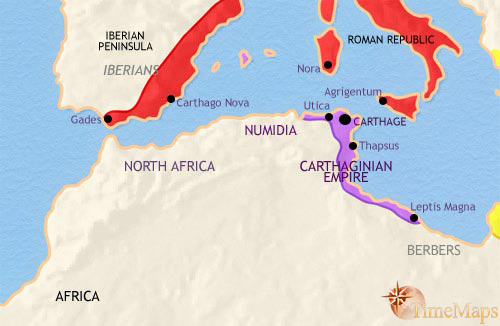 out of the city with a central acropolis on Byrsa hill, surrounded by a plain with an extensive irrigation system, has prompted a number of other authors, including Massimo Pallotino[222] and C. Corbato[223] to suggest that it had been the model for Plato’s description of Atlantis. This idea has now been adopted by Luana Monte(c).
Andis Kaulins has suggested that “ancient Tartessus (which was written in Phoenician as Kart-hadasht) could have been the predecessor city to Carthage on the other side of the Strait of Sicily. Plato reported that Tartessus was at the Pillars of Herakles.”(a) Kaulins places the ‘Pillars’ somewhere between the ‘toe of Italy’ and Tunisia.
Richard Miles has written a well-received history[1540] of Carthage, a task hampered by the fact that the Carthaginian libraries were destroyed or dispersed after the fall of the city, perhaps with the exception of Mago’s agricultural treatise, which was translated into Latin and Greek and widely quoted.
Delisle de Sales placed the Pillars of Heracles in the Gulf of Tunis.
A book-length PhD thesis by Sean Rainey on Carthaginian imperialism and trade is available online(b).
(a) Pillars of Heracles – Alternative Location (archive.org)
(b) https://ir.canterbury.ac.nz/handle/10092/4354
(c) ARTICOLO: Cartagine come Atlantide? (archive.org)
(d) https://gatesofnineveh.wordpress.com/2011/12/13/high-north-carthaginian-exploration-of-ireland/
(f) http://web.archive.org/web/20250615055315/http://phoenicia.org/himilco.html
(h) https://www.academia.edu/2421053/Dating_the_foundation_of_Carthage?email_work_card=view-paper
(i) Atlantis Rising magazine #39 p69 http://pdfarchive.info/index.php?pages/At
(j) The Classical Review. 5 (6): 280–284. June 1891
(k) https://www.academia.edu/5333030/The_Amazingh_Warriors_of_Amazon_and_Carthage
(l) Atlantis in Karthago – Die Lokalisierung des Victor Bérard – Atlantisforschung.de (German)
Amazons
Amazons is the name used by classical writers(k) to identify two matriarchal nations living near the Black Sea and in ancient Libya, but at apparently  different periods. An extensive website on the subject associates the Amazons with three locations: Lake Tritonis(j) , the Greek island of Lemnos(i) and the River Thermodon, now known as Terme Çay, in northern Turkey(h).
Accounts relating to these remote times are understandably vague, but one tale describes the Libyan Amazons as waging war against the Atlanteans, a race who lived in a prosperous country with great cities.
Attention has been drawn to the fact that the Berbers, also known as Amazigh in North-West Africa, have a matriarchal culture. The possibility of an etymological connection between Amazon and Amazigh was suggested by Guy C. Rothery (1863-1940) in his 1910 book, The Amazons[1393] , and recently endorsed by Emmet Sweeney in his Atlantis: The Evidence of Science[700]. In 1912, Florence Mary Bennett published Religious Cults Associated with the Amazons[1548], which has been republished in recent years.
Another matriarchal society in the same region has also been suggested for the Maltese Islands(h).
Sir John Chardin (1643-1713) a French-born traveller and merchant, reported that a tribe of Amazons still existed in the Caucasus in the 17th century(d).
Although the idea may be seen as fanciful, recent archaeological discoveries have provided evidence of female warriors in ancient times in parts of the former Soviet Union. The archaeologist Jeannine Davis-Kimball has written of her investigations[045] into the subject. Peter James offers[046] a solution to the existence of two locations for the Amazons. He believes that the original Black Sea location is correct and that the transference of the story to North Africa was the result of the ‘Libyanising’ intent of Dionysus of Miletus, who was later quoted by Diodorus Siculus in his account(f) of the Amazons and their war with the Atlanteans.
James offers this explanation as part of a larger relocation of mythologies to more westerly locations.
Some years ago the novelist, Lisa Smedman, published a paper, The Amazons of Africa, in which she reviewed all references to the Amazons by ancient writers, such as Diodorus Siculus and Skytobrachion. Unfortunately, this is no longer available on the internet.
A 300-page study of the migratory movements in ancient North Africa by the independent researcher, Al Barone, is to be found on the academia.edu website(n).
Other interesting views of the Amazon mystery can be found on a number of websites(a)(b).
Lewis Spence advanced the imaginative view [259.49] that the Amazons were not women at all, but men whose appearance was considered effeminate by some commentators. A more rational explanation on offer is that the males of some peoples had little facial hair or shaved (such as the Hittites) and were possibly described by their more hirsute enemies as ‘women’.
The popular idea that the Amazons were single-breasted, man-hating warriors has recently been comprehensively debunked by Adrienne Mayor in her latest book, The Amazons[1043] .
Even more eyebrow-raising is the suggestion that Amazon warriors existed in South America based on 16th century reports and modern research(c). Columbus, in a 1493 letter to Luis de Sant’angel, refers to an island named Matininó, which was inhabited only by women(m), armed with bows and arrows. Hernán Cortés also filed a similar report.
The Smithsonian magazine published a useful overview(e) of the history of the Amazon story in the April 2004 edition and in September 2011 revealed the story of the little-known female warriors of Benin (formerly Dahomey) in West Africa, numbered in their thousands, who were active during the 17th, 18th and 19th centuries. The BBC published an article in August 2018 on their history and their modern day descendants(l) .
(a) https://www.maicar.com/GML/AMAZONS.html
(b) https://web.archive.org/web/20190509212918/https://www.amazonation.com/Archaeology.html
(c) https://brazilweirdnews.blogspot.ie/2011/05/amazons-phoenicians-and-atlantis.html
(d) https://archive.org/details/travelsofsirjohn00char/page/n5/mode/2up
(e) (Smithsonian April 23, 2014) https://www.smithsonianmag.com/history/amazon-women-there-any-truth-behind-myth-180950188/?no-ist
(f) https://archive.org/details/lp0048_amazons_vs_at
(g) (Smithsonian Sept 23, 2011) https://www.smithsonianmag.com/history/dahomeys-women-warriors-88286072/?no-ist
(h) https://www.myrine.at/Amazons/mobilIndex.html
(i) https://www.myrine.at/Lemnos/mobilLemnos.html
(j) https://www.myrine.at/Berber/mobilBerber.html
(k) https://www.myrine.at/Amazons/texts_e.html
(l) (BBC Aug 27, 2018) https://www.bbc.com/travel/story/20180826-the-legend-of-benins-fearless-female-warriors
(m) https://tanlistwa.com/2018/02/22/martinica-women-island-iguanas-island-or-flowers-island/
(n) (89) The Amazingh Warriors of Amazon & Carthage (academia.edu)