Latest News
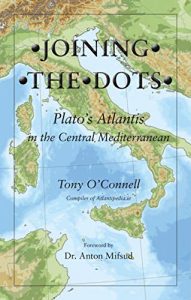
Joining The Dots
I have now published my new book, Joining The Dots, which offers a fresh look at the Atlantis mystery. I have addressed the critical questions of when, where and who, using Plato’s own words, tempered with some critical thinking and a modicum of common sense.Read More »
Homer
Homer (c. 8th cent. BC) is generally accepted as the author of the Iliad and the Odyssey, regarded as the two greatest epic poems of ancient Greece. A recent study of the Greek used by Homer has enabled scientists from the University of Reading to confirm that the language used is compatible with that used in the 8th century BC, in fact dating it to around 762 BC(i).
Nevertheless, there are questions raised regarding the authorship of the ‘Homeric’ epics. For example, Andreas Pääbo is certain that the Odyssey and the Iliad came from two different authors(ar).
Even more extreme was the opinion of the ancient geographer, Eratosthenes, who was a persistent critic of Homer, whom he considered to be a fantasist. Strabo reported what the geographer said in the late 3rd century BC: “You will find the scene of Odysseus’ wanderings when you find the cobbler who sewed up the bag of winds”(av).
Manolis Manoledakis, a professor of Classical Archaeology, in a paper(as) on the Academia website examines “an aspect of the broader issue of the geography of the Odyssey, the primary stimulus being the references of the poem to places that could be associated with the Black Sea, namely the Aeaea and the entrance to the Underworld. As we shall see, while these particular places are indeed relevant to the Black Sea region, they do not belong to the context of a specific journey with specific halts in a specific geographical sequence. The Odyssey is a synthesis of many different episodes, and there is no point in trying to trace a complete geographical course for Odysseus’ voyage.”
It should also be noted that over 130 quotations from the Illiad and Odyssey have been identified in Plato’s writings(s). George Edwin Howes (1865-1942), an American classicist, produced a dissertation[1458]+ on Homeric quotations in Plato and Aristotle.
Almost nothing is known of Homer’s life. He has been variously described as mad, blind and even mythical. Andrew Dalby, the English linguist, has gone so far as to claim[0591] that the author of the two famed epics was a woman! While in 1897 Samuel Butler, the novelist, was even more specific when he proposed that Homer was a Sicilian woman(j).
For centuries it was assumed that the content of these Homeric poems was the product of his imagination, just as the historical reality of Homer himself has been questioned. In 1795, F.A. Wolf, a German academic declared that ‘Homer’ was just a collective name applied to various 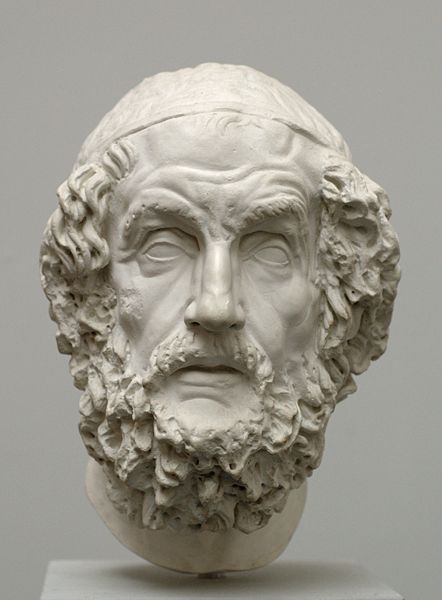 poets whose works were finally combined into their present form in the 6th century BC. Wolf’s ideas sparked furious argument among Greek scholars that still resonates today. Now (2015), historian, Adam Nicholson has claimed that the author ‘Homer’ should not be thought of as a person but instead as a ‘culture’(o).
In a 2021 review of Victor Davis Hanson’s, Who Killed Homer? [1854], Adam Kirsch outlines how “Milman Perry proved that the Iliad and the Odyssey were not written by a lone genius(ah). They were originally not written at all, but through fieldwork in Yugoslavia, Perry (1902-1935) demonstrated how the Homeric epics were the result of traditional bardic storytelling. Wikipedia describes Perry as “an American Classicist whose theories on the origin of Homer’s works have revolutionized Homeric studies to such a fundamental degree that he has been described as the ‘Darwin of Homeric studies’.”
Ed Whelan, an Irish classical scholar, published a brief paper in 2021 which endorsed the Homeric ‘multiple authors’ theory(ap).
An anonymous author offered, “Although there has been a great deal of controversy about the question of whether Homer alone wrote the two famous poems, much of the evidence points towards Homer being the author due to the consistent style of writing. Also, some analysts argue that Homer may have written one of the poems but not the other since both differ greatly in style. In contrast, the reason other analysts state for this difference is that Iliad was written in his youth while Odyssey was created during Homer’s years of age.” (aq).
The identification of the site at Hissarlik in modern Turkey as Troy, by Heinrich Schliemann, led to a complete re-appraisal of Homer’s work and, of course, further controversy. Homer’s Iliad is the story of the Trojan War and it has been suggested that in fact, he had compressed three or more Trojan wars into one narrative. What is not generally known is that there are also ancient non-Homeric accounts of the Trojan War(q).
Kenneth Wood and his wife Florence have built on the research of his mother-in-law, the late Edna Leigh, and produced Homer’s Secret Iliad[391], a book that attempts to prove that the Iliad was written as an aide-memoire for a wide range of astronomical data.
Allied to, but not directly comparable with, is the astronomical information identified in the Bible by the likes of E. W. Maunder (1851-1928)[1137].
Guy Gervis has adopted some of their work and, in a lengthy article, specifies a date of around 2300 BC, for the events described in the Iliad and Odyssey, based on an analysis of this astronomical data(n). Harald A.T. Reiche held similar views which followed some of the ideas expressed in Hamlet’s Mill[0524] by Santillana & Dechend who were colleagues of Reiche at M.I.T. They also claimed that “myths were vehicles for memorising and transmitting certain kinds of astronomical and cosmological information.”
Much has been written about the historicity of Homer’s epic accounts, including a good overview on Wikipedia(ab). Many have concluded that Homer did use real events, even if they were frequently dressed in mythological clothing compatible with the literary conventions of his day. I consider Plato to have treated the story of Atlantis similarly.
A recent study of solar eclipses recorded in Odyssey using data from NASA has confirmed that Odysseus returned to Ithaca on the 25th of October 1207 BC(r).
Scholars have generally supported the idea that Homer’s works have a Mediterranean backdrop with regular attempts to reconcile his geography with modern locations, such as the claim in 2005 by Robert Brittlestone, a British investigator to have located the site of Ithaca, the homeland of Odysseus, on the Greek island of Cephalonia. This popular idea should be put alongside the views of Zlatko Mandzuka who maintains[1396] that all the locations mentioned in the Odyssey can be identified in the Adriatic.
Kazmer Ujvarosy, of San Francisco State University, has noted that there are 22 different places currently on offer as the location of Ithaca(ax).
Nevertheless, there has been a growing body of opinion that insists that this Mediterranean identification is impossible. A range of alternative regions has been proposed(f) as the setting for the epics, which extend from Portugal as far northward as the Baltic.
Wikipedia touched on the even more controversial suggestion that Odysseus had travelled in the Atlantic – “Strabo‘s opinion that Calypso’s island and Scheria were imagined by the poet as being ‘in the Atlantic Ocean’ has had significant influence on modern theorists. Henriette Mertz, a 20th-century author, argued that Circe’s island is Madeira, Calypso’s island one of the Azores, and the intervening travels record a discovery of North America: Scylla and Charybdis are in the Bay of Fundy, Scheria in the Caribbean.” (ay)
The University of Buffalo website offers a number of maps associated with a variety of theories relating to elements found in Homer’s epic poems(az)*.<<
In his Odyssey (VII: 80), Homer wrote about the island of Scheria in the western sea. His description of the island has been compared with Plato’s description of Atlantis and has led to the theory that they refer to the same place. There is little doubt that both the detailed geography and climatic descriptions that are provided by Homer cannot be easily reconciled with that of the Mediterranean. Consequently, the Odyssey has had many interpretations, ranging from Tim Severin’s conclusion[392] that it refers entirely to the Eastern Mediterranean to Iman Wilkens’ book, Where Troy Once Stood[610], which has the voyage include the west coast of Africa, then across to the West Indies and following the Gulf Stream returns to Troy which he locates in Britain.
Location is not a problem exclusive to the writings of Plato. Wilkins’s claims are a reflection of similar ideas expressed by Théophile Cailleux[393] in the 19th century. Gilbert Pillot has also argued for voyages of Ulysses having taken him into the North Atlantic [742]. A Spanish review of Pillot’s book is available(ag). In 1973, Ernst Gideon (? – 1975) wrote in a similar vein in Homerus Zanger der Kelten, reprinted later as Troje Lag in Engelan[1643].
It is worth noting that Bernard Jones in The Discovery of Troy[1638] has recently moved Troy to Britain, probably in the vicinity of Cambridge, a location also preferred by Wilkens! Like many others, he argues that Homer’s Iliad and Odyssey were not set in the Mediterraneanx, as so many of the details that he provides are incompatible with the characteristics of that sea. However, Jones has gone further and claimed that there are details in Virgil’s Aeneid, which are equally inconsistent with the Mediterranean [p.6-10], requiring a new location! Jones’ book has been reviewed on the Hall of Maat website(at) as well as by Jason Colavito(au).
An interesting overview of the various attempts to transfer the Odyssey from the Mediterranean to Northern Europe is available(w). Damien Mackey has also endorsed the idea of a Northern European backdrop to Homer’s Odyssey(aa).
Another researcher who places most of Odysseus’ travels in the eastern Atlantic is Gerard. W.J. Janssen of Leiden University on the academia.edu website(v). In a series of six papers(ai-an), he systematically reviews Homer’s geography, identifying locations referred to by him with places in the Atlantic. He compares his identifications with other commentators including Iman Wilkens and Théophile Cailleux. His website, with an English translation, offers additional information, including the suggestion(ao) that Homer’s Laestrygonians were to be found in Cuba, an interpretation also offered by Cailleux and Wilkens. They also claim that Odysseus’ Caribbean trip included a visit to Saba, a Dutch possession, which is identified as the Aeolian Isle!
The idea of an Atlantic backdrop to the Homeric epics will not go away. The Dutch researcher, N.R. De Graaf(ae). continues to write extensively on his Homeros Explorations website(ad)(x) regarding many of the specifics in Homer’s accounts. He has proposed Lanzarote in the Canaries as the location of Scheria, which concurs with the views of Wilkens and Janssen. Other specifics are that Ithaca was near Cadiz and that Sparta was Cordoba, while the ancient city of Carmona on the plains of Andalucia are, for De Graaf, Mycenae!(af)
E.J. de Meester also argued(ac) for the British Isles as the location of many of Homer’s references. It struck me as quite remarkable that the level of debate regarding the date, source and geographical details of Homer’s works is rather similar to the controversy surrounding Plato’s Atlantis in Timaeus and Critias. The late Edo Nyland was another researcher who had also opted for a Scottish backdrop to the Odyssey and had recently published his views[394].
Felice Vinci also supports[019] a Northern European background to the Iliad and Odyssey. However, in Vinci’s case, Scandinavia, and in particular the Baltic Sea, is identified as the location for the adventures in Homer’s classic. An English language synopsis of his book is available on the Internet. The persuasiveness of Vinci’s argument has recently renewed interest in the idea of a Baltic Atlantis. The assumption is that if Troy could be located in the Baltic, so might Atlantis. Vinci’s views are comparable with those of J. Rendel Harris expressed in a lecture delivered in 1924(p) in which he claims that “we are entitled to take Homer and his Odysseus out of the Mediterranean or the Black Sea, and to allow them excursions into Northern latitudes.”
However, a scathing review of Vinci’s book can be found on the Internet(d) and in issue 216 (2006) of Fortean Times written by Marinus Anthony van der Sluijs.
Further support for a Northern European Troy has come from the historian Edward Furlong, a former naval navigation officer, who has advocated for over twenty years that the journey of Odysseus went as far north as Norway after visting, Ireland and the Scottish Islands. His particular views are outlined on the Internet(c).
Other writers, such as the late Henrietta Mertz [0396/7], have suggested that Homer’s epic refers to a trip to North America. Professor Enrico Mattievich Kucich of Lima University is also certain that the ancient Greeks discovered America America[400]. However revolutionary this idea may seem it shows how this particular subject is growing and would probably justify a reference book of its own.
The idea of an Atlantic backdrop to the Homeric epics will not go away. The Dutch researcher, N.R. De Graaf continues to write extensively on his Homeros Explorations website(x) regarding many of the specifics in Homer’s accounts.
In 1973, James Bailey also proposed in his well-received The God-Kings and the Titans[149] that the Odyssey recorded a trans-Atlantic trip. Evidence exists for large-scale mining in the Americas as early as the 5th millennium BC. Bailey maintained that the Europeans imported enormous quantities of copper and tin from Central and South America to feed the demands of the Old World Bronze Age, an idea that was later heavily promoted by Frank Joseph and in great, if overly speculative, detail by Reinoud de Jong(y).
Michael MacRae in Sun Boat: Odyssey Deciphered [985] goes even further with the suggestion that Odysseus had not only crossed the Atlantic, but, for good measure, the Pacific as well(ba).
Finally, the Atlantis connection with this entry is that if, as now appears to be at least a possibility, Homer’s Odyssey was about a journey to the North Sea, then the possibility of the North Sea setting for the Atlantis story is somewhat reinforced.
A recent book[395] by Steven Sora has developed the Atlantic notion further with the suggestion that not only was Troy located outside the Strait of Gibraltar but that both Homer’s Trojan War and Plato’s Atlantean war are two versions of the same war, with the understandable distortions and embellishments that can occur with a narrative, probably involving some degree of oral transmission and then written down hundreds of years after the events concerned.
Ukraine is soon to be added to the growing list of alternative locations for the setting of Homer’s epics with the publication of Homer, The Immanent Biography, a book by A.I. Zolotukhin(g). He claims that Homer was born in Alibant (Mykolayiv, Ukraine) on September 14, 657 BC(t). He follows the views of Karl Ernst von Baer (1792-1876) who believed that most of Odysseus’s travels took place in the Black Sea rather than the Mediterranean. Additionally, he locates Atlantis in the western Crimean area of Evpatoria(l). His 60-page book is available on his website(m).
An interesting paper(e) by the German historian, Armin Wolf, relates how his research over 40 years unearthed 80 theories on the geography of the Odyssey, of which around 30 were accompanied by maps. One of the earliest maps of the travels of Odysseus was produced by Abraham Ortelius in 1597(u), in which the adventures of Odysseus all take place within the Central and Eastern Mediterranean, arguably reflecting the maritime limits of Greek experience at the time of Homer or his sources! Another website(z) by Jonathan S. Burgess, Professor of Classics at the University of Toronto offers further information on this, including some informative bibliographical material.
In 2009, Wolf published, Homers Reise: Auf den Spuren des Odysseus[669] a German-language book that expands on the subject, also locating all the travels of Odysseus within the Central and Eastern Mediterranean.
Wolf’s ideas were enthusiastically adopted by Wolfgang Geisthövel in Homer’s Mediterranean[1578], who also concurs with the opinion of J.V. Luce [1579], who proposed that Homer was “describing fictional events against authentic backgrounds.” This would be comparable to a James Bond movie, which has an invented storyline set in actual exotic locations around the world.
Perhaps the most radical suggestion has come from the Italian writer, Michele Manher, who has proposed(h) that Homer’s Iliad originated in India, where elements of it can be identified in the Mahabharata!
In August 2015, a fifteen-hour reading of the Iliad was performed in London.
[1458]+ https://archive.org/stream/jstor-310358/310358_djvu.txt
(c) https://www.academia.edu/8167048/WHERE_DID_ODYSSEUS_GO_
(d) https://mythopedia.info/Vinci-review.pdf
(e) https://authorzilla.com/9AbvV/armin-wolf-mapping-homer-39-s-odyssey-research-notebooks.html (link broken)
(f) https://codexceltica.blogspot.com/search?q=atlantis
(g) https://pushkinclub.homerandatlantis.com/english/homer.html
(h) https://www.migration-diffusion.info/article.php?id=100
(i) https://www.insidescience.org/content/geneticists-estimate-publication-date-iliad/946
(j) https://www.sacred-texts.com/cla/aoto/index.htm
(k) https://web.archive.org/web/20180320072706/https://www.nwepexplore.com (see ‘n’)
(l) https://homerandatlantis.com/?lang=en
(m) Wayback Machine (archive.org) *
(n) https://web.archive.org/web/20180320072706/https://www.nwepexplore.com
(o) https://www.newser.com/story/200859/homer-wasnt-a-person-historian.html
(p) https://www.escholar.manchester.ac.uk/api/datastream?publicationPid=uk-ac-man-scw:1m1163&datastreamId=POST-PEER-REVIEW-PUBLISHERS-DOCUMENT.PDF (link broken)
(q) https://luwianstudies.org/the-homeric-epics/
(r) Scientists provide evidence that Homer´s Odyssey is not fiction (archive.org)
(s) https://plato-dialogues.org/tools/char/homerqot.htm
(t) https://homerandatlantis.com/?p=4938&lang=en
(u) https://kottke.org/19/03/mapping-the-odyssey-isnt-easy
(v) https://www.academia.edu/38535990/ATLANTIC_OGUGIA_AND_KALUPSO?email_work_card=view-paper
(w) https://codexceltica.blogspot.com/2009/10/homers-north-atlantic-odyssey.html
(x) http://www.homeros-explorations.nl/
(y) https://www.academia.edu/3894415/COPPER_AND_TIN_FROM_AMERICA_c.2500-1200_BC_
(z) https://wakeofodysseus.com/
(ab) https://en.wikipedia.org/wiki/Historicity_of_the_Homeric_epics#History
(ac) https://web.archive.org/web/20090907222615/https://home-3.tiscali.nl/~meester7/engodyssey.html
(ad) Homeros Explorations – Homer, facts or fiction? (homeros-explorations.nl)
(ae) https://www.homeros-explorations.nl
(af) Mycenae, rich in gold – Homeros Explorations (homeros-explorations.nl)
(ag) Perijóresis: Odisea (perijoresis.blogspot.com) (Spanish)
(ah) https://www.newyorker.com/magazine/2021/06/14/the-classicist-who-killed-homer
(ai) https://www.academia.edu/40668880/ATLANTIC_GEOGRAPHY_IN_HOMER_I
(aj) https://www.academia.edu/40849368/ATLANTIC_GEOGRAPHY_IN_HOMER_II
(ak) https://www.academia.edu/40982169/ATLANTIC_GEOGRAPHY_IN_HOMER_III
(al) https://www.academia.edu/41200642/ATLANTIC_GEOGRAPHY_IN_HOMER_IV
(am) https://www.academia.edu/41474241/ATLANTIC_GEOGRAPHY_IN_HOMER_PART_V
(an) https://www.academia.edu/41625852/ATLANTIC_GEOGRAPHY_IN_HOMER_PART_VI
(ao) LAISTRUGONIACUBA, LA HAVANA (homerusodyssee.nl)
(ap) The Homeric Question – Who WAS Homer? (bibliotecapleyades.net)
(aq) Homer | Biography, Books and Facts (famousauthors.org)
(ar) (26) The Odyssey’s Northern Origins and a Different Author Than Homer | Andres Pääbo – Academia.edu
(at) http://www.hallofmaat.com/migrations/the-discovery-of-troy-and-its-lost-history/
(av) Strabo 1.2.15