Latest News
Joining The Dots
I have now published my new book, Joining The Dots, which offers a fresh look at the Atlantis mystery. I have addressed the critical questions of when, where and who, using Plato’s own words, tempered with some critical thinking and a modicum of common sense.Read More »
Dholavira
Dilmun
Dilmun (Tilmun) is a legendary island paradise referred to in the mythology of Sumeria. Today, Bahrain is generally believed to harbour the location of this mythologically renowned city.
However, in 1983, Daniel Potts published a paper(c) which does not challenge the prevailing identification, but instead suggested that it is necessary “to both broaden and restrict the identification of Dilmun, according to the particular time in history to which one is referring.” He traces the use of the name in Mesopotamian texts as early as 3000 BC. He contends that Dilmun was applied to eastern Arabia by Early Dynastic Sumerians and that later power shifted to Bahrain with the name, Dilmun, which possibly applied to the island as well as part of mainland Arabia. Then around 2000 BC, the use of the appellation appears to have been extended to include the island of Failaka, off Kuwait. Potts suggests that subsequently Failaka may have replaced Bahrain as the centre of Dilmun.
In 1977, George Michanowsky proposed[282] that the Sumerian inscription NI-DUK-KI was the equivalent of the Akkadian ‘Dilmun’ and that it probably referred to Bahrain. He went further and identified Dilmun as Atlantis, which he contended was inundated when sea levels rose as a consequence of global warming caused by a supernova that was noted by the Sumerians 7,000 years ago.
However, in 2001 Radek Brychta published a book[203] that refutes this. Instead, he identifies Dilmun with the Indus civilisation city of Dholavira and proceeds to argue cogently for its acceptance as the original inspiration behind Plato’s Atlantis tale. He contends that the city declined at the end of the 3rd or beginning of the 2nd millennium BC as a result of natural catastrophes in the region. Brychta notes how flooding created swamps that impeded access to Dholavira reminiscent of Plato’s shoals preventing navigation where Atlantis had subsided. Brychta outlines the contacts between the Indus civilisation and Sumeria and between Sumeria and Egypt and proposes this as the route of the story of Dholavira’s demise, which eventually was related to Solon. Brychta’s book was published in the Czech Republic but extensive excerpts are available on the Internet(a) and well worth a viewing.
In 2005 it was reported that a Saudi archaeologist, Nabiel Al Shaikh, drew attention to a temple in the Saar district of Bahrain where he claims a solar observatory still functions after a fashion. It seems that the sun no longer sets where it should and is off by around 10 degrees!(d) Al Shaikh suggested that this deviance might be the result of tectonic movement or ground erosion. Others might infer ‘pole shift’? For me, this is reminiscent of George Dodwell‘s work.
Brychta’s theory is supported by Yashwant Koak, who is due to publish a book on his concept of Atlantis in India. Koak claims that investigations at Dholavira have shown a 92% match with Plato’s description of Atlantis.
The imaginative Zia Abbas also links Dilmun with Atlantis, but places it further east in Indonesia[001.28].
The MalagaBay website has an interesting illustrated article about Dilmun.(b)
(a) http://web.archive.org/web/20210623014052/https://atlantipedia.ie/samples/archive-2905-3/
(b) The Arabian Horizon – The Lost Lands: Dilmun | MalagaBay (archive.org)
(c) https://www.academia.edu/5789959/Potts_1983_-_Dilmun_Where_and_when?email_work_card=view-paper
Brychta, Radek
Radek Brychta is a Czech writer, who has written[203] about the transmission of the Atlantis story from the Indus civilisation city of Dholavira, which he claims was the legendary island of Dilmun recorded by  the Sumerians and from them, transferred to Egypt and eventually related to Solon.
Brychta considers Bab-el-Mandeb to be the location of the Pillars of Herakles.
John Sassoon,[0566] has suggested, based on Genesis 11.2 that the Sumerians had in fact migrated from the east, with the Indus Valley as a possible point of origin. He suggests further that the Sumerians were the progenitors of the Jews. This theory would also offer a line of transmission from the Indus valley to the Nile delta.
He includes a rational explanation for the 9,000-year age of Atlantis, by noting that the Egyptians, as well as the Indus civilisation, counted time in seasons of which there were three annually. Dividing 9,000 by three and adding the probable date of Solon’s Egyptian sojourn, 590 BC, gives us a more credible date of 3590 BC. This idea has also been proposed by Rosario Vieni and Axel Hausmann.
A further possible link between the Atlantis story and the Indus civilisation, is strengthened by such matters as the existence of elephants.
An abbreviated version of Brychta’s book, in seven sections, is now archived here(a). A review of Brychta’s book on the Atlantisforschung website is worth a read(b).
(a) https://web.archive.org/web/20250118101836/https://atlantipedia.ie/samples/archive-2905-3/
Dholavira
Dholavira is a recently discovered city of the Indus Valley civilisation, and is now estimated to be one of the five largest (out of 700) Harappan sites, covering an area of up to 100 hectares. It is known locally as Kotada. Only 10% of the site has been excavated, leaving a promise of further important discoveries still to come.
Its foundation is dated to around 3000 BC and it flourished until approximately 1500 BC(a). 2010 saw the first discovery in Dholavira of an inscription on natural stone in the Indus script. 2011 produced a report(b) that what may be the world’s oldest theatrical stage had been found on the Dholavira site.
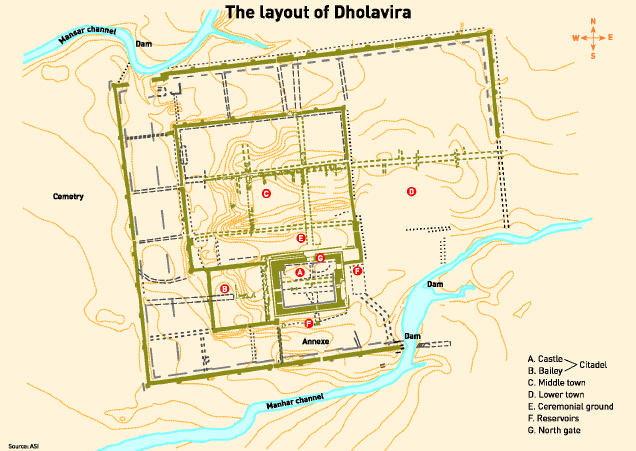 In October 2014 it was reported that a stepwell, dated to 3000 BC, had been discovered at Dholavara that was three times the size of the ‘Great Bath’ at Mohenjo Daro(c).
The city has number of special features outlined on a Pakistani website in 2015. The same posting(f) suggests that “the Indus Valley civilisation. Ideally it should be called Indus-Saraswsati civilisation, but the work to trace the path of saraswati is still in progress.”
At least two writers have claimed Dholavira as the source of Plato’s Atlantis story. Radek Brychta who has already written(d)(e) on the subject of an Atlantean connection and Yashwant Koak who is planning to publish in the near future, although, as of May 2018 nothing further has been heard of this.One claim is that “the archaeological discoveries at the site of Dholavira matches 90% of the description of the Atlantis city.”
Brychta wrote an article on his Atlantean Dholavira for the Atlantisforschung.de website(d)..
(a) https://www.worldatlas.com/articles/dholavira-ancient-wonder-of-gujarat.html
(d) https://atlantisforschung.de/index.php?title=Die_Entdeckung_von_Platons_Atlantis_VII_b (German)
(e) : : : . . . Discovering Plato’s Atlantis . . . : : :
(f) https://defence.pk/threads/dholavira-the-zenith-of-harappan-town-planning.372591/
Also See: Dilmun