Latest News
Joining The Dots
I have now published my new book, Joining The Dots, which offers a fresh look at the Atlantis mystery. I have addressed the critical questions of when, where and who, using Plato’s own words, tempered with some critical thinking and a modicum of common sense.Read More »
Dholavira
Sumerians
Sumeria was one of the earliest civilisations emerging between the 5th and 4th millennia BC and was situated in what is now central Iraq, following earlier Neolithic and Ubaid-period cultures in the region.
It was unknown in Europe until the middle of the 19th century. With the discovery and the decipherment of the Sumerian cuneiform tablets the sophistication of their culture prompted the idea that Sumer had been ‘the cradle of civilisation.’ Subsequent discoveries, such as those in the Indus Valley and more recently, Göbekli Tepe, have now somewhat diluted that idea.
Nevertheless, there is an acceptance that the Sumerians were very advanced in the field of mathematics and astronomy. The late Ernest McClain, a professor of music, was convinced that music theory could be traced back to the Sumerians as early as 3000 BC.
The origin of the Sumerians is still something of a mystery, as is their language, which seems to be an ‘isolate’, unrelated to any known language group(q). The Flem-Aths in an Atlantis Rising article (Issue 95) and Atlantis Beneath the Ice [981.70] claimed a cultural and genetic linkage between the Sumerians and the Haida of northwest America. The Flem-Aths also noted [062.54] that some have linked the languages of the two peoples!
Ronnie Gallagher has suggested that migrants from the Caucasus had provided the impetus that led to the development of the Sumerian civilisation. Gallagher’s theory is supported by Jerald Jack Starr on his Sumerian Shakespeare website, who emphatically attributes a Caucasian origin to the Sumerians(l).
Dr Heather Lynn offers a more plausible account of the origins of the Sumerians, stretching back as far as the Younger Dryas event, 12,800 years ago [2130].
Emilio Spedicato has controversially suggested that the Sumerians came from the Tibetan region!(m) Equally provocative were the views of Catherine Acholonu-Olumba, who as the author of Eden in Sumer on the Niger [1833], claimed that her book, “provides multidisciplinary evidence of the actual geographical location in West Africa of the Garden of Eden, Atlantis and the original homeland of the Sumerian people before their migration to the “Middle East”. By translating hitherto unknown pre-cuneiform inscriptions of the Sumerians, Catherine Acholonu and Sidney Davis have uncovered thousands of years of Africa’s lost pre-history and evidences of the West African origins of the earliest Pharaohs and Kings of Egypt and Sumer such as Menes and Sargon the Great.”(p)
 Sumeria has now been proposed as a possible source of the Atlantis story. Dr Ashok Malhotra, a professor of Engineering, has suggested(a) that ‘the likelihood of the Atlantis stories being of Sumerian origin is strengthened by the fact that the submergence of ancient cities was a strong part of the Sumerian mythology. It dominates their historical tradition. The destruction of the ancient city as a result of sin was also part of their beliefs.’ Malhotra then proposes that these Sumerian stories reflected actual flooding events in the Indus Valley region that were brought first to Sumeria and then were later transferred to Egypt and from thence via Solon to Plato to us.
George Michanowsky went much further and claimed that the Sumerians had known Atlantis under the name of NI-DUK-KI, known today as Dilmun[282.66]. The renowned Henry Rawlinson interpreted this name to mean ‘blessed hill’ or ‘blessed isle’. While Michanowsky’s suggestion is highly speculative, if correct, it would be the earliest known reference to Atlantis.
The Sumerian king list(e) from Larsa records eight kings (some versions note ten) before the Deluge, which may have been reflected, in a distorted fashion, in the ten patriarchs of Genesis and/or the ten kings of Atlantis! Another suggested link is with the eight generations between Adam and Noah recorded in Genesis chapter 5.
John Sassoon would seem to support Malhotra’s thesis in his book[566], which proposes a Sumerian origin for the Jews, with possible earlier links with the Indus Valley. He is not concerned with Atlantis, just the ancestry of the Jewish people, of whom Abraham was born in Sumeria around 2000-1800 BC. Sassoon’s views offer a possible transmission route for Eastern traditions and myths to have reached Egypt and subsequently through Solon to Athens.
More recently, Dr Willem McLoud, a South African researcher, commented that “we have good reason to think that Atlantis was not located beyond the pillars of Heracles in the Atlantic Ocean, as is so often propagated, but that it was actually none other than the ancient land of Sumer itself.” McLoud is primarily concerned with the Sumerians and Akkadians, which he will expand on in a forthcoming book(n).
In 2001, a book by Radek Brychta, was published in the Czech Republic, in which he also advocates a Sumerian connection. He identifies Atlantis with the legendary Dilmun of Sumerian legend and locates it on the Indus civilisation island of Dholavira. Excerpts from this fascinating book are available on the Internet and are worth a read.
However, the most extreme claims came from Zechariah Sitchin, who proposed that the Sumerians had been ‘influenced’ by ancient astronauts from the planet Nibiru, which information is to be found in their cuneiform tablets if Sitchin’s translation is to be believed. Similar daft ideas(g) have been put forward by Hermann Burgard[1316] but so far have only been foisted on a German-reading public.
As if that was not bad enough, we have an October 2016 report that the Iraqi Transport Minister claiming, among other matters, that the Sumerians launched spaceships 7,000 years ago(h)!
The Sumerian texts also crop up in the wild theories of Dieter Bremer[1022] and Jakob Vorberger, who claim that Atlantis was a space station(I)!
Jim Allen, the leading advocate of ‘Atlantis in the Andes’ has also claimed(b) a Sumerian connection with South America, citing Ruth & Alpheus Hyatt Verrill, who include in their book[838.293] three pages of Sumerian words compared with the language of ancient Peru, as well as other cultural aspects there. They also believed that Sargon of Akkad (2334-2279 BC) was known in Peru as the deity Viracocha! Their fanciful idea stems from an account of Sargon sailing to the West and spending three years there! Zhirov supported this claim[458.23] describing it as ”a seemingly semi-fantastic theory”. My reason for considering this claim to be nonsensical is simply that Sargon was continually engaged in expanding his empire and constantly dealing with rebellions in the various city-states he ruled over. The idea that he took three years out to visit America, 14,000 km away, is in no way credible.
Nevertheless, the idea of Sargon in South America persists, with James Bailey repeating it in Sailing to Paradise[0150.66] and more recently by the Afrocentrist, Clyde Winters, in an article on the Ancient Origins website(f) in which he quotes Bailey and the Verrills as supporting Lake Titicaca as the Lake Manu of Sumerian tradition. A further article(j) on the same website begins with the forceful claim that “it is becoming increasingly clear that the Sumerians had established a colony in South America called Kuga-Ki.” The paper is based on a series of questionable artefacts, the Fuente Magna Bowl, the Crespi Collection and the Pokoyia monument!
The Fuente Magna Bowl is frequently offered as evidence of a pre-Columbian link with the Sumerians in America(c), although its provenance is unclear and there are the inevitable suggestions of a hoax. A sceptical view of the ‘Bowl’ by Carl Feagans(k) is available.
Michel Leygues has published two papers in which he offers evidence that the Sumerian and Akkadian languages can be identified in the languages of many of the Native American peoples including the Hopi, Navajo and Incas(s)(t). Leygues also “presents the hypothesis that a kinship exists between Yamato Kotoba ideographic values, and Sumerian and Akkadian values. This despite a great geographical distance between Mesopotamia and Japan, and at different historical periods of language use. “(u)
Other commentators have suggested that the Sumerians reached Spain. Dr Paul Haupt (1858-1926}, an early Assyriologist proposed that the ‘two rivers’ in the story of Utnapishtim, a Noachian equivalent, were the Guadalquivir and Guadiana of Andalusia(r). Mario Mas Fenollar is a modern advocate for Sumerians in Spain.
The very existence of Sumerians has recently been attacked in an appendix to The Three Ages of Atlantis[972] by Marin, Minella & Schievenin. They maintain that the Sumerian ‘language’ “could be an artificial construct created by Akkadian priests” to be used for liturgical purposes. These ideas were first expressed at the end of the 19th century by the respected Orientalist, Joseph Halévy, and Andi Zeneli (d).
Uwe Topper’s son Ilya has also put forward the idea that the Sumerians did not exist(o). His paper is a critique, originally in Spanish, of Gunnar Heinsohn’s Die Sumerer gab es nicht.
(a) In Search of Atlantis — Getting Closer (archive.org) (new link)
(c) https://www.freerepublic.com/focus/f-news/1551445/posts
(d) https://sumeriantestament.blogspot.ie/2012/08/what-is-sumerian.html
(i) Mesopotamische Überlieferungen | Atlantis Mythologie (archive.org)
(k) https://ahotcupofjoe.net/2015/03/sumerians-in-bolivia-probably-not/
(l) https://sumerianshakespeare.com/734501.html
(m) https://www.academia.edu/6556879/AA_MER_MERU_rel_2
(n) Chapter summary – WhisperingTales (archive.org)
(p) https://www.researchgate.net/publication/262069423_Eden_In_Sumer_On_The_Niger
(q) The origin of the Sumerians and the great flood (archive.org)
(r) https://www.jstor.org/stable/pdf/528616.pdf
(t) https://www.calameo.com/read/00653319080c5e11471c2
Koak, Yashwant
Yashwant Koak is a consultant surgeon working in Britain. He is a  proponent of the idea that Dholavira, a recently discovered city of the Indus civilisation, provided the inspiration for the Atlantis story. Koak has offered six papers at the 2008 2nd Atlantis Conference in Athens. His essays cover Vedic mythology, topography, Dwarka and Indus migration to Europe.
Apart from all that he enjoys cricket and playing the didgeridoo, not, I should add, at the same time.
Indus Valley
The Indus Valley civilisation, generally dated to 2600-1900 BC and preceded by the Mehrgarh culture, is also known as the Harappan civilisation. To date, over a thousand settlements and five cities have been identified, but only 10% have been excavated(v).
The origins of the Indus people have long been debated, but a DNA study of four skeletons discovered some years earlier at Rakhigarhi, India, may offer some clues(z)(aa). A Live Science report of September 2019 noted that obtaining usable DNA from the Indus Valley is particularly difficult because the climate rapidly degrades it. Attempts to extract DNA from 61 individuals buried in the Rakhigarhi cemetery succeeded in only one case. Nevertheless, the study concluded that “about two-thirds to three-fourths of the ancestry of all modern South Asians comes from a population group related to that of this Indus Valley individual.” Vagheesh Narasimhan was one of the report’s authors.
In recent years, the Indus region has received several nominations as the source of the Atlantis story. Dr Ashok Malhotra has identified the submergence of the city of Dwarka as the inspiration for the story, which was then brought to Sumeria and later Egypt 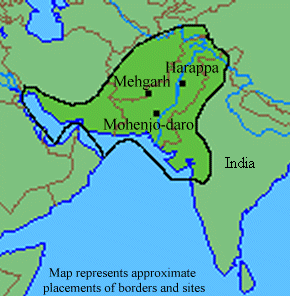 before transmission to Greece.
However, Radek Brychta has opted[203] for the ancient city of Dholavira as a more likely candidate, while independently Yashwant Koak arrived at the same conclusion, although no publication has yet appeared.
A 2014 blogger offered similar ideas with a paper(n) entitled ‘Atlantis was Indus Valley plateau?’ but then proceeds to describe Indonesia as the hyperdiffusionist source for the great civilisations “such as those of the Egyptians, the Greeks, the Cretans and the Mesopotamians. These also included the Jews, the Phoenicians, and the Aryans, driven away from their ancestral lands in Indonesia and Southeast Asia.”
In Thorwald C. Franke’s Newsletter No.119 he draws attention to a review by Professor Heinz-Günther Nesselrath of a new overpriced book by Erika Daniels-Qasim. Although the book is published in German[1580], Nesselrath’s highly critical review is in English(ac), Nesselrath concludes that this is just another useless attempt to link Plato’s Atlantis with the Indus Valley civilisation. Franke describes it as a ‘sad book’.
Although the ‘ancient alien’ idea has nothing to back it up, the claim that a very ancient nuclear war destroyed the Indus civilisation has had some support(ad). However, Jason Colavito has also debunked the story of the ‘radioactive skeleton’ there(ab). A decade ago (2013) Dale Drinnon also published a blog refuting the ancient atomic war claims(aj).
In 2012, the Spanish researcher, José Angel Hernández, proposed that the Tarshish of the Bible was to be found on the coastal region of the Indus Valley, but that Tartessos was a colony of the Indus city of Lothal and had been situated on both sides of the Strait of Gibraltar! He also compared the bull cult of Plato’s Atlantis with that of the Indus civilisation(f)(g).
The central Indus city of Mohenjo-Daro was only rediscovered in 1922(m) and a curious more recent discovery was that 10% of artefacts found there related to play! Clusters of game pieces suggested the use of communal social centres. Unrelated, but perhaps more relevant to our study is the fact that there is a dearth of weaponry, fortifications, or evidence of warfare in the Indus culture(d), which is in sharp contrast to the belligerent Atlantean society described by Plato. More details of the city and the Indus culture can be read on the Italian larazzodeltempo.it website(ag)(ah).
A frequently referred to anomaly at Mohenjo-Daro is evidence of vitrification and radioactivity that some have attributed to atomic warfare or attacks by ancient aliens(af). A more balanced view(k)(l) can be found online. A 2015 article on this subject is also worth a look(o). Jason Colavito has unearthed(ab) the origin of this claim, tracing it back to the 1960s and an unreliable Russian writer, Alexander Gorbovsky, compounded by later distortions by ‘fringe investigators’.
A 2012 conference on Harappan archaeology saw the origins of that culture pushed back to the 7th millennium BC, contemporary with that of Sumer(j). The same conference saw linguistic connections between the two cultures under discussion. However, despite numerous attempts over the past century, the Indus Valley script remains undeciphered(p), although there are regular claims of successful decipherment, 2007(q), 2009(r), 2011(s), 2013(t), with nearly 100 claimed decipherments in all, somewhat reminiscent of the constant flow of Atlantis theories. Now linguists are turning to computer technology to finally solve the problem(x).
A radical theory regarding Mohenjo-Daro has been proposed by an Indian researcher, Jeyakumar Ramasami, in which he claims that the city was a necropolis and not a metropolis. His book on the subject can be downloaded as a free Word file(e). A similar theory was proposed by Hans Georg Wunderlich regarding the Minoan ‘palace’ of Knossos on Crete.
A comprehensive website(a) with many photos and diagrams relating to the Indus Valley civilisation is available. A related article by Patrick Chouinard is also of interest(b).
A recent discovery off the Konkan Coast in the State of Maharashtra in western India has revealed a remarkable structure in waters whose depth has prompted suggestions that it may date from a period of lower sea level some be 8,000 years age(c). A wall 24 km long, 2.7 metres high and 2.5 metres in width was discovered in just three metres of water. Speculation has centred on the possibility of it being evidence of a completely unknown civilisation that could pre-date that of the Indus Valley. A second site, thought to be pre-Harappan, located in Rakhigarhi village in Haryana’s Hisar district, over 200 km from Chandigarh, is now under investigation.
A 2008 article(i) adds further information about the Indus Valley, which includes a reference to the Neolithic site at Mehrgarh, a precursor to the Indus civilisation and dated to 7000 BC, a date that has now been pushed back to 8000 BC according to a paper published(u) in the May 25th, 2016 edition of Nature.
A recent paper(w) has revealed how the Indus people coped with the consequences of climate change when their civilisation was at its height around 2500-1900 BC. Another paper suggests that the demise of the Indus Valley civilisation was the result of climate change caused by changing monsoon patterns. The author, Nishant Malik, assistant professor at the Rochester Institute of Technology’s School of Mathematical Sciences, used mathematical modelling to support his claim(ae).
Until now it was thought that many of the Indus settlements had been dependent on a major Himalayan river, the Ghaggar-Hakra, now dried up. However, recent studies(y) indicate that this river changed course over 8,000 years ago suggesting that “when the Indus people settled the area, there was only an abandoned large river valley occupied by seasonal monsoon river flow instead of a large Himalayan river.” So it seems that, unlike the Egyptian and Mesopotamian civilisations the Indus people did not require a substantial permanent river!
Joanna Gillan published an article giving a potted history of Mohenjo Daro and including a critical review of those, including David Davenport, who have tried to prove that the site was the location of an ancient atomic war. Supporters of this idea have pointed to quotations from the Mahabharata in support of this idea. However, Gillan revealed that “Rather than being entirely fictitious, the passage is composed of a merging together of various unrelated passages scattered throughout the 200,000-verse epic, some of which are also questionable English translations of a questionable French translation of the original Sanskrit. When viewed in their original context, they are a little less convincing”(ak).
Another article on the Ancient Origins website, also by Gillan, in January 2022, reviews the history of Mohenjo Daro and unfortunately highlights that “Although it has survived for five millennia, Mohenjo Daro now faces imminent destruction. While the intense heat of the Indus Valley, monsoon rains, and salt from the underground water table is having damaging effects on the treasured site, it is the visitors that flock in their thousands to the site that are the biggest threat. Adding to the problem is a lack of funding, public indifference, and government neglect. The government even approved a festival being held at the site back in 2014, where tents, lights and stages were hammered into the walls of the delicate ruins.
Mohenjo Daro is already in an incredibly fragile condition. It is estimated that at its current rate of degradation, the World Heritage-listed site could be gone within 20 years(ai).
(b) https://newagearchaeology.weebly.com/the-indus-valley.html
(c) A civilisation as old as Indus valley? (archive.org)
(d) Indus Valley Civilization: The Demise of Utopia (archive.org)
(e) https://archive.org/details/NewInterpretationsOnIndusValleyCivilization
(f) https://joseangelh.wordpress.com/category/mito-y-religion/
(g) https://joseangelh.wordpress.com/category/arqueologia-e-historia/
(i) https://wondersofpakistan.wordpress.com/2009/02/21/mehrgarh-the-lost-civilisation-2/
(j) Archive 2329
(k) Mohenjo Daro – The Thunderbolts Project™ (archive.org) (new link)
(l) http://web.archive.org/web/20210121184629/https://atlantipedia.ie/samples/archive-2329/
(m) https://www.freerepublic.com/focus/chat/2959492/posts
(n) See: Archive 3617
(o) http://web.archive.org/web/20170506192343/https://dailygrail.com/Hidden-History/2015/2/Mohenjo-Daro-Ancient-Nuclear-Mystery
(p) https://www.nature.com/news/ancient-civilization-cracking-the-indus-script-1.18587
(q) https://www.hindunet.org/hvk/articles/0207/56.html (offline Nov. 2016)
(r) https://www.theguardian.com/science/2009/apr/23/indus-civilisation-language-symbols
(s) https://www.boloji.com/articles/10657/a-new-light-on-the-decipherment-of
(t) Decoding the Ancient Script of the Indus Valley | Archaeology Online (link broken)
(z) https://www.quora.com/When-will-Rakhigarhi-excavations-DNA-results-be-published
(ac) https://bmcr.brynmawr.edu/2018/2018.08.23/
(ad) Nuclear War In Ancient Times | War Between Rama Empire and Atlantis? (archive.org)
(ag) Mohenjo-Daro, a Bronze Age metropolis – The Tapestry of Time (larazzodeltempo.it) (link broken)
(ah) The Indus Civilization May Be Prior to Egypt and Mesopotamia – The Tapestry of Time (larazzodeltempo.it) {link broken)
(ai) Mohenjo Daro and The Mounds That Hid a Civilization | Ancient Origins (ancient-origins.net)
(aj) http://web.archive.org/web/20250710070951/https://atlantipedia.ie/samples/archive-2324/
(ak) Was the Mohenjo Daro ‘Massacre’ Real? | Ancient Origins (ancient-origins.net)