Latest News
Joining The Dots
I have now published my new book, Joining The Dots, which offers a fresh look at the Atlantis mystery. I have addressed the critical questions of when, where and who, using Plato’s own words, tempered with some critical thinking and a modicum of common sense.Read More »
Patrick Chouinard
Chouinard, Patrick
Patrick Chouinard is an American writer, former producer of Archaeology TV and editor-in-chief of The New Archaeology Review (NAR)(a) . Chouinard has expressed the view that Atlantis was just a myth reflecting global tales of much earlier civilisations. However, he is happy to allow a range of alternative Atlantis theories to be aired in NAR. The NAR website includes a wide selection of articles dealing with ancient history and also includes free pdf copies of the earliest issues(c) .
Chouinard is also the author(b) of Forgotten Worlds [0864] published in May 2012, in which he reviews several mysteries, including the Deluge, the Mayan Calendar, as well as pre-dynastic Egypt, but once again he ‘sits on the fence’ regarding the location of Atlantis. Robert Schoch has written the Foreword to this book.
Chouinard has also written(d) about the Indus Valley civilisation, referring to it as “the Atlantis of the east?”
He is also the author of Lost Race of the Giants [1424] in which he refers to “Pre-Adamic times that were controlled by a lost group of proto-Aryan giants.” A more condensed version of his idea of Atlantean giants as a race having an ante-diluvian global presence can be found in a chapter of Lost Civilizations [831] edited by Michael Pye & Kirsten Dalley.
In 2019, The Barnes Review, an extreme racist publication, published The Rise of the Aryans [2116] by Chouinard that offered numerous instances of where his sentiments really lie. I offer two short quotes, the first (p.183) describes The Master Plan by Heather Pringle, as “typical work of Jewish-inspired propaganda”. On page 195, he adds, “Himmler continued to investigate Scandinavia even through the onset of the war. Himmler deserves credit for his ambition and motivation, and for giving our people the hope of finding our true past. I intend to continue to update my readers on the works of the Ahnenerbe and the wonderful work they did and the revealing truths and facts they have discovered.” (g)
Chouinard has also used the name Patrick Fox(e)(f).
In 2025, Chouinard continued his commentary on Giants and their connection with Atlantis with the publication of Giants of Atlantis [2115].
(a) https://web.archive.org/web/20071002211906/http://www.newarchaeologyreview.com/
(b) https://www.innertraditions.com/forgotten-worlds.html
(d) http://newagearchaeology.weebly.com/the-indus-valley.html
(e) Interview with historian and author Patrick Fox – Divine Truth Ministries (archive.org)
(g) Rise Of The Aryans : Free Download, Borrow, and Streaming : Internet Archive
Giants
Giants are featured in the mythologies of many cultures globally. However, many of these same cultures also have ‘little people’ in their folklore (a). In Ireland, they were known as leprechauns.
Some commentators have striven to prove that a race of giants, as described in the Bible, such as the Nephilim, actually existed. This idea appeared to gain traction with the discovery of what appeared to be human bones in the 19th and early 20th centuries that suggested above normal stature. This has led to ongoing controversy. A study of the biblical Goliath and his family is relevant here(j).
There is a rare genetic form of giantism known as acromegaly. The BBC published an interesting article on the genetic mutation that causes the condition being more common in Mid Ulster in Northern Ireland than anywhere else in the British Isles(h). A scientific study confirmed this localised prevalence(i).
Wikipedia has noted that the giants’ bones were either the result of “hoaxes, scams, fabrications or the misidentifications of extinct megafauna”(b). It also notes that as early as 1934, the idea of giants was debunked by Aleš Hrdlicka, curator of anthropology at the Smithsonian Institution(l). The Smithsonian has since been accused of a cover-up by creationists and conspiracy theorists. However, that institution has been ably defended by more rational researchers, such as Jason Colavito (c)(d)(e). He returned to the subject again in August 2025(k), when it was reported that US congressman Eric Burlinson, a creationist and UFO believer, suggested that there should be an investigation into the claim that the Smithsonian is hiding the bones of biblical giants!
A more recent development has been the linking of giants with Atlantis. I suspect that in some instances Atlantis was added to the book titles simply to enhance their salebility! The best known and probably the earliest extensive study came from Denis Saurat in the 1950s [536][537]. Since then many, such as Tony Finlay(f), have touched on the subject. Richard Cassaro has advocated that megalithic structures in Italy had been built by giants from Atlantis(g). In the 2020s the related book titles became more blatant – Giants of Atlantis[2115] (Patrick Chouinard, 2025), Giants and Atlantis[2114] (Laurent Glauzy, 2015). However. hard, irrefutable evidence is still lacking.
(a) Little people (mythology) – Wikipedia
(b) Giant human skeletons – Wikipedia
(c) http://www.jasoncolavito.com/1/post/2013/05/the-human-tendency-to-attribute-greatness-to-giants.html
(f) https://www.tonyfinlay.co.uk/
(g) Hidden Italy: The Forbidden Cyclopean Ruins (Of Giants From Atlantis?) – Richard Cassaro
(h) (BBC June 8, 2022) https://www.bbc.co.uk/news/uk-northern-ireland-61726811
(j) Hereditary Gigantism-the biblical giant Goliath and his brothers – PMC (nih.gov)
(l) The Oshkosh Northwestern. 3 March 1934.
Indus Valley
The Indus Valley civilisation is dated to 2600-1900 BC (preceded by the Mehrgarh People) is now referred to as the Harappan civilisation. To date, over a thousand settlements and five cities have been identified, but only 10% have been excavated(v).
The origins of the Indus people has been debated for some time, but a DNA study of four skeletons discovered, some years ago, at Rakhigarhi, in India, may offer some clues. However, three years later (2017) the results have still not been made public(z)(aa)! A September 2019 report in Live Science highlighted the fact that gathering usable DNA from the Indus Valley is extremely difficult as the climate there degrades it rapidly. Attempts to extract DNA from 61 individuals in the cemetery in Rakhigarhi were successful in only one instance. Unfortunately, only limited information was gleaned from this study, namely that “about two-thirds to three-fourths of the ancestry of all modern South Asians come from a population group related to that of this Indus Valley individual.” according to Vagheesh Narasimhan, one of the authors of the report.
In recent years, the Indus region has received several nominations as the source of the Atlantis story. Dr Ashok Malhotra has identified the submergence of the city of Dwarka as the inspiration for the story, which was then brought to Sumeria and later Egypt 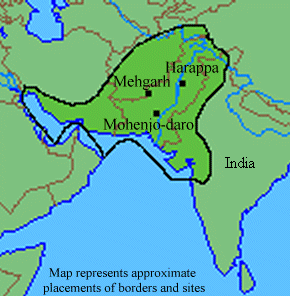 before transmission to Greece.
However, Radek Brychta has opted[203] for the ancient city of Dholavira as a more likely candidate, while independently Yashwant Koak arrived at the same conclusion and intends to publish soon.
A 2014 blogger offered similar ideas with a paper(n) entitled ‘Atlantis was Indus Valley plateau?’ but then proceeds to describe Indonesia as the hyperdiffusionist source for the great civilisations “such as those of the Egyptians, the Greeks, the Cretans and the Mesopotamians. These also included the Jews, the Phoenicians, and the Aryans, driven away from their ancestral lands in Indonesia and Southeast Asia.”
In Thorwald C. Franke’s Newsletter No.119 he draws attention to a review by Professor Heinz-Günther Nesselrath of a new over-priced book by Erika Daniels-Qasim. Although the book is published in German[1580], Nesselrath’s highly critical review is in English(ac), Nesselrath reveals that this is just another useless attempt to link Plato’s Atlantis with the Indus Valley civilisation. Franke describes it as a ‘sad book’.
Although the ‘ancient alien’ idea has nothing to back it up, the claim that a very ancient nuclear war destroyed the Indus civilisation has had some support(ad). However, Jason Colavito has also debunked the story of the ‘radioactive skeleton’ there(ab). A decade ago (2013) Dale Drinnon also published a blog refuting the ancient atomic war claims(aj).
In 2012, the Spanish researcher, José Angel Hernández, proposed that the Tarshish of the Bible was to be found on the coastal region of the Indus Valley, but that Tartessos was a colony of the Indus city of Lhotal and had been situated on both sides of the Strait of Gibraltar! He also compared the bull cult of Plato’s Atlantis with that of the Indus civilisation(f)(g).
The central Indus city of Mohenjo-Daro was only rediscovered in 1922(m) and a curious more recent discovery there, was that 10% of artefacts found there related to play! Clusters of game pieces suggested the use of communal social centres. Unrelated, but perhaps more relevant to our study is the fact that there is a dearth of weaponry fortifications or evidence of warfare in the Indus culture(d), which is in sharp contrast to the belligerent Atlantean society described by Plato. More details of the city and the Indus culture can be read on the Italian larazzodeltempo.it website(ag)(ah).
A frequently referred to anomaly at Mohenjo-Daro is evidence of vitrification and radioactivity that some have attributed to atomic warfare or attacks by ancient aliens(af). A more balanced view(k)(l) can be found online. A 2015 article on this subject is also worth a look(o). Jason Colavito has unearthed(ab) the origin of this claim, tracing it back to the 1960s and an unreliable Russian writer, Alexander Gorbovsky, compounded by later distortions by ‘fringe investigators.
A 2012 conference on Harappan archaeology saw the origins of that culture pushed back to the 7th millennium BC, contemporary with that of Sumer(j). The same conference saw linguistic connections between the two cultures under discussion. However, despite numerous attempts over the past century the Indus Valley script remains undeciphered(p), although there are regular claims of successful decipherment, 2007(q), 2009(r), 2011(s), 2013(t), to date totalling nearly 100, somewhat reminiscent of the constant flow of Atlantis theories. Now linguists are turning to computer technology to finally solve the problem(x).
A radical theory regarding Mohenjo-Daro has been proposed by an Indian researcher, Jeyakumar Ramasami, in which he claims that the city was a necropolis and not a metropolis. His book on the subject can be downloaded as a free Word file(e). A similar theory was proposed by Hans Georg Wunderlich regarding the Minoan ‘palace’ of Knossos on Crete.
A comprehensive website(a) with many photos and diagrams relating to the Indus Valley civilisation is available. A related article by Patrick Chouinard is also of interest(b).
A recent discovery off the Konkan Coast in the State of Maharashtra in western India has revealed a remarkable structure that is based on sea-level changes that may be 8,000 years old(c). A wall 24 km long, 2.7 metres high and 2.5 metres in width was discovered in just three metres of water. Speculation has centred on the possibility of it being evidence of a completely unknown civilisation that could pre-date that of the Indus Valley. A second site, thought to be pre-Harappan, located in Rakhigarhi village in Haryana’s Hisar district, over 200 km from Chandigarh, is now under investigation.
A 2008 article(i) adds further information about the Indus Valley, which includes a reference to the Neolithic site at Mehrgarh a precursor to the Indus civilisation and dated to 7000 BC, a date that has now been pushed back to 8000 BC according to a paper published(u) in the May 25th, 2016 edition of Nature.
A recent paper(w) has revealed how the Indus people coped with the consequences of climate change when their civilisation was at its height around 2500-1900 BC. Another paper suggests that the demise of the Indus Valley civilisation was the result of climate change caused by changing monsoon patterns. The author, Nishant Malik, assistant professor at the Rochester Institute of Technology’s School of Mathematical Sciences, used mathematical modelling to support his claim(ae).
Until now it was thought that many of the Indus settlements had been dependent on a major Himalayan river, the Ghaggar-Hakra, now dried up. However, recent studies(y) indicate that this river changed course over 8,000 years ago suggesting that “when the Indus people settled the area, there was only an abandoned large river valley occupied by seasonal monsoon river flow instead of a large Himalayan river.” So it seems that, unlike the Egyptian and Mesopotamian civilisations the Indus people did not require a substantial permanent river!
Joanna Gillan published an article giving a potted history of Mohenjo Daro and including a critical review of those, including David Davenport, who have tried to prove that the site was the location of an ancient atomic war. Supporters of this idea have pointed to quotations from the Mahabharata in support of this idea. However, Gillan revealed that “Rather than being entirely fictitious, the passage is composed of a merging together of various unrelated passages scattered throughout the 200,000-verse epic, some of which are also questionable English translations of a questionable French translation of the original Sanskrit. When viewed in their original context, they are a little less convincing”(ak).
Another article on the Ancient Origins website, also by Gillan, in January 2022 reviews the history of Mohenjo Daro and unfortunately highlights that “Although it has survived for five millennia, Mohenjo Daro now faces imminent destruction. While the intense heat of the Indus Valley, monsoon rains, and salt from the underground water table is having damaging effects on the treasured site, it is the visitors that flock in their thousands to the site that are the biggest threat. Adding to the problem is a lack of funding, public indifference, and government neglect. The government even approved a festival being held at the site back in 2014, where tents, lights and stages were hammered into the walls of the delicate ruins.
Mohenjo Daro is already in an incredibly fragile condition. It is estimated that at its current rate of degradation, the World Heritage-listed site could be gone within 20 years(ai).
(b) https://newagearchaeology.weebly.com/the-indus-valley.html
(c) A civilisation as old as Indus valley? (archive.org)
(d) Indus Valley Civilization: The Demise of Utopia (archive.org)
(e) https://archive.org/details/NewInterpretationsOnIndusValleyCivilization
(f) https://joseangelh.wordpress.com/category/mito-y-religion/
(g) https://joseangelh.wordpress.com/category/arqueologia-e-historia/
(i) https://wondersofpakistan.wordpress.com/2009/02/21/mehrgarh-the-lost-civilisation-2/
(j) Archive 2329
(k) Mohenjo Daro – The Thunderbolts Project™ (archive.org) (new link)
(l) http://web.archive.org/web/20210121184629/https://atlantipedia.ie/samples/archive-2329/
(m) https://www.freerepublic.com/focus/chat/2959492/posts
(n) See: Archive 3617
(o) https://dailygrail.com/Hidden-History/2015/2/Mohenjo-Daro-Ancient-Nuclear-Mystery
(p) https://www.nature.com/news/ancient-civilization-cracking-the-indus-script-1.18587
(q) https://www.hindunet.org/hvk/articles/0207/56.html (offline Nov. 2016)
(r) https://www.theguardian.com/science/2009/apr/23/indus-civilisation-language-symbols
(s) https://www.boloji.com/articles/10657/a-new-light-on-the-decipherment-of
(t) Decoding the Ancient Script of the Indus Valley | Archaeology Online (link broken)
(z) https://www.quora.com/When-will-Rakhigarhi-excavations-DNA-results-be-published
(ac) https://bmcr.brynmawr.edu/2018/2018.08.23/
(ad) Nuclear War In Ancient Times | War Between Rama Empire and Atlantis? (archive.org)
(ag) Mohenjo-Daro, a Bronze Age metropolis – The Tapestry of Time (larazzodeltempo.it)
(ai) Mohenjo Daro and The Mounds That Hid a Civilization | Ancient Origins (ancient-origins.net)
(aj) http://web.archive.org/web/20250710070951/https://atlantipedia.ie/samples/archive-2324/
(ak) Was the Mohenjo Daro ‘Massacre’ Real? | Ancient Origins (ancient-origins.net)