Latest News

NEWS September 2023
September 2023. Hi Atlantipedes, At present I am in Sardinia for a short visit. Later we move to Sicily and Malta. The trip is purely vacational. Unfortunately, I am writing this in a dreadful apartment, sitting on a bed, with access to just one useable socket and a small Notebook. Consequently, I possibly will not […]Read More »
Joining The Dots
I have now published my new book, Joining The Dots, which offers a fresh look at the Atlantis mystery. I have addressed the critical questions of when, where and who, using Plato’s own words, tempered with some critical thinking and a modicum of common sense.Read More »
Aegean Sea
The Aegean Sea is located in the eastern Mediterranean, bounded by the Greek mainland in the north and west, Turkey in the east and extending to Crete in the south. In 1899, R.F. Scharff claimed that it was commonly accepted that the Aegean had been dry land until after the appearance of man(c). Zhirov wrote of this landmass being referred to as ‘Aegeida’ before it subsided to form the Aegean Sea [0458.96], but he doubted that it occurred before ‘thinking man’ arrived there.
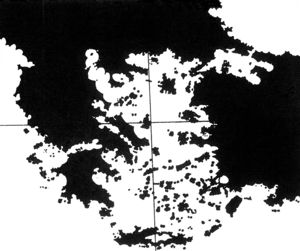 The 15th-century map of Ibn Ben Zara appears to show the islands of Aegean as larger and more numerous than today!
The importance of the Aegean to the ancient Greeks is highlighted by Plato when he described their relationship as one where the Greeks “are like frogs around a pond.” (Phaedo 109a-b)
However, it has been noted(i) that the Homeric poems (and the works attributed to Hesiod) studiously avoid any reference to the Aegean Sea, an avoidance that appears all the more striking when juxtaposed with the fact that there are other named seas in the poems.
A 280-page overview of the Aegean civilisations from the Neolithic to the Hellenistic period(f) is worth a look.
It can be reasonably argued that initially, the Greeks had little knowledge of the world beyond the Aegean, which might explain why Plato did not seem to know the exact identity of the Atlanteans. In this regard, a quote from an AtlantisOnline forum seems relevant – “There is evidence, moreover, that the Greeks were restricted by the Phoenicians to the Aegean Sea for a period of many centuries from 1200 BC onwards, and Naval Historians attribute this to the availability exclusively to the Phoenicians of two elements in ship construction, namely long straight cedar timbers (compared to short sinuous olive timbers available to the Greeks) and Bronze for fixings, claddings and battering rams, which were used in battle to perforate hulls, sinking the enemy.”(e)
Many researchers have suggested the Aegean as a possible location for Atlantis with Thera and Crete as the leading contenders. In fact, it is Thera, with its dramatic volcanic eruption, in the middle of the second millennium BC that still  manages to command considerable support after nearly one hundred years since it was first mooted. Its advocates view it as the most likely source of inspiration for Plato’s tale, in spite of the fact that it conflicts with many of the details described by him.
One regular blogger, ‘mapmistress’, proposed (2010) that the Pillars of Heracles were situated at Rhodes with Atlantis situated north of the island in the Aegean. This suggestion is based on the claim that all English translations of Timaeus 24e are ‘botched’ and that the original does not say “larger than Libya and Asia together” but instead should read “north of Libya and west of Asia”! In fact, she goes further with the claim that the very word ‘Atlantis’ was invented by Benjamin Jowett!(d)
Three Italian linguists, Facchetti, Negri, and Notti, presented a paper to the Atlantis conference on Melos outlining their reasons for supporting an Aegean backdrop to the Atlantis story. Another paper was presented by four members of the Hellenic Centre for Marine Research which demonstrates how three-quarters of the Cyclades Plateau was submerged between 16000 BC and 6000 BC as the sea levels rose after the last Ice Age. Kurt Lambeck and Anthony Purcell also presented a paper along similar lines.
>However, not everyone is happy with Atlantis being placed in the Aegean. About 20 years ago an anonymous contributor to the now-defunct geocities website wrote the following piece regarding the matching of Atlantis with the eruption of Thera(o).
“To arrive at this conclusion is simple enough – take the numbers Plato uses for the dimensions and antiquity of Atlantis, divide them by ten, then keep all the fabulous details about the architecture and pretend it applies to the structures and artifacts recovered by archaeology – then throw out all the details about its conquering armies, its location, and its complete disappearance. No wonder there’s such an exact match!”<
Paulino Zamarro has offered a very radical theory, outlined in his book [024], which claims that Atlantis was located in the Aegean, with its capital on Melos, at a time when sea levels were lower and the islands more extensive in area, with some of them joined together. He postulates an isthmus or land bridge between Gibraltar and Morocco, which he believes was breached around 5500 BC. An idea supported by Strato and Seneca. He contends that this breach not only flooded the Aegean but also was also responsible for the subsequent inundation of the Black Sea, which until then was a smaller freshwater lake.
Diamantis Pastras, a Greek-Australian confectioner presented to the Atlantis Conference in 2005 [0629.295] his theory that Atlantis had been situated in the Aegean Cyclades along with nearby Astipalea in the Dodecanese, which he maintains constituted a single larger landmass 3,500 years ago.
Recent studies have revealed(b) the extent of very early seafaring in the Aegean can be pushed back to around 10,000 BC with evidence of obsidian trading at that period. However, the lower sea level at that time would have meant that the Aegean islands would have been much larger with shorter distances, if any, between them, so it may be unwise to read too much into the obsidian evidence.
A 2018 article pushes back Mediterranean seagoing even further(h). Consider how this evidence may relate to Plato’s comment that when Atlantis was established “at that time neither ships nor sailing were as yet in existence” (Crit.113e). However, December 2022 brought a claim of even earlier seafaring in the Aegean, possibly as far back as 450,000 years ago, according to a team from the University of Patras in Greece led by George Ferentinos(n).
In 1998 William Ryan and Walter Pitman published[025] their evidence for the enlargement of the Black Sea with seawater. The book received widespread attention that led to a subsequent expedition to the area by Robert Ballard, the famous discoverer of the Titanic.
However, Zamarro’s ideas have received very little notice, probably because he has only been published in Spanish. His theory regarding the silting and closure of the mouth of the Mediterranean deserves further consideration, as its confirmation would have a profound effect on the course of future studies of the prehistory of the region and in particular Atlantology.
C.C.M. Hardy was a regular contributor to Sykes‘ Atlantis journal, in which he suggested that remnants of Atlantis would be found in the seas around Greece. Hans-Henning Klein favours the island of Samothrace in the northern Aegean as the home of Atlantis(l).
A half-hearted attempt to link the Greek island of Thasos with Atlantis is to be found on the German de.pluspedia.org website(j).
A recent recruit to the ‘Atlantis in the Aegean’ camp is Christos A, Djonis with his theory[935] that Atlantis lay in the Aegean Sea, to the north of Thera, which itself contained the capital city of the Atlantean confederation. He makes no reference to Zamarro, who proposed a similar location fifteen years ago and consequently, considers Djonis’ work as a form of plagiarism! Apart from that, my gripe is that Djonis wastes over half his book discussing UFOs and ancient astronauts. Another proponent of a Theran Atlantis is Elias Stergakos, who also published his short book[1035] on the Minoan Hypothesis in 2014.
In the same year, the Italian architect Costa Kyrki published a paper entitled Lost Atlantis in which he proposed that the sunken Atlantis was situated between the island of Samos and Miletus on mainland Turkey(k).
J.P. Rambling on his Redefining Atlantis website(g) has now added his support to the concept of an Aegean Atlantis, situated on a large landmass, now mostly submerged, and which included what is now Santorini.
It is worth noting that Jürgen Spanuth In defending his North Sea location for Atlantis scornfully denounced the possibility of an Aegean Atlantis in Atlantis of the North [015.247]. “Neither Thera nor Crete lie in the ‘Atlantic sea’ but in the sea of Crete, which is clearly referred to in Crit.111a and is obviously not the Atlantic sea of Tim.24. Neither island lies at the mouth of a great river; neither was ‘swallowed up by the sea and vanished’ (Tim.25d): the Aegean never became ‘impassable to navigation’ (ibid.) Solon and Plato could never have said of the Aegean that passage there was hindered by ‘impenetrable mud’ (Crit.108e) for both had sailed through it – their contemporaries would have laughed at them if they had made such an absurd assertion.” Spanuth failed to highlight that Plato referred to the shoal of mud in the present tense indicating that it was still a hazard in his day!
What I cannot understand is that if Atlantis had existed in the Aegean, why did Plato not simply say so?
The Atlantisforschung website offers a selection of articles dealing with many aspects of the Aegean and its possible connection with Atlantis(m).
(a) https://atlantipedia.ie/samples/document-250811/
(b)https://www.stonepages.com/news/archives/004698.html
(c) https://www.gutenberg.org/files/33236/33236-h/33236-h.htm#Page_61
(d) https://pseudoastro.wordpress.com/2009/02/01/planet-x-and-2012-the-pole-shift-geographic-spin-axis-explained-and-debunked/ (about half way down page)
(e) https://atlantisonline.smfforfree2.com/index.php?topic=3238.1260
(f) https://www.slideshare.net/darkyla/greeks-9775861
(g) https://redefiningatlantis.blogspot.ie/
(h) https://www.sciencemag.org/news/2018/04/neandertals-stone-age-people-may-have-voyaged-mediterranean
(j) Atlantis Verortung in der Ägäis (Thasos) – PlusPedia
(k) https://www.behance.net/gallery/17045455/LOST-ATLANTIS
(l) ATLANTIS ERAT ! – Es gab ATLANTIS! – Samothrake ist Atlantis – Atlantisforschung.de
(n) Ancient Humans May Have Sailed The Mediterranean 450,000 Years Ago : ScienceAlert
(o) Sunken Civilizations — www.geocities.com/sunkenciv/index.html (archive.org) *