Latest News
Joining The Dots
I have now published my new book, Joining The Dots, which offers a fresh look at the Atlantis mystery. I have addressed the critical questions of when, where and who, using Plato’s own words, tempered with some critical thinking and a modicum of common sense.Read More »
Hunza Valley
Spedicato, Emilio
Emilio Spedicato (1945- ) was born in Milan. He graduated in physics and is now working in numerical analysis and applied mathematics. He has held a full professorship at Bergamo University since 1984. In addition to his more conventional academic  pursuits, he also researches ‘non-standard models of planetary evolution and non-standard interpretation of myth and ancient religions.’
Spedicato has developed a list(a) of ‘54 theses for reconstructing Earth and human history during the catastrophic period 9500 to 700 BC’(l). This list is partly based on the work of Velikovsky, DeGrazia and Ackerman and is intended to be the basis of a larger work in book form. Some of his ideas will be seen as highly controversial, such as the genetic manipulation of humans by extraterrestrial visitors. He locates the Garden of Eden and the ‘creation’ of Adam and Eve in the Hunza valley of modern Pakistan(e).
He ventured into further controversial territory with his support for an updated version of Hörbiger’s moon capture theory(f) and endorsement for pole shifts(g)(0) after long periods of stability following encounters with large extraterrestrial bodies. He considers the last of these to have taken place in the 10th millennium BC.
Spedicato, in a series of papers delivered to the Atlantis Conference on Melos in 2005, linked the biblical Exodus with the Flood of Deucalion, which he dates as 1447 BC(d). He contended that these events were connected with the explosion of a large extraterrestrial body over Southern Denmark, remembered in Greek tradition as Phaëton. He also claims that a large object impacted or exploded over the Great Lakes ice cover around 10.900 BC(k).
Atlantis has not escaped Spedicato’s attention and he has put forward the Caribbean island of Hispaniola as the home of Atlantis(b), specifically suggesting that Lake Enriquillo in the Cul-de-Sac Depression, which runs from Haiti across the border into the Dominican Republic. Spedicato accepts the possibility of the destruction of Atlantis around 9600 BC and has written an interesting paper(c) linking the demise of Atlantis with a direct asteroidal impact, or a close encounter with a planet-sized body. Not without significance, is the fact that Hispaniola is not submerged, in spite of the sea level rising hundreds of feet, since the very early date proposed by Spedicato for the destruction of Atlantis, which should have sent it even deeper beneath the waves of the Caribbean.
In his paper entitled, Was Atlantis in Hispaniola? Arguments in Favour(n) he outlines his belief that “the Atlantis civilisation developed during the terminal phase of the last great glaciation. It was terminated by a catastrophe, of extraterrestrial origin, which led to the now confirmed fast melting of most ices covering North America (north of a line from Seattle to Washington) and northern Europe; this event is now rather precisely dated at circa 9500 BC.” He also considers Plato’s ‘muddy shoals’ to be a reference to the Sargasso Sea.
Furthermore, leaving aside the question of submergence altogether, Spedicato does not explain how an Atlantis in the Caribbean could, in 9600 BC, have attacked Greece or Egypt, which did not exist as structured societies at that time.
Even more intriguing is why they would plan such a venture, considering a distance of 10,000 kilometres lay between them.
Spedicato has contributed at least a dozen papers to the Migration and Diffusion website, including one on a possible Indian inspiration behind the Giza pyramid complex(h) as well as a paper(i) on the planet known to the Sumerians as Nibiru and today sometimes referred to as Planet X. He controversially claims that a close encounter with Nibiru, around 9500 BC, ended the last Ice Age and brought about the demise of Atlantis! A difficulty with that idea is that if the encounter with Nibiru destroyed Atlantis AND ended the Ice Age how could the location where Atlantis was submerged still be marked by mud shoals 9,000 years later when sea levels had risen by 300-400 feet, as confirmed by Plato in Timeaus 25d?
Another radical idea put forward by Spedicato, was expressed in a paper delivered to the 2005 Atlantis Conference [629.411], in which he claimed, what he called ‘the ancestors of the Greeks’ had visited Canada. Based on his interpretation of excerpts from the writings of Plutarch, he specifies a region at the mouth of the St. Lawrence River as the point of contact. Manolis Koutlis goes further, suggesting that the Greeks had colonies there from 1500 BC until 1500 AD. Then, in his book In the Shadow [1617] he adds the even more extraordinary claim that Atlantis had been situated on an island at the entrance to the St. Lawrence!
In 2010, Spedicato published Atlantide e L’Esodo (Atlantis and Exodus) which is currently being translated into English.
In February 2015, Spedicato published another paper(j) with the radical proposal that the alignment of the three main Giza pyramids was not intended to reflect the three stars in Orion’s belt according to the Orion Correlation Theory (OCT), as proposed by Gilbert & Bauval[326], but instead, were more closely matched to the arrangement of three volcanoes on Mars! He claims that these volcanoes were visible from Earth during Mars periodic close encounters with our planet, between 7000 BC and 700 BC, during a 54-year cycle. However, Andrew Collins has also disputed the OCT and has instead offered evidence that the alignment of the three principal Giza pyramids matches more closely the ‘wing’ stars of the Cygnus constellation, than the ‘belt’ of Orion! (m).
Later in 2015, the prolific Spedicato published another paper(k) in which he linked Mayan catastrophes with those of Hesiod, Plato and the Bible.
In late 2023, Spedicato, with assistance from Stuart Harris, published a two-part article(p)(q) concerning the location, dimensions and date of the Tower of Babel. Part One focuses on a possible connection between the dimensions of the Great Pyramid of Giza with that of the Tower of Babel. With regard to the confusion of language associated with the Tower, Spedicato speculates that “construction works were stopped after a sudden strong magnetic field, due possibly to a close passage by Mercury, damaged the brain areas associated to the aquirement of new languages.“
A 2026 paper by Spedicato briefly touches on a number of controversial subjects including, the Garden of Eden, the Deluge, Babel and Ophir. He has frequently commented on them over recent years and now intends to consolidate his theories relating to them into a single volume(r).
(a) http://www.cartesio-episteme.net/ep8/ep8-spedic.htm
(b) https://www.academia.edu/10973532/ATLANTIS_IN_HISPANIOLA
(c) Wayback Machine (archive.org)
(d) https://www.2008-paris-conference.org/mapage13/deucalione-testo-inglese-1-.pdf
(f) https://aisberg.unibg.it/bitstream/10446/316/1/WPMateRi05(2008)SpedicatoPetruzzi.pdf
(g) https://www.unibg.it/dati/bacheca/63/21825.pdf
(h) https://www.migration-diffusion.info/article.php?id=353
(i) https://www.migration-diffusion.info/article.php?id=351
(j) https://www.migration-diffusion.info/article.php?year=2015&id=453
(m) (99+) (PDF) Orion: The Eternal Rise of the Sky Hunter | Andrew Collins – Academia.edu
(o) Wayback Machine (archive.org)
(r) file:///C:/Users/Tony/Downloads/Spedicato%20%2030-5-26%20(1).pdf
Garden of Eden
The Garden of Eden, like Atlantis, has excited the imagination of many over the centuries. Its location has been the subject of what was sometimes wild speculation that offered a range of locations, compared with the variety of sites proposed for Atlantis.
The traditional belief was that the ‘Garden’ had been situated in Mesopotamia between the Euphrates and Tigris as noted in the Bible. Athanasius Kircher, who is better known to many for his speculative map of Atlantis located in the Atlantic Ocean, also produced a plan of the Garden of Eden, in what is now southern Iraq. David J. Gibson (1904-1966) arrived at a similar conclusion placing ‘Eden’ just south of Baghdad in his book, The Land of Eden Located, now available online(t).
The T&T Clark Encyclopedia of Second Temple Judaism offers a clue to the sort of difficulties that ‘Garden seekers’ must deal with, in the Garden of Eden entry. “as an earthly garden, its specific location within both the Hebrew Bible and Second Temple literature. Thus, some texts place it in the east (Gen 2:8; 1En.32; Jub 8:16; 2 En. [rec.32] 42:3, 65:10; Philo QG 1:7; Leg 1:56; Josephus, Ant. 1.3), while others place it in the west (Gen 3:24; Josephus, JW 2.155), north (Ezek 28:13; 1En. 61.1), or northwest (1 En.24-25, 70:3).”(ap)
More recently, Robert McRoberts, in an article about the rivers of Eden, included a map by Arianna Ravenswood, who placed Eden northwest of Babylon, in what is now the Iraqi Province of Diyala(u).
Within the same region is a submerged location at the head of the Persian Gulf promoted by journalist, Dora Jane Hamblin (1920-1993),(av) who highlighted(av) the work of archaeologist, Juris Zarins (1945-2023)(w). In his theory, the Bible’s Gihon River would correspond with the Karun River in Iran, and the Pishon River would match the Wadi Batin river system that had drained the now dry, but once quite fertile central part of the Arabian Peninsula. His suggestion about the Pishon River is supported by James A. Sauer (1945–1999) formerly of the American Center of Oriental Research although strongly criticized by the archaeological community(x).
A number of commentators have suggested that the site of Eden is now under water, where lower sea levels during the Ice Age would have revealed land now submerged, such as in the Persian Gulf. The Red Sea has also been proposed.
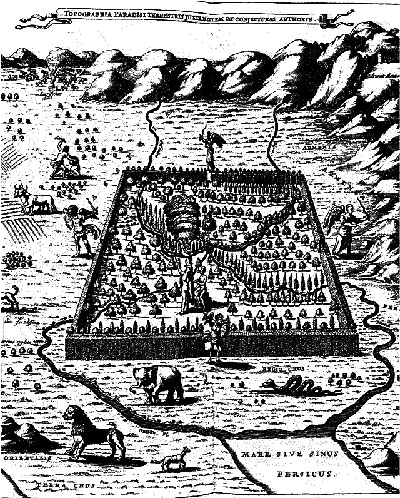
Kircher’s Garden of Eden
The conventional idea has been enhanced in the opinion of some by the discoveries of the German archaeologist, Klaus Schmidt, who believed that his excavations at Göbekli Tepe in Turkey have unearthed artifacts dating to 8000 BC, when the people there changed from hunting and gathering to agriculture. This region also contains Ur and Harran, mentioned in the Old Testament and since Göbekli Tepe, is located between the Tigris and Euphrates and within view of the Taurus Mountains, it conforms remarkably to the topographical description of Eden in the Bible. Tom Knox speculated on this in an article in the UK’s Daily Mail Online(aa).
It was no great surprise when I found at that least one commentator has proposed Göbekli Tepe and the surrounding area was the site of the Garden of Eden(au).
Garold Spire jr an American researcher, offers a strong case for placing Eden in southern Turkey at the Karaca Dag shield-volcano. He studied the sacred books of the Abrahamic religions and drew up a short list of characteristics that the Garden must have;
1) It must have been warm enough to be comfortable without protective clothing. Gen 2:25.
2) It must be uphill geographically, due to the fact that four rivers exited from it, these are the Euphrates, the Tigris, the Pishon, and the Gihon. Gen 2:10-14
3) The Pishon must compass or border Havila where there is gold and onyx. Gen 2:11, 12.
4) The Gihon must compass or border the whole land of Cush. Gen 2:13
5) It must account for a flaming sword on its east side. Gen 3:24
6) It must be well watered, Gen 13:10 by a mist (in Hebrew) not rain, Gen 2:5-6, which came up from the earth.
Spire maintains that his Turkish location has all these features(an).
Christopher Columbus believed that the source of the Orinoco River, in what is now known as Venezuela had been the location of Eden. Antonio de León Pinelo (1590-1660) was a Spanish chronicler who spent some years in South America and was also convinced that the Garden of Eden had been situated between the great rivers of South America(k)!
The imaginative Augustus Le Plongeon claimed the Yucatan as the location of the ‘Garden’(s) an idea endorsed by his wife, Alice Dixon Le Plongeon.
In more recent times, Ramiro Gonzales Yaksic (1966- ), the author of Earthly Paradise: The Garden of the Andes [1055] in which he claims to have identified the biblical Garden of Eden in his native Bolivia(ar). Dieter Groban has written in support of Yaksic(as).
James Bailey published Sailing to Paradise [0150] in 1994, some years before Yaksic’s book, in which he added further support for his Atlantis in America contention. Additionally, he placed the Garden of Eden somewhere on the Bolivian Altiplano.
[0150] in 1994, some years before Yaksic’s book, in which he added further support for his Atlantis in America contention. Additionally, he placed the Garden of Eden somewhere on the Bolivian Altiplano.
General Gordon of Khartoum fame was so impressed by the island of Preslin in the Seychelles, that he declared it to be the Garden of Eden and its famed Coco de Mer and breadfruit plants to be the Tree of Life and the Tree of Good and Evil. Science writer, Karl Shuker, has written an extensive article, Forbidden Fruit, for the January 2016 edition of Fortean Times, in which he gives the background to Gordon’s obsession and his inability to garner any serious support for it.
At the beginning of the 20th century, it was reported(r) that G. F. Becker (1847-1919) a geologist with the USGS nominated Luzon in the Philippines as the site of the biblical ‘Garden’, while Sven Hedin (1865-1952) a much-decorated Swedish geographer chose Janaidar a mythical city in Central Asia.
George H. Cooper, the American writer, identified Salisbury Plain [0236.111] as the Garden of Eden, along with its Wiltshire river system matching the Euphrates and Tigris in the Genesis story. W. Comyns Beaumont chose Britain’s Glastonbury as the site of the original Garden.
In the middle of the last century, a Baptist preacher, Elvy E. Callaway, announced that the Garden had been located in the vicinity of Bristol, Florida(j).
David Rohl has studied the matter in great detail [230] and located the ‘Garden’ in the northern Iranian province of East Azerbaijan near the city of Tabriz(ad)(aj). Rohl’s reasoning is worthy of study and perhaps a comparison with the views of Emilio Spedicato, who offers his explanation for placing Eden in Pakistan’s Hunza Valley in two papers on the Internet(b)(y). Rohl was partly inspired by the work of Reginald A. Walker [1388/9]. Spedicato has also placed the Tower of Babel in the Hunza Valley(aw)(ax).
The inventive David Hatcher Childress published an article in issue 31 of the Atlantis Rising magazine with the title of Central Asia’s Ancient Heart and a subtitle that asks the question ‘Could Afghanistan Once Have Been the Garden of Eden?’ He then proceeds to offer a couple of pages about ancient Mongolia, with little reference to either Afghanistan or the Garden of Eden!
Andrew Collins claims [073] that the original Mesopotamian name for Eden was Kharsag, a view echoed by the late Christian O’Brien(q). O’Brien’s nephew, Edmund Marriage, identifies the Bekka Valley in Lebanon as the location of Eden of Genesis. A new Lebanese location site is the subject of a website and forum(h)(i). An excerpt from O’Brien’s book, relating to Eden, can be read online(v).
Ari Zuker bravely suggests that the land of Israel was the Garden of Eden(ao). John Appelt, an American pastor, also supports this idea (at).
The Sabbah brothers, Roger and Messod, controversially place Eden in Egypt [310] and offer a range of evidence to support this contention. Ralph Ellis has also opted for Egypt in his book, Eden in Egypt[0951] and claims that Adam and Eve were in reality, Akhenaton and Nefertiti! Ellis also supports his theory with two online papers providing excerpts from his books(o)(p).
A Christian website, logoschristian.org, used to also claim that Eden had been located in the eastern Nile Delta, specifically named Al Mansura.
In 2025, the controversial researcher, Constantin Borisov, published a paper in which he proposed “a new perspective on the location of The Garden of Eden. Through exploration using biblical texts, medieval scholars’ works, and contemporary scholarly research, I aim to reconcile biblical narratives with historical records and scientific findings to support my conclusions. I argue that Eden is situated in Egypt, attributing the origin of the four rivers of Eden to the Oceanus River, a concept initially introduced by the first-century Jewish historian Josephus. I assert that Josephus’ hypothesis may indeed be correct. The tree of life, a vital element of Eden, is suggested to be located in Giza, with the sacred mount identified as the Great Pyramid of Giza. Furthermore, the everlasting spring-like state in the Garden of Eden as alluded in the book of Genesis, impervious to the Earth’s climatic conditions, is also examined in the paper” (ay).
In 1933, John G. Jackson wrote a paper advocating an African origin for the legend of the Garden of Eden. Jackson’s extreme Afrocentric views may have coloured his view of this subject!
Further to the west is the Tunisian town of Oudna, which has been nominated as Eden by one Patrick Archer , on his somewhat sparse website(d).
Gerald Wells also identified some of his Algerian Atlantis territories as having included the biblical Garden of Eden(aq).
Another African location was put forward by Georg Hinzpeter over half a century ago, when he suggested that the Ethiopian plateau had been the home of Adam & Eve before their eviction(z).
Stephen E. Franklin has also opted for an African location for the Garden of Eden, placing it south of the Ahaggar Mountains near the Wadi Tafanasset, in southern Algeria.(ah) He also claims that Mt. Tahat, the highest peak in the Ahaggars, was, according to Franklin, the original Atlas mountain referred to by Herodotus as the home of the Atlantes (sometimes Atarantes(ai)). Sprague De Camp noted [194.191] that Paul Borchardt also identified the ancient Mt. Atlas with the Ahaggar Mountains, rather than the Atlas Mountains of the Maghreb! I should add that this identification of Mt. Atlas remains moot.
In 2014, Stan Deyo chose Tanzania as the location of the Garden of Eden(h). Paulo Riven has also supported the region as the site of the ‘Garden’(ak). This idea has been echoed elsewhere and more recently on a website dealing with the history of Israel(f) and on a Christian website where the Ngorongoro Crater is specified(g).
Carl Seaver has also offered an African location for the Garden. In a 2022 article, he reports that according to recent research, Botswana is the most likely location of the Garden and where humans originated. Eden sat in the Kalahari Desert, which used to be a wetland where the early humans lived. During this time, Lake Makgadikgadi stretched from Namibia, Botswana, and Zimbabwe(am).
In 2023 an African location for the Garden was again proposed by journalist, Tom Hale, who wrote(al) “The so-called Cradle of Humankind can be found in South Africa around 50 kilometers (31 miles) northwest of Johannesburg. This site is home to the largest concentration of human ancestral remains anywhere in the world. Among the thousands of fossils found here, researchers have unearthed the remains of Australopithecus, an early ape-like human species dated to around 3.4 to 3.7 million years old.
It wasn’t until 200,000 to 300,000 years ago that modern Homo sapiens evolved. Once again, Africa was the location of this development, with modern humans most likely first emerging somewhere around modern-day Ethiopia.
According to his well-illustrated website(f) Paulo Riven has located the Garden of Eden just north of the Ngorongoro crater in Tanzania.
So, if we’re looking for a scientific Garden of Eden, it looks like South Africa and Ethiopia are our best bet. Whether these sites were once home to a paradise where four rivers once met remains to be seen, however.”
What may appear just as implausible to many is the claim by Felice Vinci[019], that the Eden story was imported from northern Europe, specifically from Finnish Lapland(af). At the end of the 19th century, William Fairfield Warren placed the Garden in the Arctic [0078].
Even more incredible is the assertion by the likes of William C. Chappell, that the Garden of Eden was situated in the United States. His Mormon-inspired views are available as a free eBook(c) on the Internet. Interestingly, Jackson County, Missouri, was the location of Eden revealed by Joseph Smith(ac). the founder of Mormonism and well-known collector of wives.
A more ‘commercial’ suggestion has come from Dennis Brooks, who suggested that Tarpon Springs, Florida, was originally the location of the Garden of Eden and that Tampa Bay contained the port of Atlantis.
The Urantia Book promotes the idea of two Edens, one near Cyprus and a second further east! In 2003, Robert Sarmast compiled a list of similarities between Plato’s account of Atlantis and the description of the Garden of Eden in the Urantia Book(l).
In his 2004 book, Finding Atlantis, he claimed one of the Edens, noted in The Urantia Book, along with Atlantis, had been situated near Cyprus, now in waters a mile deep! Two expeditions were organised to verify his claims, but nothing conclusive was found. Although very little has been heard from Sarmast in recent years, in 2018, Robert S. Bates attempted to breathe new life into Sarmast’s ideas that the Mediterranean region around Cyprus had been home to both Atlantis and the Garden of Eden(ae).
Sarmast’s ideas regarding Atlantis and the Garden of Eden received support from the Christian fundamentalist writer, Robert Gielow, in his book, Noah’s Flood [808].
Stephen Oppenheimer has pointed out[004] that Genesis 2:8 reads that “the Lord God planted a garden eastward in Eden”. He argues (p.409) that this supports the idea of a ‘paradise’ in the Sundaland region. However, Oppenheimer does not equate Eden with Atlantis.
Dhani Irwanto who has placed Atlantis in the Java Sea, has also claimed has also claimed that the biblical Garden of Eden was situated on the Indonesian island of Kilmantan.
As Monty Python used to say “now for something completely different” – The North Pole. This suggestion has come from Gene Matlock, who advocated that ‘Eden was the North Pole’ in a paper of the same name(ab).
The Garden of Eden has been suggested by some as another name for Atlantis, representing as it does a mythical time of peace and abundance. However, Eden is never spoken of in terms of military might and commercial success attributed to Atlantis. One of the better-known proponents of this idea of an Atlantean Eden was the late Professor Arysio dos Santos(a) who was convinced that it was located in the South China Sea, before the ending of the last Ice Age submerged large areas of Sundaland. Confusingly, he referred to Eden as ‘Lemurian Atlantis’, but added that “This Lemurian Atlantis of ours should not be confused with the purely fanciful counterparts of the Theosophists and other such followers of Mme. Blavatsky.” Their ‘Lemuria’ is a hypothetical sunken continent of the mid-Pacific region, one which never existed at all.
Shortly before his death, in 2005, Santos published [320] his theories, expanding on material that he had made available on the Internet for some years. Frank Joseph also claims [106][107] that the Garden of Eden was located on the lost island of ‘Lemuria’, located in the Pacific.
Bill Hanson, who has authored a number of books on ancient ‘mysteries’, has recently written a work [352] that links the Garden of Eden with Atlantis. He identifies five similarities between the two accounts:
- Both prehistoric locations are regarded as ‘lost paradises’.
- The four rivers of Eden are reflected in the four waterways of Poseidon the island capital of Atlantis.
- Atlantis started with ten kings and the Bible speaks of ten patriarchs.
- Zeus destroyed Atlantis because mortals and gods mated, whereas the Bible records the mating of the ‘sons of God’ and human females.
- Atlantis was flooded just as the Age of the Patriarchs ended with the flood of Noah.
The late Joseph Robert Jochmans identified(g) Atlantis with Eden in a comprehensive article on his website. John Nichols also wrote a long article(e) identifying Atlantis with the Garden of Eden and placing it on the Celtic Shelf, about a hundred miles off the coast of France due west of Brest.
Frederick Dodson in a hefty 523-page book [989] claims an Atlantis-Garden of Eden connection(n). In 2018, the Catalan researcher, José Luis Espejo, also equated Atlantis with the Garden of Eden[1607].
In 2022, a writer, hiding behind the nom de plume of ‘gserpent’, produced a lengthy article blending Atlantis, Eden and Lemuria into one heap of literary manure(ag).
Currently. the sadly benighted Iraq is trying to lure tourists to spend their holidays in ‘the Garden of Eden’(m)!
(a) http://www.lost-civilizations.net/atlantis-corroborating-evidence-page-12.html
(b) kharsag (grazian-archive.com)
(c) http://losttruthfound.com/gardenofedenfound.pdf
(d) https://patrickofatlantis.com/
(e) https://jjswn35.wordpress.com/article/atlantis-eden-how-to-find-2vfxjftuay98o-9/
(f) The Garden of Eden – Tribes of Atlantis (archive.org)
(g) See: Archive 3602
(h) The Garden of Eden – Found in Rashaya El-Wadi – the-lebanon.com (archive.org) or http://web.archive.org/web/20200613124200/https://atlantipedia.ie/samples/archive-3182/
(i) https://www.christianforums.com/threads/the-garden-of-eden-origin-of-agriculture-found-near-rashaya-el-wadi-lebanon.7535161/
(j) Weird Florida (archive.org)
(k) http://web.archive.org/web/20191017003405/https://atlantipedia.ie/samples/archive-2999/
(l) http://web.archive.org/web/20210410213608/https://atlantipedia.ie/samples/archive-3603/
(o) https://www.ancient-origins.net/opinion-guest-authors/eden-egypt-part-1-001827
(p) https://www.ancient-origins.net/opinion-guest-authors/eden-egypt-part-2-001831
(q) https://www.goldenageproject.org.uk/obrienvsitchin.php
(t) https://nabataea.net/djgibson.html
(u) https://web.archive.org/web/20190916073848/https://theancientneareast.com/the-four-rivers-of-eden/
(w) https://www.ldolphin.org/eden/
(x) https://en.wikipedia.org/wiki/Juris_Zarins
(z) Atlantis, Vol.17, No. 2/3, April 1964, p.27
(ab) http://www.viewzone.com/edenpole.html
(ac) https://www.fairlatterdaysaints.org/answers/Joseph_Smith/Prophet/Garden_of_Eden_in_Missouri
(ad) http://www.british-israel.ca/Eden.htm
(ae) EAP-Essay-FINAL.pdf (evolving-souls.org)
(af) The climatic optimum, the Indo-European paradise and the Garden of Eden – The Tapestry of Time (larazzodeltempo.it)
(ag) Atlantis: The Garden of Eden – secretsoftheserpent (archive.org)
(ah) https://neros.lordbalto.com/ChapterEight.htm
(ai) W. W. How, J. Wells, A Commentary on Herodotus, BOOK IV, chapter 184 (tufts.edu)
(aj) https://davidrohl.blogspot.com/2012/02/
(al) https://www.iflscience.com/where-is-the-garden-of-eden-and-where-would-it-be-located-today-66925
(am) https://www.historydefined.net/where-would-the-garden-of-eden-be-today/
(an) (99+) The Garden of Eden-allegory or archaeology | Gari Spire – Academia.edu
(ao) (99+) THE GARDEN OF EDEN IN GALILEE | Ari Zuker – Academia.edu
(ap) (PDF) Garden of Eden – Paradise | Eshbal Ratson – Academia.edu (archive.org)
(ar) https://www.opinion.com.bo/articulo/cultura/jardin-eden-estaba-bolivia/20100513203242342019.html
(as) https://www.facebook.com/Groben.Turismo/posts/926029544094509
(at) https://ebible.com/questions/790-what-is-the-location-of-the-garden-of-eden (third item)
(au) The Garden of Eden Discovered?Spiritual Core Theory (archive.org)
(av) https://www.ldolphin.org/eden/index.html
(ay) https://www.scirp.org/journal/paperinformation?paperid=136407