Latest News
Joining The Dots
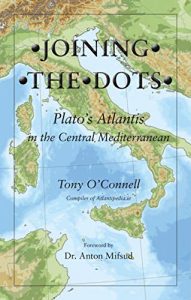
I have now published my new book, Joining The Dots, which offers a fresh look at the Atlantis mystery. I have addressed the critical questions of when, where and who, using Plato’s own words, tempered with some critical thinking and a modicum of common sense.Read More »
William Whiston
Younger Dryas, The (YD)
The Younger Dryas, also known as Dryas III, was a mini Ice Age that lasted from about 10,700 BC until around 9600 BC. It is named after a wildflower called Dryas octopetala that flourished during this relatively short timespan. In Ireland, the event is known as the Nahanagan Stadial and in Britain as the Loch Lomond Stadial. In 2015, a paper constraining the date of the event to within 100 years, using Bayesian statistical analyses, proposed a period between 12,835 and 12,735 years ago(h).
For about thirteen hundred years the glaciers had been slowly retreating until within a short time-span temperature dropped and they began to advance again. The cause of this cooling is not entirely clear.
CAUSES
One view is that a sudden release into the North Atlantic of vast quantities of freshwater that had been contained by huge ice dams is assumed to have closed down the Gulf Stream, resulting in a twelve hundred year lowering of global temperatures. There is evidence that the change only took one or two decades. The same threat is said to exist today with the possibility of the melting of the Greenland ice cap. It also seems that this YD cooling ended with the same rapidity.
The most popular and controversial theory is that YD was caused by an extraterrestrial encounter. This is now known as the Younger Dryas Impact Hypothesis (YDIH) and can trace is origins back to 2006 (see below). This impact has been attributed to various bodies such as a large asteroid or comet, with Halley’s(ay) or Encke’s Comets and even a second Moon have sometimes been specified as possible culprits! Others have suggested reduced solar activity(ag) or volcanism on a global scale.
The November 2013 issue of the BBC Focus magazine [p.30] had a brief article on the impact theory, citing evidence that the northern hemisphere saw a drop of as much as 15°C around 11,000BC. In the absence of a suitable impact crater of the right age, there is still much scientific scepticism(b).
A recent application of archaeoastronomy by Martin Sweatman and Dimitrios Tsikritsis led them to conclude that the carved symbols at Göbekli Tepe recorded an encounter, involving the explosion or impact with part of Encke’s Comet around 13,000 years ago, which triggered the Younger Dryas Event, (sometimes referred to as the 13kya event) that provided the impetus for the Neolithic Revolution. Sweatman later expanded their work in his book Prehistory Decoded [1621] and an article on the Ancient Origins website(k). In June 2021, Sweatman had a paper entitled ‘The Younger Dryas impact hypothesis: review of the impact evidence’ published in the journal ‘Earth Science Review’ of the University of Edinburgh(u).
Kevin A. & Patrick J. Casey also maintain that a globally catastrophic event occurred 13,000 years ago(j). The kernel of their theory is that originally the Earth had two moons that at some later point collided, producing our current Moon, while the remnant of the second one eventually exploded over North America kick-starting what we refer to as the cooler Younger Dryas period. They are adamant that it was not a comet or asteroid that caused the devastation, and so clash with the conclusions of Richard Firestone and his colleagues.
A somewhat technical paper, published in July 2020, challenges the comet impact theory because of geochemical anomalies, Instead, they argue that the YD event was a consequence of widespread volcanic activity(s), rather than an impact! Martin Sweatman refutes this in a paper on Graham Hancock’s website(i).
A completely different view is expressed in Rod (Carl) Martin‘s latest book [1623], where he proposes that the Younger Dryas ended as a result of a catastrophic event. Is it possible that there were two cataclysmic episodes with opposite effects?
John Ackerman, a keen follower of Immanuel Velikovsky did claim that there were two such events related to “the capture of the Moon into its current orbit,” marking the beginning and the end of the Younger Dryas period(q).
Coincidentally, Professor Emilio Spedicato independently concluded that it was a cometary impact in the North Atlantic that was responsible for the Younger Dryas. Subsequently, when temperatures rose again it resulted in the flooding of vast areas of low-lying landmasses that in Spedicato’s opinion included Atlantis, which he locates in Hispaniola.
In 2020, Tony Petrangelo argued that the Younger Dryas event did not destroy Atlantis, but that it was more compatible with the story of Phaeton(ac).
A 2014 paper(ak) entitled Nanodiamond-Rich Layer Across Three Continents Consistent with Major Cosmic Impact at 12,800 Cal BP by Charles R. Kinzie et al., has developed further the idea of this event being associated with the Younger Dryas. In a similar vein is an article(ai) from Megan Gannon.
Additionally, in early 2017, further possible evidence of an impact at the start of the Younger Dryas was offered by a team led by Christopher Moore of the University of South Carolina, when they identified a distinct layer of platinum in the soil that coincided with the start of YD. Commenting on this anomaly Moore noted that “Platinum is very rare in the Earth’s crust, but it is common in asteroids and comets.”(e) In 2019, Moore published further data(m) supporting the extraterrestrial impact theory, based on studies carried out on sediments, which date back 20,000 years, from White Pond Lake, situated in southern Kershaw County, South Carolina. “Other examples of excessive platinum grains have been found across Europe, western Asia, Chile, South Africa(r) and North America.” (n)
The previous year saw two papers published online(i), reinforcing the YD impact theory as a global event and adding evidence that the event resulted in a conflagration that “may have consumed ?10 million km2, or ?9% of Earth’s terrestrial biomass.”
Related to this is a paper by Andrew Collins that draws attention to the ‘Usselo horizon’, a charcoal-rich layer of between 1 and 8 inches, found on all continents, indicating widespread fires, now dated to 12,900 years ago(l). An additional paper by Hans Kloosterman offers additional background information on the charcoal-rich layer(ab).
Ice cores from Greenland indicate a further cooling period circa 6200 BC that may be related to the abandonment of many Neolithic settlements during this period. Other periods of abrupt climate change have been identified from 3800 BC to 3500 BC and 2800 BC to 2000 BC.
The fact that Plato’s apparent date for the demise of Atlantis, circa 9600 BC, roughly corresponds with the current, best estimate for the date of the Younger Dryas is interesting but unfortunately not conclusive proof of any direct connection. On the contrary, the fact that Athens did not exist until millennia later would have made it rather difficult to have been attacked by Atlanteans at that early date. In the absence of any supportive archaeological evidence, a linkage between Atlantis and the Younger Dryas will have to remain a matter of faith rather than fact. Interesting but inconclusive.
In December 2014 Graham Hancock raised the issue of a cometary encounter as the cause of the Younger Dryas and its possible association with ancient Egypt(ah). In 2017, he reviewed the Younger Dryas debate over the previous decade in a lengthy essay(v). This was prior to the publication of America Before. He finished with the the following comment. “Perhaps the lost civilization that I have spent the last quarter of a century trying to track down had its most significant outpost, possibly even its heartland, in North America in the period BEFORE the Younger Dryas cataclysms of 12,800 to 11,600 years ago?” Hancock is inferring here that there was a single global civilisation, a hyperdiffusionist stance that I consider indefensible.
A short paper by John Patrick Hill offers a theory that requires more than faith to accept it; he wrote “Just over 12 thousand years ago, the world was struck by an immense meteor group. It destroyed all of North America and much of Europe and went weIl beyond……… I found proof to support that the creators of the Giza Three and Stonehenge used the Barringer Crater in Arizona as part of the geometry for their for their massive structures.” Later he reveals that at “Giza, when one takes the distance between the outside corners of the three large pyramids there, that distance is equal to 0.72 miles, the exact distance (diameter) at Barringer.” An extended version of Hills’s paper is available online(t).
In another paper, Hill(aa) says that “the Younger Dryas Meteor Event struck 12.8 thousand years ago and it was so large, it is wrote down not only in geologic records but also in holy books, as Noah’s Flood.”
Recent discoveries in northern Sudan of dozens of skeletons, the majority of whom were killed by flint-tipped arrows, have led to the suggestion(c) they were the result of food shortages resulting from the Younger Dryas that in turn led to warfare over diminished food availability.
In 2020, James Lawrence Powell (1936- ), a noted geologist, author, former college president and museum director entered the Younger Dryas debate with the publication of Deadly Voyager[1911]. In it, Powell offers wholehearted support to the Younger Dryas Impact Hypothesis (YDIH), understandably generating a favourable review from Graham Hancock(w). Even more important, is that Powell’s book induced a number of heavy-duty critics of YDIH, including Michael Shermer to change their opinion(x). In 2022 Powell concluded a paper reviewing the YDIH debates with the following; “Finally, we can now assess Sweatman’s suggestion that the YDIH may be ready for promotion from hypothesis to the status of theory. If we combine the definitions of “theory” from the National Academy of Sciences and the American Association for the Advancement of Science, it would read something like this:
‘A scientific theory is a well-substantiated explanation of some aspect of the natural world, based on a body of facts that have been repeatedly confirmed through observation and experiment. It refers to a comprehensive explanation of some aspect of nature that is supported by a vast body of evidence. One of the most useful properties of scientific theories is that they can be used to make predictions about natural events or phenomena that have not yet been observed.’
Those who have read this article and Sweatman’s have the information to decide whether the YDIH meets this definition. In this author’s opinion, there is a strong case that it does. Moreover, it should not be forgotten that no other single theory can explain the YD and its associated effects.”(y)
The YDIH is based on the claim that around 12,800 years ago the Earth had an encounter with a very large asteroid or comet that broke up in an airburst over North America and of which some fragments possibly hit the ground directly(ad).
Many effects have been linked with this event with varying levels of enthusiasm including a suggested association with the demise of Atlantis. Elsewhere, megafaunal extinctions, cataclysmic floods, the disappearance of the Clovis people and the creation of the Carolina Bays(aj), have all been proposed as consequences of this episode.
In 2006, Richard Firestone, Allen West & Simon Warwick-Smith published the foundations of the YDIH in The Cycle of Cosmic Catastrophes [110]. A year later the hypothesis had a more public airing at the American Geophysical Union Press Conference, Acapulco, Mexico, May 23(ag). This was followed the same year by the publication of a formal paper in the Proceedings of the National Academy of Sciences of the United States of America(ai).
Since then volumes have been written on the subject, both pro and con(af).
Martin Sweatman brought further evidence to bear on this debate in an article(al)on the Graham Hancock website. This focuses on the investigations at Hall’s Cave in Texas described in a paper by N.Sun et al, where the team concluded that the trace elements found there could indicate a volcanic rather than an impact as the cause of the Younger Dryas cooling! Sweatman disagrees with their conclusions claiming that there seems to be an element of selectivity in choosing data, leading to a wrong conclusion.
2019 also gave us a paper that included an extensive bibliography and overview of the YDIH debate(an). A Thai site also offers a wide-ranging look at the YDIH(ae). Conflicting evidence regarding the possibility of the Younger Dryas being caused by such an impact is impartially outlined on many internet sites(a).
I note that Robert Schoch claims that there is no evidence to support the Younger Dryas impact theory, instead, he believes that “it was most likely due to reduced solar activity at that time, a solar shut-down.”(aq) Schoch’s wide-ranging critique has been refuted by the Comet Research Group.(ar)
In 2012, Jennifer Marlon et al published a paper, now made available by her on the Academia website, in which they presents “arguments and evidence against the hypothesis that a large impact or airburst caused a significant abrupt climate change, extinction event, and termination of the Clovis culture at 12.9 ka. It should be noted that there is not one single Younger Dryas (YD) impact hypothesis but several that conflict with one another regarding many significant details.”(ap)
In 2011, an article by Nicholas Pinter et al offered a critical review of the evidence available at that time, which, from its perspective, did not fully support the YDIH(ax).
Scienceopen.com is a website offering “A peer-reviewed open-access journal collection covering all aspects of airbursts and impacts on Earth by comets and asteroids”. October 2023 brought the publication of five papers on the subject(as).
In March 2024, The New York Times Magazine published an updated overview of the history and current status of the YDIH(at). The sceptical tone of the article includes an interesting look at the psychological drivers behind the popularity of the hypothesis with the general public. It concludes noting that “In a sense, what West and his collaborators think now hardly matters. The hypothesis has already penetrated deeply, and perhaps indelibly, into the public imagination, seemingly on its way to becoming less a matter of truth than a matter of personal and group identity. Nobody I spoke with seemed to think it would go away soon, if ever. West, though, took a measured view. “All we can say is this is a hypothesis,” he said. “It’s still a debate. We may be wrong; we may be right. But only time will tell.”
In April 2024, geoarchaeologist Marc Young published a lengthy article(au) on Graham Hancock’s website, rebutting arguments put forward by YDIH sceptics.
Sweatman’s support for the YDIH has been challenged twice by archaeologist and geologist Vance T. Holliday and his associates(aw), the latest in December 2024, which was reviewed by Jason Colavito(av).
>>Although the 21st century has seen the YDIH gain widespread popular support, it has obscured the work of George Dodwell and Mike Baillie who have offered evidence of a more recent encounter with a comet or some other large extraterrestrial body around 2345 BC. This idea was also expressed by Willam Whiston in his 1696 book, A New Theory of the Earth [1162], where he contended that an encounter with a comet, in 2346 BC, caused the biblical Deluge, which in turn led to the destruction of Atlantis [p262 5th ed]. His book is now freely available online as a pdf file(az). Edmond Halley and Isaac Newton expressed similar opinions. We can conclude that it is possible that a number of cometary impacts have occurred over the millennia and may do so again.<<
(b) http://www.livescience.com/39362-younger-dryas-meteor-quebec.html
(d)
(f) http://www.space.com/17676-comet-crash-ice-age.html
(i) https://www.dailygrail.com/2018/02/a-comet-impact-13000-years-ago-set-fire-to-10-of-the-planet/
(j) https://www.academia.edu/38380799/13k_Theory_Atlantis_Revisited.pdf
(k) https://www.ancient-origins.net/history-important-events/younger-dryas-0012216
(l) http://www.andrewcollins.com/page/articles/Lommel.htm
(n) https://edition.cnn.com/2019/10/29/world/ice-age-extraterrestrial-impact-scn/index.html
(o) https://www.robertschoch.com/plasma_iceage.html
(p) Comet Research Group responds to Robert Schoch – The Cosmic Tusk (archive.org)
(q) Firmament and Chaos (archive.org)
(s) https://advances.sciencemag.org/content/6/31/eaax8587
(t) Archive 6555 | (atlantipedia.ie)
(u) The_Younger_Dryas_impact_hypothesis_MBS.pdf (ed.ac.uk)
(v) The Younger Dryas Impact research since 2007 – The Cosmic Tusk (archive.org) *
(w) https://grahamhancock.com/deadly-voyager/
(x) In praise of intellectual honesty – The Cosmic Tusk
(y) https://journals.sagepub.com/doi/full/10.1177/00368504211064272
(aa) Migration & Diffusion (migration-diffusion.info)
(ab) Catastrophist Manifesto (archive.org) *
(ac) https://atlantis.fyi/blog/atlantis-and-the-younger-dryas-impact-hypothesis
(ad) https://humanoriginproject.com/evidence-younger-dryas-impact-hypothesis/
(ae) YDIH: Younger Dryas Impact Hypothesis | Thongchai Thailand (archive.org)
(af) https://cometresearchgroup.org/publications/
(ag) https://www.youtube.com/watch?v=f1GCgOI3B1o
(ah) http://www.grahamhancock.com/forum/HancockG13.php
(a1) http://www.ncbi.nlm.nih.gov/pmc/articles/PMC1994902/
(aj) Carolina bays….in the Midwest? – The Cosmic Tusk (archive.org)
(an) YDIH: Younger Dryas Impact Hypothesis | Thongchai Thailand (tambonthongchai.com)
(ao) https://journals.sagepub.com/doi/full/10.1177/00368504211064272
(ap) (99+) Arguments and Evidence Against a Younger Dryas Impact Event | Jennifer Marlon – Academia.edu
(aq) https://www.robertschoch.com/plasma_iceage.html
(ar) Comet Research Group responds to Robert Schoch – The Cosmic Tusk (archive.org)
(as) https://blog.scienceopen.com/2023/10/introducing-comet-research-group-on-scienceopen/
(at) The Comet Strike Theory That Just Won’t Die – The New York Times (nytimes.com)
(au) The Younger Dryas Impact Hypothesis: A Guide For The Perplexed – Graham Hancock Official Website
(ax) https://www.sciencedirect.com/science/article/abs/pii/S0012825211000262
(az) https://gallica.bnf.fr/ark:/12148/bpt6k61715d/f14.item.r=.langEN *
Deluge of Noah
The Deluge or Noah’s Flood are the commonly used terms when referring to the biblical flood of Genesis. It might perhaps be more accurate to use the plural, as there is evidence of several large-scale catastrophic inundations within the human memory. The Noachian deluge has been the subject of continuous debates: was it real or pure fantasy, was it local, regional or global and is the Ark to be found on Mt. Ararat?
Reginald Fessenden controversially noted in his, The Deluged Civilization of the Caucasus Isthmus [1012] that “the traditions were collected, tabulated and compared. This developed the fact that there were only five traditions of an inundation of more than local character.”
1. The Greek tradition; of Deucalion; the Aegean, 100 to 250 miles southwest of the Black Sea.
2. The Egyptian-Phoenician; of Atlantis and the Greeks; the western and northeastern shores of the Black Sea.
3. The Cimmerian; of the Crimea; the north shore of the Black Sea.
4. The Hebrew-Babylonian; of Noah and Atra-Hasis; the southeast shore of the Black Sea.
5. The Phrygian; of Noe; the south shore of the Black Sea.
The Flood of Noah is an echo of the Babylonian Gilgamesh epic, which in turn has a resonance with the deluge story of Manu in Indian mythology. If all three relate to the same event, it would be of great interest to discover if there was an even earlier shared origin.
Noah is the hero of the Deluge story in Genesis. He was also an accomplished shipbuilder and viticulturist. According to some, he was also an Atlantean! Cosmas Indicopleustes, a 6th century AD theologian and geographer from Alexandria, wrote of Atlantis as a large island in the western ocean. He also added a twist to the tale by recording an ancient tradition that Noah had resided on Atlantis! More recently, Frank Joseph [108.85] has endorsed this daft idea.
Interestingly, so many of the deluge stories include a scenario where the ’hero’ is warned of impending doom. To me, this would make sense that where a landbridge was threatened by gradually rising waters on one side, simple observation would have provided adequate time to warn those at risk on the other side.
Another identification, by Robert Bowie Johnson Jr., is that Noah is Nereus in Greek mythology and widely depicted in Greek art(c). Confusingly, it has also been suggested(a) that Enoch, usually accepted as the grandfather of Noah, was the same person.
According to Plato, Atlantis was destroyed by the gods as a punishment for their wickedness, while the same reason is given in the Bible for the obliteration of Noah’s people. Coincidentally, both Atlantis and Noah’s homeland, which was probably located in Mesopotamia, were destroyed by water, leading to the not unreasonable suggestion that the two stories are related.
While the biblical account of the Deluge does not stand up to detailed scrutiny(j), the global ubiquity of Flood stories is seldom adequately explained. Some possibilities that occur to me are related to the ending of the last Ice Age, which had watery consequences around the world. While the rising sea level took place in fits and starts, there were more dramatic events during this period, such as the huge meltwater lake discharges and Heinrich Events that occurred across North America and Eurasia. The effect in the southern hemisphere was less spectacular. Survivors would have been forced to migrate in all directions, bringing their account of these floods with them. Another explanation, but in my view, a more likely cause of global floods, would have been a close encounter with a large extraterrestrial body, an idea promoted by various researchers such as Emilio Spedicato, who nominated Mars as the guilty party.
Apart from the story of the actual flood, global or otherwise, the detailed biblical account of the building of the Ark, along with the gathering of the animals and the voyage itself does not hold water (sorry)(y). Some decades ago, Roger A. Moore offered a forensic study of the account, which, is still impressive(x).
A pithy debunking of the story of Noah’s Ark is to be highly recommended(cb).
In March 2019, a paper by Roger M. Pearlman, put forward another radical idea, namely, that Göbekli Tepe had been founded by Noah (Noach) and his sons(u).
A more light-hearted look at the story of Noah is also worth a read(n).
Every aspect of Noah’s Deluge story in the Bible has been a source of controversy for centuries. From the nature and cause of the Flood itself, as well as the building of the Ark and its final resting place and of course the date of the event.
Some years ago, Pastor Bertrand L. Comparet (1901-1983), a staunch racist(w), denied that the Flood of Noah had been a global event(v).
2018, began with matters hitting rock-bottom, when an English-language newspaper offered the following headline(l) “Turkish academic claims Prophet Noah used a cell phone to call his son before the flood.” Unsurprisingly, Jason Colavito has covered this story with an interesting blog(m).
DATE
Plato’s Atlantis story contains a curious reference in Timaeus (23a-c) to a series of floods that occurred in the Eastern Mediterranean(ah) since the Atlantean war, namely, those of Ogyges, Deucalion and Dardanus. If based on historical fact, on its own, the Biblical Flood or the breach of a landbridge cannot explain this succession of inundations, but suggests that there could be a much more complex story still to be revealed, which was spread over millennia.
Anastasios Stamou, presented a paper [750.183] to the 2008 Atlantis Conference, in which he reviewed the evidence relating to three floods that befell ancient Greece and alluded to by Plato. Drawing on ancient Greek texts, including the Parian Marble, he places these events in chronological order, beginning with the flood of Ogyges, then Deucalion’s and finally that of Dardanos.
Three very ancient global floods are proposed by Marin, Minella & Schievenin in The Three Ages of Atlantis [972] and date them to 10,500, 9600 and 6700 BCE.
Stamou accepts that conventional wisdom has it that these flood events occurred in the 2nd millennium BC and based his paper on that assumption. However, he expressed serious doubts about this dating, suggesting a much earlier date for some inundations and promising a future paper dealing with this revision.
Stephen Oppenheimer mentions [0004] three sudden ice melts, 14,000, 11,500 and 8,000 years ago that would have had a global effect. It should be considered that the second date is close to Plato’s apparent date for the destruction of Atlantis.
Since writing, as we know it, did not develop until long after de-glaciation, it is virtually impossible to precisely identify the date, location or extent of any of the early myths relating to these possible de-glaciation inundations.
In an August 2017 paper, on the Migration & Diffusion website(s), Stuart L. Harris put forward his reasons for dating the Flood of Noah to 3161 BC and the Exodus Flood to 1445 BC.
Similarly, Gérard Gertoux places the Deluge circa 3200 BC in a lengthy paper(z), in which he also controversially touches on subjects such as radiocarbon dating, the age of the patriarchs, the Ice Ages, evolution and more.
China has its own ‘Great Flood’ tradition, which in the August 2016 edition of Science journal had its reality given strong support in a paper(bi) by a mainly Chinese team of researchers, who date the event to 1920 BC.
Recent years have seen the above-mentioned flooding of the Black Sea, or even more controversially, the flooding of the desiccated Mediterranean basins, following the breaching of a suggested landbridge at Gibraltar, proposed as possible sources of the story of Noah in the Bible. These inundations are dated to around 5600 BC and their memory should have survived in the traditions and mythologies of the region. In addition to that, the Persian Gulf is also accepted by many to have been dry during the last Ice Age, but also began to flood around 5000 BC. In Northern Europe, the Baltic Sea and the Celtic Shelf both suffered post-glacial inundations, while around the same time in the South China Sea, the enormous Sunda Shelf suffered extensive flooding.
The flooding of the Celtic Shelf along with parts of southwest Britain and southeast Ireland is the subject of a 2016, thought-provoking book [1166] by Philip Runggaldier
On a more controversial level, Donald Patten and Samuel Windsor presented evidence [0277] for a series of close encounters between Mars and the Earth during the 1st millennium BC. David Rohl, the Egyptologist, dates Noah’s Flood to 3114 BC [0229] and links it with the climatic consequences of a major catastrophe in the Aleutian Islands.
Alexander and Edith Tollman linked the Noachian Deluge with the consequences of a cometary impact in 7552 BC. On the other hand, G.F. Dodwell, the Australian astronomer, after studying ancient gnomons, concluded that it was a worldwide catastrophe in 2345 BC, that altered the Earth’s tilt, leading to the Deluge. This is comparable with the 1696 claim by William Whiston, that the earth had an encounter with a comet in 2346 BC, which caused the Flood of Noah. Emilio Spedicato advocates 3161 BC, as the date of the biblical Deluge(ac), which has also been endorsed by Stuart L. Harris(ad).
In a paper(r) revised in 2017, Barry Warmkessel noted that theologians and historians have attempted dating Noah’s Flood event, both recently and as far back as the time of Christ. The following are just a few of the results from these attempts:
- JOSEPHUS GREAT FLOOD DATE: (3148 BC)
- HALES GREAT FLOOD DATE: (3155 BC)
- SEPTUAGINT GREAT FLOOD DATE: (3246 BC)
- SAMARITAN PENTATEUCH GREAT FLOOD DATE: (2998 BC)
Therefore. theologically at least, it seems quite reasonable (to Warmkessel) that Noah’s Flood occurred between 3000 and 3250 BC and that the Ark would have been built slightly before that time.
When Ryan & Pitman(ae) published their 1997 theory that around 5600 BC, the Black Sea had been flooded by water from the Aegean breaching the Bosporus, it did not take long before it was speculated that the event was reflected in the story of Noah’s Deluge. With little delay, strong objections to the idea were raised by many others(af)(bz).
T.R.Holme has an interesting article(ax) on the flooding of the Black Sea and the migration from the region that resulted. He also links that event with the work of the late Marija Gimbutas (1921-1994).
Nick Thom, an engineering lecturer at Nottingham University has written The Great Flood [776] which gives an overview of many Flood myths, but more importantly, he identifies the emptying of glacial Lake Agassiz around 6250 BC, as the mechanism that caused a tilting of the Earth, which in turn generated a global deluge remembered by the survivors in myth and later recorded in scriptures. This is also fully outlined in a lengthy entitled, A Re-interpretation of the 8.2ky BP Event(ag). Also relevant to our subject is his claim that the flow of water was from the Black Sea into the Aegean rather than the other way around!
The most radical date for the Flood of Noah comes from Rich McQuillen who in a 2022 paper “links the flood of Noah to the flood of Ahmose and Atrahasis, and shows it to be a real flood caused by Santorini”!(bv)
THE CAUSE
Jeffrey Goodman, the controversial author of Psychic Archaeology [781], maintains that “Noah’s Flood was, in reality, a tsunami caused by a comet” and supports this contention with a retranslation of Genesis 7:11 (ar).
Kirk Kirchev in a recent (April 2018) two-part article(bb) “offers a unifying scientific hypothesis that connects diverse ancient flood myths with mainstream scientific fact.” and concluded that “If my calculations and assumptions are correct, an object of around 900 km in diameter passing the earth at an altitude of less than 1000 kilometres (621.37 miles) (of average, rocky density) would be large and heavy enough to create a strong localized tidal uplift in the oceans beneath its flight path (approximately 50 times the current tidal amplitude). That is large enough to destroy most of humankind, and a large portion of the fauna, but small enough to not cause a major extinction event or to disturb earth’s orbital path and rotation.”
Immanuel Velikovsky’s controversial cosmological ideas suggest that our Earth had at one point been a satellite of Saturn! In his unpublished book, In the Beginning (bk), he proposed that “The conflict between the larger planets resulted in long-stretched filaments ejected by a disturbed Saturn to cross the Earth’s orbit. The hydrogen of the planet combined with the oxygen of the terrestrial atmosphere in electrical discharges and turned into water” and so generated the Deluge!
In 1993, Alexander Tollman and his wife Edith published, Und die Sintflut gab es doch. Vom Mythos zur historischen Wahrheit, “which claimed that Noah’s flood was the consequence of a bolide impact about 9500 years ago, and supported the claim through geology (impact craters, iridium, shatter cones, stress lamination of minerals, radiocarbon dating, dendrochronology, a peak of acid in the Greenland ice) and legends and folk traditions.”(bj) Christian O’Brien has endorsed the Tollmans’ ideas(bl).
Aloys Eiling (1952- ) a German researcher, has offered a variation on the close encounter theory, suggesting that the Deluge was one of the consequences of the capture of our Moon that took place when our planet was already populated – somewhere between 40,000 and 13,000 BC. He notes(bn) that “the capture of the Moon caused worse than a flood; it changed the geography of the world. Earth’s surface was devastated, millions died, and life in total was brought to the brink of extinction. In the collective memory of mankind, the event indelibly remained in the myths about a Deluge.”
Nevertheless, there is one rather disturbing element to be found alongside some of the flood myths, namely that the deluge event was concurrent with the sun seemingly standing still and in some cases, it is recorded that the Moon also appeared to stop(o)(av)! One explanation on offer is that it is a reference to an eclipse(aw). This might be acceptable if it was compatible with other myths from different parts of the world, which does not appear to be the case. Furthermore, it does not explain the association of the stopping of the sun with the global deluge. A very close encounter between the Earth and another large celestial body might.
As I see it, we are left with the two popular explanations for the global flood myths, either a close encounter with an extraterrestrial body that created a megatsunami on such a scale that it swept around the globe, perhaps many times before dissipating, or the melting of the Ice Age glaciers produced the cyclical bursting of ice-dams and landbridges and the inundation of vast areas of low-lying land. I’m inclined to believe that the balance of probabilities favours the latter explanation, although I find it difficult to accept that gradual deglaciation would or could, have generated floods that ‘covered mountains’ (Gen. vii.19)!
Other floods may have been caused by tsunamis resulting from underwater earthquakes and/or storegga. Quite recently it was discovered(bh) that around 6000 BC, a calamitous tsunami was generated in the Mediterranean when Mt. Etna in Sicily sent approximately 6 cubic miles of rock and rubble crashing into the sea. One could be forgiven for speculating that this event may have triggered the flooding of the Black Sea, which is dated to this same period.
GLOBAL or LOCAL
The scientific case against a global deluge is presented in a paper by Lorence G. Collins(bt), who also published a study of Genesis 7:11, which in describing the Deluge notes “on the same day all the fountains of the great deep burst open, and the floodgates of the sky were opened.”
In 2013, Geologist David R. Montgomery, a professor at the University of Washington, authored The Rocks Don’t Lie [2029] which offered a fresh open-minded look at Noah’s Flood and how it is viewed today by both science and religion. He concluded – “Like most geologists, I had come to see Noah’s Flood as a fairy tale—an ancient attempt to explain the mystery of how marine fossils ended up in rocks high in the mountains. Now I’ve come to see the story of Noah’s Flood like so many other flood stories—as rooted in truth.”
“It appears that humanity’s rich legacy of flood stories reflects a variety of ancient disasters. The global pattern of tsunamis, glacial outburst floods and catastrophic flooding of lowlands like Mesopotamia or the Black Sea basin, fits rather well the global distribution and details of flood stories.”
So Montgomery considers the source of Noah’s Flood to have been a local event such as the flooding of the Black Sea region and refers to Angelos Galanopoulos, who similarly associated the tsunamis generated by the mid-second millennium BC eruption of Thera (Santorini) with the Flood of Deucalion. Montgomery’s views were given further exposure on the LiveScience website(bx).
A decade later (May 2023), the Greek Reporter website re-examined the possible extent of Noah’s Flood(by).
THE ARK
An interesting overview of traditional, as well as modern thinking, regarding the possible historical reality behind the Deluge of Genesis is presented(ai) by Robert Squillace, on the New York University website.
On January 1st,2010 it was revealed(b) that a 3,700-year-old Babylonian tablet which, unlike the biblical record, describes an ark made of reeds, 70 metres in width and round in shape(aj)(ak). This would have been recorded a thousand years before the Genesis story was written down. Understandably, this has caused the knickers of some fundamentalist Christians to become seriously twisted! The discovery has now been expanded on by a cuneiform specialist at the British Museum, Irving Finkel, in The Ark before Noah [0995]. Jason Colavito offers an interesting review of the book(d).
There is an unexpectedly large number of books written over the last century on the subject of Noah’s Ark that is listed on a specialist website(e). One such offering, resurrected by Jason Colavito(f), provides some comic relief with the claim in 1922 by C. E. Getsinger, who wrote that Noah’s Ark was the Great Pyramid!(g) Even earlier, John Taylor (1781-1864) claimed [1451] that Noah had built the Great Pyramid! Nevertheless, a recently deciphered fragment of the Dead Sea Scrolls has suggested that the Ark was shaped like a pyramid!(h)(i)
Even more radical is the result of a high-tech study of fragments of the Dead Sea Scrolls, which suggest that Noah’s Ark was pyramidal in shape(al)! Commenting on this report,
Even more radical is the result of a high-tech study of fragments of the Dead Sea Scrolls which suggest that Noah’s Ark was pyramidal in shape(al)(h)(i)! Jason Colavito has pointed out that the concept of a pyramid-shaped ark is not new(am).
Haaretz reported that the new reading of the fragments has changed our understanding about Noah’s Ark. Thanks to the high-resolution imagery, a word following the phrase “the ark’s tallness” had previously been illegible. However, the new scans showed that the correct words is ne’esefet, meaning “gathered,” which according to researcher, Dr. Alexey Yuditsky, means that the ark’s ribs were gathered together at the top in the shape of a pyramid. Dr Yuditsky said that the Septuagint, a Greek translation of the Bible dating to the third century BC, used a Greek verb with a similar meaning to describe the Ark. Moreover, medieval authors like Maimonides suggested that the ark’s roof was pointed.
Commenting on this report, Jason Colavito has pointed out that the concept of a pyramid-shaped ark is not new(am)citing the work of Lorenzo Ghiberti (1378-1455), who was actually depicting a widespread Jewish and early Christian belief about the Ark. Origen, in Genesis Homily 2, Philo in Questions and Answers on Genesis 2.5, and Clement in Stromata 6.11, all claimed that the Ark was pyramidal in shape. They derived this from the account in Genesis, which claimed that the Ark is 300 by 50 cubits at the base, but rose to a window embedded in a peak, but one cubit square. They concluded, therefore, that the ship must be pyramidal to fit those measurements.
Barry Warmkessel also entered the fray with the suggestion that aliens had been involved in the design and construction of the Ark(r)!He believes “that it was NOT built by humans ~5200 years ago. It offers details of alien engineering principles involving the Golden Ratio. Its metallurgy shows ironwork not even possible until ~3200 years ago as well as the presence of other metals (e.g. titanium and aluminum) that would have been difficult to fabricate even in the early twentieth century. The Book of Noah explicitly specifies that “angels” (with extensive metallurgical skills) built the Ark. They were likely the Nommos, an amphibian species reportedly from the Sirius star system. They left mankind with cuneiform writing and the wheeled vehicle (alien technology of that day). They offered us astronomical knowledge of their own and our solar system (including Vulcan) and evidence of a past major comet/meteorite Earth impact. Finally, they appear to have left repositories of technologies far more advanced than our own.Their story tells of an alien species’ attempt to save a deceitful mankind from an approaching comet impact catastrophe that caused Noah’s Great Flood.”
Nevertheless, Warmkessel’s idea certainly competes with the suggestion of Xavier Séguin that the ‘Ark’ of Noah had been an Earth satellite(aa)!
Even more radical is the claim by Hebrew scholar Richard Seary that the Ark never actually existed, but that conventionally accepted understanding of the Genesis text is the result of some incorrect translations(aq). One example is that there is no such material as gopher wood and that the word ‘gofer’ means lava!
A life-sized replica of Noah’s Ark was due to cross the Atlantic Ocean from Holland in the summer of 2016(an). It was built over four years by a carpenter, Johan Huibers, completing it in 2012. It is 410 feet long, 95 feet wide and 75 feet tall. It weighs 2,500 tons and is said to hold more than 5,000 people at any one time. However, there is no provision for live animals! The replica was sold to Aad Peters, a Dutch artist, who in 2019 brought it to Ipswich in Britain. Unfortunately, it has been impounded by the authorities there as it lacks the appropriate paperwork to permit it to leave. There are also serious concerns regarding its seaworthiness and it is also clocking up port fees of £500 a day(ao)(ap).
Michael Hearns, an Irish researcher, has just published (Aug.2023), an interesting article on the Ancient Origins website recounting the many anomalies in the biblical story of the Ark(bw).
UBIQUITY OF FLOOD MYTHS
Flood myths are found throughout the world and for centuries were seen as confirmation of the reality and universality of the Biblical Flood of Noah. However, when it was discovered that the Earth had endured a series of Ice Ages and that following each of these, the melting ice caps led to worldwide inundations with consequent immortalisation of these events through locally developed myths, it led to speculation that Noah’s Flood may have been just a regional, but a catastrophic event. It is also probable that separate regional inundations would have occurred as deglaciation continued at the end of the last ice age, so when recounted through mythology many centuries later, they may appear to refer to a single global event.
The competing concepts of global deluge versus local inundations are discussed in a brief paper(bc) by L. James Gibson, who concluded that “these local floods do not explain important features of the biblical flood.”
Ronan Coghlan has included an extensive list of flood myths from around the world in Companion to Atlantis and Other Mystery Lands [727].
Nevertheless, megafloods are not necessarily only caused by tsunamis and melting glaciers. “A 43-day storm that began in December 1861 put central and southern California underwater for up to six months” a catastrophic event that is now generally forgotten. An extensive 2013 article(bd) in Scientific American has full details.
These ancient flood stories are to be found to contain content with a remarkable similarity of detail. It is worth pointing out that none of these legends ever recount the ‘hero’ of their particular tale returning to his former home. One simple explanation for this might be that the original homelands no longer existed. This would not normally be the case if the floods in question were tidal, storm-driven or even giant tsunamis. However, if the inundations were the result of rising sea levels, resulting from the melting of Ice Age glaciers, we could expect two principal effects. The first would have been the gradual submergence of all low-lying flood plains that are now identified as continental shelves. Two of the best known of these would be the Sunda Shelf (Sundaland) and the area stretching from the west coast of mainland Europe across the North Sea, encompassing the British Isles and into the Atlantic beyond Ireland. The second effect would have been the dramatic inundation of valleys and basins protected by low landbridges or dams. Again, we have examples, some debatable, such as the Baltic, the Red Sea, the Persian Gulf, the Black Sea, the Mediterranean and perhaps the Caribbean, the Gulf of Mexico and the Sea of Japan.
An extensive and more general collection of Flood myths can be found on the internet(be). A USGS list of the world’s greatest floods, ancient and recent, is available as a pdf file(bf). Similarly, a website by Mark Isaak, offers an extensive overview of flood myths around the world, although the site does not appear to have been updated for some years(bg).
Despite the existence of these huge collections of worldwide flood myths(ay) there appears to be one glaring omission, from all such databases, namely a contribution from Egypt where, inexplicably, there is no such deluge tradition, apart from the predictable annual flooding of the Nile. However, there is the Egyptian story of Hathor/Sekhmet(az)(ba) who flooded the land with blood, which some may interpret as a mythological code for water!
The flooding of all these worldwide locations would have occurred quite slowly over an extended period following the last Ice Age, possibly providing the basis for the widespread existence of these flood myths. However, it could not explain the biblical claim that the flood covered mountains.
Dhani Irwanto, author of Atlantis: The Lost City in Java Sea [1093], offers a number of interesting articles on his website, including an extensive overview of the ubiquity of Deluge stories, concluding with the following comment “Thus, Noah and the waters of the great Flood are not only recalled in the ancient traditions of all nations, but their names have also become incorporated in many and varied ways into the very languages of his descendants. The trails are tenuous and often almost obliterated so that some of the inferred connections are speculative and possibly mistaken, but the correlations are too numerous to be only coincidental, thus adding yet one more evidence for the historicity of the Great Flood.(bs)“
Many Atlantologists have sought to link the Deluge with the inundation of Atlantis. As early as 1915, Garrett Serviss, put forward the possibility that a lost continent in the Arctic Ocean, containing Atlantis, was destroyed and that this cataclysm also generated Noah’s Flood(ca).
Egerton Sykes was a keen supporter of the idea of a connection between the destruction and Noah’s Deluge. Joseph S. Ellul has interpreted the biblical story to support the idea of a landbridge at Gibraltar, which eventually collapsed when the waters of the Atlantic rose after the last Ice Age. Ellul maintains that Genesis 7:11 ‘All the springs of the Great Deep broke through’ is a reference to the percolation of the Atlantic waters, through the Gibraltar dam, which eventually led to its collapse as the sea level rose or was shattered by seismic or tectonic movements. I find it hard to accept this, because the pressure that is exerted by the Atlantic would have rapidly changed any such seepage into a major breach and the subsequent collapse of the dam. Gerhard F. Hasel, Professor of Old Testament and Biblical Theology offers a more conventional interpretation of “the fountains of the great deep” in a paper with the same name(ab).
MT. ARARAT
Nevertheless, 2017 finished with renewed interest in Noah’s Ark being generated by media reports(k) of statements emanating from The Geoscience Research Institute, which is sponsored by the Seventh-day Adventist Church, claims that a 2010 expedition to Mount Ararat in Turkey, carbon-dated timbers found there to 4,800 years ago.
A sceptical 2019 article has looked critically at many aspects of the story of the Ark, including the most commonly offered Turkish site as the resting place of the Ark – “One of the most famous supposedly-Noah’s-ark sites is the admittedly very boat-looking Durupinar site in the Mount Tendurek area in Turkey. According to Atlas Obscura, the site was exposed in the late 1940s after a series of earthquakes and storms.”(an)
The late David Allen Deal was another investigator to propose the Ararat region as the landing place of the Ark, with Mt. Judi (Judi Dagh) as the specific location(o). A more recent article supports his ideas(p). David Rohl has also been drawn to Mt. Judi as a probable contender(bu). The precise location of the biblical Ararat is a matter of continuing and intense debate(q).
The UK’s Daily Mail added that talking after the initial claims in 2010, Mike Pitt, a British archaeologist, said the evangelical explorers had yet to produce compelling evidence. He said: ‘If there had been a flood capable of lifting a huge ship 2.5 miles [4km] up the side of a mountain 4,800 years ago, I think there would be substantial geological evidence for this flood around the world. And there isn’t.’
In his 2020 book, Apocalypse [1874], Dr Sean Welsh agreed that Noah’s Ark finally rested on Mt. Ararat, but took everyone by surprise by claiming that it was not Ararat in Turkey, but Ararat mountain on Crimea’s Kerch Peninsula! Welsh does not explain where Shinar was in relation to his Ararat. Conventional wisdom locates it in southern Mesopotamia, placing them around 2,500 km apart.
Eberhard Zangger has drawn attention to the fact that originally ararat would have been written without vowels – RRT. While the vowel ‘a’ was usually inserted to fill the gaps, Zangger as shown that RRT is read in Assyrian texts as Urartu, the name of an ancient state in what is now Armenia near Lake Van [484.215].
Angelo Palegro was an Italian researcher who spent 35 years seeking Noah’s Ark on Mount Ararat (Mount Agiri) on the Turkish-Iranian border(bq). Unfortunately, in 2021 he fell ill while in Turkey and died on August 15th, aged 86, and in accordance with his wishes, was buried on the slopes of Mt. Ararat(bp).
However, a more valuable offering was a paper(ab) delivered in 2008, to the Sixth International Conference on Creationism in Pittsburgh, PA by Anne Habermehl. She finished her contribution, Review of the Search for Noah’s Ark, with the following conclusions;
“(1) It would appear that the Ark cannot have landed on Mount Ararat, because scientists have shown that this mountain did not exist until some time after the Flood had ended. (Also, the area that Mount Ararat occupies was probably not yet included in Urartu at that time.)
(2) In light of historical and geographical considerations, Mount Cudi near Cizre, Turkey, is the most likely place where the Ark landed.
(3) It seems doubtful that anyone has actually seen the Ark anywhere in modern times. The alleged sightings all seem to evaporate on careful examination.
(4) It is unlikely that very much of the Ark exists today; it is probable that over the millennia it has decayed, and various scavengers have taken most of it away.
(5) Because of 14C dating problems, it may not be possible to prove that any given samples are or are not the right age to have come from the Ark.
(6) More archaeological work needs to be done if we are ever to reasonably prove the Ark’s landing spot anywhere.
(7) It is probable that no matter what is found in any location, there are those who will remain unconvinced.
(8) Interest in finding the Ark is unabated, and the Ark search will go on.
At the end of the day, we have to face the reality that it may be difficult, or even impossible, ever to prove where the Ark landed. This author would have liked to end on an optimistic note for the soon recovery of a largely intact, proven Ark, but this seems unlikely; and this paper therefore ends, in the words of T. S. Eliot (1925): “Not with a bang but a whimper.”
In 2021, author S.H. Scholar, in a short book entitled Heavenly Flood [1891] modestly claimed to have “uncovered history’s greatest secret – the influence of ancient astrology on the development of Noah’s Ark and the Great Flood Tale.” John McHugh has also offered a comparable zodiacal link with the biblical Deluge story in, The Celestial Code of Scripture [1892] which has been critiqued by Gary D. Thompson(bm).
Eugenio Ralbadisole who advocates India as the home of Atlantis, also locates the landing place of Noah’s Ark in the same region. Based on texts in the Vedas where “we read that a man after a catastrophic flood arrived with his ship full of animals in a village called Naubandhana. A location with similar names can be found near “Barda Hills” in Gujarat.” (bo)
Recently, Emilio Spedicato offered the following claim(cc); “The Ark was built on Lake Manasarovar (Tibet) , near the sources of the Indus and Sutlej Rivers, a region rich in gold (identified as the land of Ophir, from which Hiram brought gold to Solomon), south of the sacred Mount KaiIash-Meru.”
(a) The First Eden (archive.org)
(b) http://www.guardian.co.uk/uk/2010/jan/01/noahs-ark-was-circular
(c) http://njbiblescience.org/presentations/Greek%20Mythology%20and%20Genesis.pdf
(d) http://www.jasoncolavito.com/1/post/2014/05/on-irving-finkels-the-ark-before-noah.html
(e) http://www.throneofgod.com/SBG/sbg.htm
(g) The Thomson Review, Thomson, Illinois, July 19th, 1922 – p.3,
(k) http://www.dailymail.co.uk/sciencetech/article-5020131/Experts-claim-Noah-s-Ark-Mount-Ararat.html
(o) https://noahsfloodnoahsark.wordpress.com/category/chapter-13-discovery-of-lost-ancient-city/
(q) https://web.archive.org/web/20190128072213/http://compmyth.org/journal/index.php/cm/article/view/15
(r) http://web.archive.org/web/20201024124331/https://atlantipedia.ie/samples/archive-3514/
(s) http://www.migration-diffusion.info/article.php?id=540
(t) The First Eden – Part One (archive.org)
(u) https://www.academia.edu/38664571/Gobekli_Tepe_founded_by_Noah_and_sons
(v) https://israelect.com/ChurchOfTrueIsrael/comparet/comp19.html
(x) https://ncse.ngo/impossible-voyage-noahs-ark
(y) https://www.grunge.com/145325/the-untold-truth-of-noahs-ark/
(aa) https://eden-saga.com/en/looking-noahs-ark.html
(ab) https://www.academia.edu/39177466/A_Review_of_the_Search_for_Noahs_Ark
(ac) http://www.migration-diffusion.info/article.php?id=498
(ad) http://www.migration-diffusion.info/article.php?id=540
(ae) https://www.researchgate.net/publication/222471228_An_Abrupt_Drowning_of_the_Black_Sea_Shelf
(af) https://barryhisblog.blogspot.com/p/why-black-sea-is-not-site-of-noahs-flood.html
(ag) https://www.researchgate.net/publication/304674803_A_Re-interpretation_of_the_82ky_BP_Event
(ah) https://web.archive.org/web/20200216200648/http://www.ancient-wisdom.com/mythologyhome.htm
(ai) Untitled Document (archive.org) (link broken)
(ak) https://www.theatlantic.com/technology/archive/2014/01/noahs-ark-round/283335/
(an) https://www.grunge.com/145325/the-untold-truth-of-noahs-ark/
(an) http://www.huffingtonpost.com/entry/life-sized-noahs-ark-to-sail_us_571f99cbe4b0b49df6a91ffc
(ao) https://en.wikipedia.org/wiki/Johan%27s_Ark
(aq) Fortean Times, April 2014, p.55
(bl) Giant Comet Launched Noah’s Ark (goldenageproject.org.uk)
(ar) http://www.newscientificevidenceforgod.com/2011/03/noahs-flood-was-really-tsunami-caused.html
(as) https://grahamhancock.com/eilinga2/
(at) A R T I C L E S THE FOUNTAINS OF THE GREAT DEEP. Gerhard F. Hasel Associate Professor of Old Testament & Biblical Theology Andrews University – PDF Free Download (archive.org) *
(av) https://biblehub.com/joshua/10-13.htm
(ax) http://www.geocities.ws/gardenofdanu/the_great_deluge.htm
(ay) https://web.archive.org/web/20200922201924/http://www.talkorigins.org/faqs/flood-myths.html
(az) A Drunk, Bloodthirsty Goddess: The Flood Myth Of Egypt – Parallel Myths (wordpress.com)
(ba) https://digitalcommons.georgiasouthern.edu/cgi/viewcontent.cgi?article=1443&context=honors-theses
(bc) Geoscience Research Institute | Local Catastrophes, or a Worldwide Deluge? (archive.org)
(be)Flood Stories from Around the World (archive.org)
(bf) http://pubs.usgs.gov/circ/2004/circ1254/pdf/circ1254.pdf
(bg) See (be)
(bh) Towering Ancient Tsunami Devastated the Mediterranean | Live Science
(bi) http://science.sciencemag.org/content/353/6299/579
(bj) https://en.wikipedia.org/wiki/Alexander_Tollmann
(bk) http://varchive.org/itb/hydrox.htm
(bl) Giant Comet Launched Noah’s Ark (goldenageproject.org.uk)
(bm) Critique of John McHugh’s Astronomical Interpretation of Noah’s Flood (westnet.com.au) (Link Broken)
(bn) https://grahamhancock.com/eilinga2/
(bo) City of Atlantis – Atlantide (archive.org)
(bp) Italian researcher buried in Turkey after decades… | Rudaw.net
(bq) Studies by Palego (noahsark.it) (account suspended)
(bs) Great Flood and the Repopulation of Man | Atlantis in the Java Sea (atlantisjavasea.com)
(bt) https://ncse.ngo/yes-noahs-flood-may-have-happened-not-over-whole-earth
(bu) https://davidrohl.blogspot.com/2012/03/
(bv) (99+) A Simple Chronology for Biblical Archaeology | Rich McQuillen – Academia.edu
(bw) Stairway To Heaven In Noah’s Ark | Ancient Origins Members Site (ancient-origins.net)
(bx) Did Noah’s flood really happen? | Live Science
(by) https://greekreporter.com/2023/05/15/noah-flood/
(bz) https://www.latimes.com/archives/la-xpm-2003-jan-19-adfg-noah-story.html
(ca) https://chroniclingamerica.loc.gov/lccn/sn83045389/1915-01-03/ed-1/seq-46/
(cc) file:///C:/Users/Tony/Downloads/Spedicato%20%2030-5-26%20(1).pdf
* See Atlantis Vol.6, Nos.1,2&3, May, July & September 1953
2345 BC
2345 BC is a specific date offered by George Dodwell to identify the time for which there was consistent evidence that the tilt of the Earth’s rotational axis was altered(c). He believed that this event caused the Flood of Noah.
Coincidentally, in his 1696 book, A New Theory of the Earth [1162], William Whiston contended that an encounter with a comet, in 2346 BC, caused the biblical Deluge, which in turn led to the destruction of Atlantis (p262 5th edition).
More recently, Reinaud de Jonge proposed(b) a similar linkage between the 2345 BC cosmic encounter and the biblical Deluge. He wrote a series of six papers on the 2345 BC catastrophe(d). “It appears the Disaster was caused by a cosmic collision with a huge Comet. Probably, the Earth was in the tail of this Comet (or Comet Swarm) for a period of two months. After that, the whole climate was disrupted for another two months. The calamity is described in the Bible as the Deluge or the Flood. More than half of the world’s population perished: 2.6 million men (54%). It happened at the start of the Sixth Dynasty of Egypt (c.2370-2189 BC), which led to the end of the Old Kingdom.”
Also possibly related is the year 2350 BC when “there was a ‘near-simultaneous’ collapse which saw great societies crumble and the Middle East plunged into a dark age”, according to a December 2019(a) “paper published in the Monthly Notices of the Royal Astronomical Society, researcher W.M. Napier of Armagh University, Northern Ireland, wrote: ‘Studies of Earth’s history over the last 150,000 years have revealed that the climate is subject to sudden temperature changes, with transitions often taking place within decades or even a few years.”
The collapse of the Akkadian civilisation is specifically mentioned as a possible consequence of an encounter with fragments from a disintegrating Encke’s Comet hitting the Earth, creating a ‘meteor hurricane’. This impact idea was endorsed by W. Bruce Masse in a paper(e) now available on the academia website, although he did not specify Encke’s Comet.
Mike Baillie, a leading dendrochronologist, presented to a Quantavolution Conference in Athens in 2011 compelling evidence for a catastrophic event in 2345 BC.
What has become known as ‘the mid-24th century BC climate anomaly’ or ‘2350 BC Middle East Anomaly’ occurred between 2354–2345 BC. I find it hard to believe that there is no connection between this event and the data on offer from Dodwell and Baillie. Atlantisforschung also offers an article on the subject(f).
In 2026, C.R. Sant published a new book [2134] addressing the Atlantis mystery and dating its demise to 2346 BC..
(b) https://web.archive.org/web/20191230033527/http:/barry.warmkessel.com/2345BC.html
(c) https://www.barrysetterfield.org/Dodwell/Dodwell_Manuscript_1.html
(d) https://web.archive.org/web/20191229071342/http://barry.warmkessel.com/dejonge.html
(e) (99+) The Archaeology and Anthropology of Quaternary Period Cosmic Impact | Agustin Domingo – Academia.edu (2.2.4.1.)
Ancient Chronology
Ancient Chronology is a subject fraught with difficulties(a) as well as the focus of intense academic debate, particularly over the past half-century.
Archbishop Ussher (1581-1656) calculated the date of creation to have been 23 October 4004 BC(d). Incredible as it may seem, even today (2019), there are still people prepared to give further consideration to his ideas (c)(e).
There is a library of books and papers on the internet relating to the chronologies of the eastern Mediterranean and the difficulties in trying to align them, that a lifetime of study is required to resolve them all. I can only give a taste here of the spectrum of theories on offer{6615}{6630}.
Sir Isaac Newton (1642-1727) became the first ‘modern’ revisionist of accepted ancient chronology. His work was heavily criticised and few serious advances were made until the development of Egyptology following Napoleon’s invasion of Egypt at the end of the 18th century.
Difficulties with details of Egyptian dating slowly accumulated, particularly when endeavouring to align it with Greek, Minoan and other Eastern chronologies. The scholarly debates became very public in the middle of the 20th century with the eventual publication of Ages in Chaos by Immanuel Velikovsky and the attempts made to suppress it altogether. The refining of Velikovsky’s theories followed, with important contributions by S. Talbott, Edward Schorr and John Bimson. Some, such as Emmet Sweeney, have accused Velikovsky of being over-dependent on his belief in the inerrancy of biblical chronology.
The Society for Interdisciplinary Studies (SIS)(b) was founded in 1974 and produces regular publications. This was followed a few years later by three important books[229][230][232] by David Rohl and Centuries of Darkness [046] by Peter James, who also wrote The Sunken Kingdom in which he proposes that the story of Atlantis was inspired by historical events in Lydia, now in western Turkey. Rohl & James were in agreement on many details, but fell out over the identity of Shishak (was he Ramesses II or III?). However, prior to that, in the early 1980s, they had published a joint paper that gave the world a first look at their New Chronology. Rohl republished it in 2012(v).
On the occasion of the SIS Jubilee Conference in 1999, a paper by P. John Crowe was presented, which gave a valuable insight into historical revisionism before and after Velikovsky(a).
In 2002, Manfred Bietak and Ernst Czerny, both distinguished Egyptologists, edited a collection of 45 papers presented at a SCIEM Conference in 2000, highlighting the problems of synchronising the chronologies of civilisations in the Eastern Mediterranean in the 2nd millennium BC(w).
Gunnar Heinsohn (1943-2023) was a Professor Emeritus at the University of Bremen but was also an ardent chronology revisionist, concerned not just with the dating problems of the ancient world(l) but also with difficulties to be seen in the first millennium of the Common Era(m).
One of the most controversial aspects of Plato’s Atlantis story is the old Egyptian priest’s claim that Atlantis was destroyed 9,000 years before Solon’s visit. He also related that Athens, who fought the Atlanteans, was established one thousand years before the Egyptian state or, as is more likely, before the foundation of the city of Sais. Apart from anachronisms in Plato’s narrative, the archaeological evidence completely contradicts the dates seemingly offered by the priests of Sais. It is interesting that most of the chronology revisionist debate centres on the second millennium BC, which is arguably the most rational timeframe for the destruction of Atlantis based on the Bronze Age references in Timaeus and Critias, provided they are not just anachronistic embellishments.
I should also mention that while the debates regarding the Bronze Age chronologies rage on, further controversy has arisen regarding claims of duplicated centuries in the first millennium of our era. Leading the charge here are Anatoly Fomenko(k) [1823], Heribert Illig(h)(i)(j) and Gunnar Heinsohn(g). A keen supporter of Fomenko’s work is Garry Kasparov, the former World Chess Champion(p). More critical views of Fomenko’s work are on offer from commentators such as, Stephen Sorensen(s) and Robbie Mitchell(y).
Nathaniel Lloyd had written an extensive three-part paper on the history of chronological revisionism(t). This should be read in conjunction with a paper entitled The Glorious Stupidity of Fomenko’s New Chronology(u).
Up to this point, I have outlined some of the problems and theories concerning the accurate alignment of specific events with particular years. A clash of archaeology and accepted history, secular and religious. has generated libraries of debate. However, our problems do not end with the counting of years, but contention has also arisen over the length of the day before the seventh century BC. Evidence is available to show that there was a 360-day year in use around the world in those ancient times.
Some religious sites have proposed that before the Deluge, we had a 365-day year, then it changed to 360 days and then reverted to the current 365.2422 days(q). By way of complete contrast, Danny Faulkner, a creationist astronomer, rejects the idea that the world was created with a 360-day year, although it is a view held by many creationists(r).
William Whiston was one of the first ‘modern’ commentators to conclude that in very ancient times a 360-day year was used(n). More recently, Immanuel Velikovsky devoted a chapter of Worlds in Collision to The Year of 360 Days(o). The Brit-Am movement endorsed Velikovsky’s views in this regard, as does William F. Drankenbring(x).
(b) Welcome – Society for Interdisciplinary Studies (archive.org)
(d) https://en.wikipedia.org/wiki/Ussher_chronology
(e) https://www.academia.edu/36854822/Ussher_Explained_and_Corrected
(f) See (a)
(g) https://www.q-mag.org/_search.html?req=heinsohn
(h) The Phantom Time Hypothesis • Damn Interesting
(i) Wayback Machine (archive.org)
(j) Jan Beaufort: 30 questions about chronology (cybis.se)
(k) https://en.wikipedia.org/wiki/New_chronology_(Fomenko)
(l) THE RESTORATION OF ANCIENT HISTORY (archive.org)
(m) https://www.q-mag.org/_search.html?req=heinsohn
(o) I. Velikovsky, Worlds in Collision, Part 2, Chapter Viii, p.316
(p) Wayback Machine (archive.org)
(q) http://xwalk.ca/360vs365.html
(r) (PDF) On the Caution about the 360-Day Year (researchgate.net)
https://www.researchgate.net/publication/265167051_On_the_Caution_about_the_360-Day_Year
(s) Fomenko’s New Chronology – Ctruth
(t) https://www.historicalblindness.com/blogandpodcast//the-chronological-revision-chronicles-part-one-the-fomenko-timeline (new link)
(v) https://davidrohl.blogspot.com/2012/11/
(w) The Synchronisation of Civilisations in the Eastern Mediterranean in the … – Google Books
(x) The Mayan Calendar and the 360 Day Year (triumphpropheticministries.com)
(y) https://www.historicmysteries.com/unexplained-mysteries/anatoly-fomenko/38783/
Whiston, William *
William Whiston (1667-1752) was an English historian and theologian. In his  1696 book, A New Theory of the Earth [1162]+, he contended that an encounter with a comet, in 2346 BC, caused the biblical Deluge, which in turn led to the destruction of Atlantis (p.262, 5th edition). His book is now freely available online as a pdf file(a).
Immanuel Velikovsky, in his unpublished book, In the Beginning(d), has pointed out that Whiston conclusions were strongly influenced by several earlier writers, particularly mentioning Abraham Rockenbach (1536-1611).
Both George Dodwell and Mike Baillie have also offered evidence for a globally catastrophic event in 2345 BC. The ancient Chinese document, Huai-nan Tzu, recounts a legend of ten suns appearing in the sky, an account which might be related if the suggested(b) date of 2345 BC for the event could be verified.
Reinoud de Jonge offered a paper(c) linking petroglyphs found at Mougau-Bihan in Brittany with a cosmic catastrophe circa 2345 BC. He associated the event with the biblical Deluge.
He had the idea that the antediluvian population had been much greater than the present continents could accommodate and he reasoned that an additional landmass was required to cater for these extra people. Whiston took Plato’s description, of the submerged Atlantis being greater than Libya (North Africa) and Asia combined, at face value and assumed that such a large piece of extra territory would have been adequate to meet the needs of his presumed enlarged world population.
[1162]+ https://archive.org/details/newtheoryofearth0000whis/page/n417/mode/2up
(a) https://gallica.bnf.fr/ark:/12148/bpt6k61715d.r=.langEN
(b) UFO – Historical Sightings 45,000 BC – 9 BC, page 1 (archive.org) *
Carli, Giovanni Rinaldo
 Giovanni Rinaldo Carli (1720-1795) was an Italian who had quite a diverse range of interests, from economics to ancient history to oenology.
In a book[087] concerning the history of the Peruvians he expressed his belief that a close encounter with a comet altered the orbit of the earth, lengthened the year and was responsible for the Deluge. A consequence of this catastrophic fly-by was also the destruction of Atlantis, which he located in the Atlantic, leaving the Azores and Canaries as its remnants today.
Stephen P. Kershaw comments[1410.202] that where Rudbeck used the Atlantis story to support Swedish nationalism, Carli attempted to use it to enhance the prestige of his native Italy.
His idea of a cometary interference with the earth is an extension of the theories of William Whiston (1667-1752), the Anglican priest, who sought to reconcile science and religion. The French astronomer, Jérôme Lalande, developed Carli’s cometary ideas further.
Baillie, Mike
Mike Baillie is an Emeritus Professor of Palaeoecology in the School of Archaeology and Palaeoecology, Queen’s University, Belfast. He is a dendrochronologist[113] of world renown, who outlined in his recent book [111] the evidence for catastrophic encounters with asteroids or comets over the past five millennia that opened a whole new chapter in the search for the truth about our past. Baillie ascribes these events to 2354-2345 BC, 1628-1623 BC, 1159-1141 BC, 208-204 BC and 536-545 AD. He touches on a number of  legendary and historical events such as the Deluge, the Exodus and King Arthur, but seems to studiously avoid any direct reference to Atlantis. Nevertheless, his theory, in conjunction with the suggestions of writers such as Emilio Spedicato, enhances the possibility of the destruction of Atlantis being a consequence of a more widespread catastrophe.
In a 1999 article, Baillie concluded with the following comment, “There is, I feel, a strong case for the contention that we do not inhabit a benign planet. This planet is bombarded relatively often. If this story is correct, we have been bombarded at least three times – and probably five times – since the birth of civilization some 5,000 years ago. And each time, the world was changed.”
In 2004, it was claimed that a very large comet or asteroid, estimated to be ¾ of a mile in diameter, crashed into what is now Germany. The date is calculated at 200 BC, which coincides with one of Baillie’s dated catastrophes. The remains of a possibly related crater field has been identified stretching from the town of Altoetting to Lake Chiemsee(i).
Perhaps even more relevant to our study was a PowerPoint presentation(b) from Baillie to a Quantavolution Conference in Athens in 2011, which offered compelling evidence for a catastrophic event in 2345 BC. His data reinforces the work of George Dodwell , who demonstrated with his study of ancient gnomons decades earlier that something dramatic happened to the rotational axis of the Earth in 2345 BC, which is possibly the same 2346 BC encounter with a comet proposed by William Whiston in 1696. At the same conference Baillie also presented evidence for dating the eruption of Thera to 1628 BC.
In 2016, C.R. Sant published a new book [2134] focused on the Atlantis mystery. In it he proposes that the destruction of Atlantis was a consequence of a change to the Earth’s axial tilt. He dates this alteration to 2346 BC, aligning his evidence with that of Dodwell and Whiston.
Baillie is also co-author with Patrick McCafferty of a fascinating work[112] that reinterprets some of the heroes and gods of Celtic mythology as a coded account of our ancestors’ observation of a close encounter or impact of comets with the Earth. However, Baillie’s books should be read in conjunction with an equally compelling volume, Thunderbolts of the Gods [148](a). by David Talbot and Wallace Thornhill, who offer a complementary rather than conflicting interpretation of early man’s perception of highly visible cosmic events. Talbot and Thornhill have linked ancient myths and thousands of petroglyphs with their view of an electric universe, where large-scale plasma phenomena were witnessed and recorded by preliterate man. Their book has drawn extensively on the work of Dr. Anthony Peratt, who has gathered and classified an enormous database of petroglyphs from all over the world(d) that are apparently a record of celestial demonstration(s) of plasma physics.
Although in Exodus to Arthur (2000) Baillie attributed ancient global catastrophic ‘climatic upsets’ to encounters with asteroids or comets, in 2012, he wrote a paper concerning the same five events, but now ascribed the cause to major volcanic eruptions in the distant past(g)! Archaeologist Colin Burgess wrote a paper supporting Baillie’s work(h).
Nevertheless, Baillie also has his critics, particularly in relation to his attitude towards proponents of the ‘New Chronology’ such as Peter James and David Rohl(c).
(b) https://www.qconference-athens-2011.grazian-archive.com/the2345topicmbai/index.html
(c) https://www.cokenais-soas.com/CAIS/Religions/non-iranian/Judaism/Persian_Judaism/book6/pt1.htm (halfway down page) (link broken)
(d) https://ieeexplore.ieee.org/document/1265340
(e) http://www.zetatalk.com/theword/tword04n.htm
(f) https://freerepublic.com/focus/chat/714636/posts
(g) Do Irish Bog Oaks Date the Shang Dynasty? – Current Archaeology
(h) Volcanoes, Catastrophe and the Global Crisis of the Late Second Millennium BC – Current Archaeology
Ragnarok: The Age of Fire and Gravel
Ragnarok: The Age of Fire and Gravel [022] by Ignatius Donnelly, who took the title of his book from the word ‘Ragnarök’, which, in Scandinavian mythology, describes the destruction of the world of men and gods. He claims  to have written this 450-page book in seven weeks in 1882. Some later editions have misleadingly added The Destruction of Atlantis to the original title, as Atlantis is only peripheral to the subject of a book. However, ‘Atlantis’ in a book title will always help to inflate sales.
A number of contemporary press reviews of Ragnarok, when it was originally published have been made available on the Atlantisforschung website(e).
Coincidentally, just two centuries earlier, Edmund Halley had also speculated that a cometary encounter with the Earth had led to the biblical Deluge(d). William Whiston offered a related theory[1162].
Donnelly seems to have anticipated the work of Immanuel Velikovsky when he wrote of a close encounter or actual impact with the Earth by a comet. He presents an array of geological evidence to support this contention. In addition, he proposes that this celestial clash is also a displacement of the poles. Again, this is an idea that was taken up by a number of writers in the succeeding century and is still strongly supported today. Like Velikovsky, Donnelly postulated that the resulting catastrophes were recorded in mythology and biblical texts. One of the specific consequences of this encounter was the destruction of Atlantis, which he expanded on in his previous book, Atlantis, concerning Plato’s sunken civilisation. Both of Donnelly’s books are available on the Internet(a).
The catastrophism of Donnelly’s Ragnarok can be seen as anticipating aspects of the more recent theories of Richard Firestone and his colleagues, that have come to be known as the Younger Dryas Impact Hypothesis (YDIH).
In 2013 experts in Norse mythology announced that a Viking apocalyptic ‘Ragnarok’ was due on February 22nd, 2014! (b) The claim, which I suspect was a publicity stunt, was downplayed on February 23.
(a) Ragnarok: The Age of Fire and Gravel Index (archive.org)
(d) https://www.jasoncolavito.com/halley-on-noahs-comet.html