Latest News
Joining The Dots
I have now published my new book, Joining The Dots, which offers a fresh look at the Atlantis mystery. I have addressed the critical questions of when, where and who, using Plato’s own words, tempered with some critical thinking and a modicum of common sense.Read More »
Tyrrhenia
Central Mediterranean
The Central Mediterranean is a very geologically unstable region, containing as it does all of Europe’s land-based active volcanoes(a), regular seismic(b) activity with the attendant risk of tsunamis. It is now estimated that a devastating tsunami will hit the Mediterranean every 100 years(c). While the Aegean region experiences the greatest number of earthquakes, the Central Mediterranean, particularly around Sicily, is also prone to regular tremors.
The idea that Atlantis was situated in this region is advocated by a number of researchers, including Alberto Arecchi, Férréol Butavand, Anton Mifsud, Axel Hausmann, as well as this compiler. Plato unambiguously referred to only two places as Atlantean territory (Crit.114c & Tim 25b) North Africa and Southern Italy as far as Tyrrhenia (Tuscany) plus a number of unspecified islands.
The area between Southern Italy and Tunisia has had a great number of sites proposed for the Pillars of Herakles, while possible locations for Gades are on offer, with a number places still known today by cognates of that name.
Plato clearly includes continental territory as part of the Atlantean domain as well as a number of important islands. Within a relatively small geographical area, you have two continents, Africa and Europe, represented by Tunisia and Italy respectively, as well as the islands of Sicily, Sardinia, Corsica and Malta, together with a number of smaller archipelagos, matching Plato’s description exactly. The later Carthaginian Empire also occupied much of the same territory apart from eastern Sicily and southern Italy which by then was controlled by the Greeks and known as Magna Graecia.
For me, the clincher is that within that region, we have the only place in the entire Mediterranean to have been home to elephants up to Roman times – Northwest Africa.
(a) https://en.wikipedia.org/wiki/Volcanology_of_Italy
(b) The Europeam Mediterranean Seismic Centre – EMSC, records all activity in the region.
(c) Tsunami Alarm System – A3M Tsunami Alarm System (tsunami-alarm-system.com) (German & English)
National Geographic
National Geographic or Nat Geo are the registered trademarks of the National Geographic Society and are now, sadly, part of the Murdoch communications empire. Its magazine and TV channel enjoy global recognition. Undoubtedly, NG has enhanced our view of the world around us. One piece of NG trivia is that the word ‘tsunami’ first appeared in an English language publication in the September 1896 edition of National Geographic Magazine.
In May 1922, NG published its first picture of Stonehenge. A century later it returned to this remarkable monument for its cover story in its August 2022 edition. It highlights how the use of new technologies has greatly enhanced our knowledge of the site and the people who built it. Jim Leary, a lecturer in field archaeology at the University of York, admits that “a lot of the things we were taught as undergraduates in the 1990s we know now simply aren’t true.” This beautifully illustrated article is a useful update on developments at this huge UNESCO World Heritage Site.
Generally, NG has avoided controversy, but not always(a), so it will be interesting to see how its new chief, James Murdoch, a climate change denier(b), will deal with the NG views on the subject up ’til now(c). However, for me, it was something of a surprise when NG tackled the subject of Atlantis.
In 2004, NG News published a short article(d) highlighting the theories of Ulf Erlingsson and Rainer Kühne, who, respectively, were advocates for Ireland and Spain as Atlantis locations. Also in 2004, Zeilitsky and Weinzweig claimed to have found submerged man-made structures near Cuba and subsequently sought US government funding for further research there. It has been suggested that NG objected and further exploration did not take place! In 2006, NG gave the Atlantis in America theory of Zapp & Erikson an airing(e).
However, in 2012, Andrew Collins offered a different account of the Zelitsky funding difficulties(m).
In a short 2011 article(l)., NG trotted out the now generally abandoned idea that Atlantis had been a continent. The idea was obviously later dumped by NG as well when James Cameron et al. went looking for Atlantis in Malta, Sardinia and Santorini in 2016.
December 2012 saw NG publish an article on Doggerland, without any reference to the suggestion that there might be an Atlantis connection. NG has also voiced the scepticism of well-known commentators, such as Robert Ballard and Charles E. Orser jnr(f).
However, I find that the NG treatment of Atlantis is inconsistent. In October 2011 an anonymous article(k) on one of their sites, entitled The Truth Behind Atlantis: Facts, declared that Atlantis was continental in size (and so must have been located in an Ocean?) This is based on a misinterpretation of the Greek word meison. Nevertheless last year NG had Simcha Jacobovici, remotely guided by James Cameron, scouring the Mediterranean, from Spain to Sardinia, Malta, and Crete for evidence of Atlantis. This attention-seeking exercise found nothing but a few stone anchors that proved nothing and inflicted on viewers an overdose of speculation!
NatGeo TV aired a documentary(g) in 2015 relating to earlier excavations in the Doñana Marshes of Southern Spain by a Spanish team and partly hijacked by the late Richard Freund. A new NG documentary, hyped with the involvement of James Cameron and Simcha Jacobovici, was filmed in 2016 and later broadcast at the end of January 2017. Initially, it was thought by Robert Ishoy to be in support of his Atlantis location of Sardinia, but at the same time, Diaz-Montexano was convinced that his Afro-Iberian theory was to be the focus of the film. To coincide with the airing of the new documentary, D-M has published a new book, NG National Geographic and the scientific search for Atlantis[1394] with both English and Spanish editions.
Jason Colavito was promised a screener but had the offer subsequently withdrawn. One wonders why.
Once again, NG promotes the region of the Doñana Marshes as a possible location for Atlantis(i), based on rather flimsy evidence, such as six ancient anchors found just outside the Strait of Gibraltar. They estimate the age of the anchors at 3,000-4,000 years old. unfortunately, they are not marked ‘made in Atlantis’. Rabbi Richard Freund, never afraid to blow his own shofar, makes another NG appearance. Jacobovici throws in the extraordinary claim that the Jewish menorah represents the concentric circles of the Atlantean capital cut in half, a daft idea, previously suggested by Prof. Yahya Ababni(k).
What I cannot understand is why this documentary spends time dismissing Santorini and Malta as possible locations for Plato’s Atlantis and at the same time ignoring the only unambiguous geographical clue that he left us, namely that the Atlantis alliance occupied part of North Africa and in Europe the Italian peninsula as far as Tyrrhenia (Tuscany) and presumably some of the islands between the two.
Overall, I think the NG documentaries have done little to advance the search for Atlantis as they seem to be driven by TV ratings ahead of the truth. Perhaps, more revealing is that Cameron is not fully convinced by the speculative conclusions of his own documentary.
Jason Colavito, an arch-sceptic regarding Atlantis, has now published a lengthy, scathing review(j) of NG’s Atlantis Rising, which is well worth a read. While I do not agree with Colavito’s dismissal of the existence of Atlantis, I do endorse the litany of shortcomings he identified in this documentary.
For me, NG’s credibility as a TV documentary maker has diminished in recent years. Just one reason is the “2010 National Geographic Channel programme, 2012: The Final Prophecy, enthused about an illustration in the Mayan document known as the Dresden Codex (because of where it is now kept), which was claimed to show evidence of a catastrophic flood bringing the world to an end in 2012. This illustration included a representation of a dragon-like figure in the sky spewing water from its mouth onto the Earth beneath, which has been taken by some, although by no means all, experts in Mesoamerican mythology to indicate the onset of a terminal world-flood. However, no date was given, so the link with 2012 is entirely spurious (Handwerk, 2009; Hoopes, 2011).”(n)
(a) National Geographic Shoots Itself in the Foot — Again! (archive.org)
(b) https://gizmodo.com/national-geographic-is-now-owned-by-a-climate-denier-1729683793
(d) http://web.archive.org/web/20220121054050/https://atlantipedia.ie/samples/archive-3582/
(e) https://www.dcourier.com/news/2006/oct/02/atlantis-theory-by-local-anthropologist-makes-nat/ (not available in EU)
(f) http://science.nationalgeographic.com/science/archaeology/atlantis/
(g) https://www.youtube.com/watch?v=nyEY0tROZgI & https://www.youtube.com/watch?v=choIyaPiMjo (no longer available)
(h) https://mosestablet.info/en/menorah-tablet.html
(l) https://channel.nationalgeographic.com/the-truth-behind/articles/the-truth-behind-atlantis-facts/ (link broken) See: The Truth Behind: Atlantis (TV Movie 2011) – IMDb *
(m) Cuban ‘Atlantis’ Cover-Up Solved?, page 11 (archive.org)
(n) Doomsday Cults and Recent Quantavolutions, by Trevor Palmer (q-mag.org) (about 2/3rds down page)
Flambas, P.P.
P. Philip Flambas is the Australian author of Plato’s Caribbean Atlantis[1368]. The self-explanatory title makes Dr Flambas’ objective clear. The book was published in Australia and is a hefty 932 pages and is also available as a Kindle ebook. The book is so enormous that a full critique would require another book. He outlined his theories on the Ancient Origins website(b).
In my opinion, the book has many flaws and is just a case of quantity masquerading as quality. One of my first gripes is that the author places Atlantis in the 10th millennium BC, a period during which there is NO archaeological evidence for any structured societies in either Egypt or Athens.
Even more ridiculous is his suggestion that the Atlantean Empire was centred in the Caribbean and included what are now the U.S. states around the Gulf of Mexico, all of Mesoamerica and all the countries along the northern coast of South America. Then, realising that Plato had also described Atlantean territory that included parts of Europe and North Africa, Flambas added them as well for good measure. Flambas accepts that the Atlantean territory included parts of Europe and North Africa, but that, apparently unknown to Plato, the capital of this empire was in the Caribbean! I don’t find that credible, but readers will have to decide for themselves.
Eleven millennia later, Europe could not keep control of its American colonies even with improved navigation, vessels and weaponry, so how did his Caribbean Atlantis manage the control of its European territory?
Furthermore, Flambas is incorrect in saying that Plato noted that part of Atlantean territory extended as far as the Tyrrhenian Sea, in fact, he said that they controlled as far as Tyrrhenia (Timaeus 25b & Critias 114c), in other words, they held part of southern Italy. Even without that, if parts of the Western Mediterranean had been occupied by Atlanteans from the Caribbean, it is hard to believe that some knowledge of the existence of the Americas was not well known throughout the whole Mediterranean region, sailors not being known as the most tight-lipped people. But Flambas claims that this knowledge was not available to Europeans until Columbus, eleven thousand years.
Flambas has a large section on empires and their development through the occupation of contiguous territory, which I fully agree with, yet he proposes that these ancient Atlanteans preferred to expand across the wild Atlantic to colonise the Mediterranean rather than the easier option of pushing either north into North America or south into the equally valuable South America with shorter supply lines. Expansion across the Atlantic from America makes no sense.
On a more positive note, as a layman, I think that Dr Flambas has done creditable original work with his “Hydraulic Hypothesis” which relates to a modification of our view of Plate Tectonics. The extensive geological research carried out by him is admirable, but for me, his attempt to link it with Plato’s story of Atlantis is just a speculation too far.
Finally, his book is well illustrated, but to produce a volume of this size without an index is unforgivable. I was also disappointed to find that much of Flambas’s Chronology of Atlantis Theories was copied from this site, including errors, without any attribution!
Flambas has also written on the debate surrounding the abrupt ending of Plato’s Critias(a). He concluded that “rather than Plato leaving the Critias unfinished, a more likely explanation for its abrupt ending is that it was once complete and the remainder was lost, as were thousands of other Ancient Greek literary works. That loss may also include the Hermocrates dialogue, which was possibly the first or final part of a trilogy, or yet another dialogue that would have created four related dialogues.”
In a subsequent online discussion(a) about Flambas’ paper, the most salient opposing comment came from Thorwald C.Franke who proposed that Critias was never finished and “the Hermocrates wrote since there are no other testimonies from ancient authors. All the other dialogues have left traces in ancient literature.”
Flambas has produced a trilogy of videos to augment his book. Part 1 is now available on the academia.edu website(c).
(a) (99+) Discussion: The Incomplete Critias.docx – Academia.edu (discussion closed)
(c) (99+) Plato’s Atlantis – Part 1 The Atlantis Story | Photios Flambas – Academia.edu
(d) (99+) Plato’s Atlantis – Part 2 The Nature of the Atlantic Island | Photios Flambas – Academia.edu *
Heupel, DuWayne
DuWayne Heupel is the author of Atlantis in Context[1230] in which he concludes that the Atlantis story was an invention by Plato to promote his concept of an ideal form of government and “demonstrate the dangers of national hubris.” However, it would seem to fail as a morality tale when Plato also included the demise of the ‘righteous’ Athenians in his narrative. This is compounded by his reference to another ideal city, Magnesia, in Laws. Why did he need to create two model cities?
Nevertheless, Heupel includes a lot of historical background to Athens and the people referred to by Plato, although by his own admission, he does engage in some speculative conclusions. He also claim that elements in Plato’s story were possibly inspired by real places, like Carthage, Atalanta and Thera and real events such as the Persian and Peloponnesian Wars. What I find strange about that, is that the places listed by Heupel are not mentioned at all by Plato, but locations, such as Tyrrhenia and Libya, which are included in the text, are apparently not considered to be relevant by Heupel. It seems clear Heupel accepts that there are actual historical underpinnings to the Atlantis story, but in my opinion has chosen the wrong ones.
The late Anthony N. Kontaratos, listed twenty-two direct and indirect instances, in Timaeus and Critias, where Plato has asserted the truthfulness of the Atlantis story. As far as I’m aware, there is nothing comparable with this anywhere else in Plato’s writings. This alone should persuade listeners/readers that at least Plato believed he was transmitting a true story. However, Plato did have some reservations regarding details in Solon’s narrative, as expressed in Critias 118c-d. If Plato had invented the whole story, it is highly unlikely he would create exaggerations in an invented tale and then draw attention to them, unless, of course, he was engaging in a double bluff! For my part, I believe this is highly improbable and his reluctance to blindly accept all that was transmitted to him was outweighed by the trustworthiness of Solon, his source. Solon was held in such high regard by the people of Athens that for a writer to invoke his name as an informant, without good reason, would be committing literary suicide. This would be similar to unjustifiably quoting George Washington or Nelson Mandela. It is equally improbable that Plato would invoke the names of his family in support of a hoax.
Therefore, it is not unreasonable to assume that Plato, in good faith, wrote down the story of Atlantis as recorded by Solon. Unfortunately, trust in Solon is not enough to explain away the difficulties in the narrative, including the very item that raised the initial doubts in Plato’s own mind.
For my part, I believe that the balance of probabilities favours the acceptance of the reality of Atlantis and is clearly worthy of continuing research.
Two Crops a Year
Two Crops a year is one of the characteristics of Atlantean agriculture according to Plato (Critias 118e).
The North African climate was slightly wetter at the time of Hannibal (2nd & 3rd cent. BC), later, Algeria, Egypt and particularly Tunisia, were the ‘breadbaskets’ of Imperial Rome(b) and may also have been so for the Atlanteans who earlier had control from North Africa to Tyrrhenia! Even today well-irrigated plains in Tunisia can produce two crops a year, usually planted with the autumnal rains and harvested in the early spring and again planted in the spring and harvested in late summer. The Berbers of Morocco produce two crops a year—cereals in winter and vegetables in summer(a).
It is worth noting that Mago, the Carthaginian author of a 28-book work on the agricultural practices of North Africa. had his books brought to Rome after the destruction of Carthage in 146 BC, where they were translated from Punic into Latin and Greek and were widely quoted. It is clear that Mago’s work was a reflection of a highly developed agricultural society in that region, a description that could also be applied to Plato’s Atlantis!
Although two crops are possible annually in other parts of the world, I must emphasise that North Africa is the only part of the Atlantean territory referred to by Plato (Timaeus 25b) that was so productive and continued to be so until the Romans, who depended on it along with Egypt to feed Rome.
James Bailey who advocated an American location for Atlantis refers [150.63] to the irrigation systems of ancient Mexico and the ability to raise three crops a year in Mexico and the coastal plains of Peru as all echoes of Plato’s description of Atlantis.
Tyrrhenian Sea
>The Tyrrhenian Sea according to Massimo Pittau was named after the Sardinian Nuragics, since in ancient Greek ‘Tyrrenoi’ means ‘builders of towers’. As noted elsewhere, Sardinia was an important part of the Atlantean domain.<
Plato clearly states that Atlantis controlled Europe as far as Tyrrhenia (Critias 114c), which implies that they dominated the southern half of the Italian peninsula. The Sea is surrounded by the islands of Corsica, Sardinia, Sicily and the Lipari Islands as well as continental Europe in the form of the Italian mainland. Not only does it contain islands with an adjacent continent (see Timaeus 24e). It is also accessed through the straits of Messina and Sicily, both of which have been identified as locations for the Pillars of Heracles before Eratosthenes applied that appellation to the region of Gibraltar.
Timaeus 24e-25a as translated by Bury reads “there lay an island which was larger than Libya and Asia together; and it was possible for the travellers of that time to cross from it to the other islands, and from the islands to the whole of the continent over against them which encompasses that veritable ocean (pontos=sea). For all that we have here, lying within the mouth of which we speak, is evidently a haven having a narrow entrance; but that yonder is a real ocean (pelagos=sea), and the land surrounding it may most rightly be called, in the fullest and truest sense, a continent.” Similarly, Lee and Jowett have 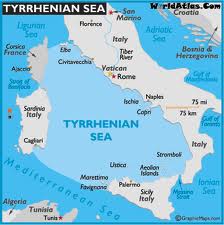 misleadingly translated both pontos and pelagos as ‘ocean’, while the earliest English translation by Thomas Taylor correctly renders them as ‘sea’. Modern translators such as Joseph Warren Wells and a Greek commentator George Sarantitis are both quite happy to agree with Taylor’s translation. However, Peter Kalkavage translates pontos as ‘sea’ but pelagos as ‘ocean’!
For me, there is a very strong case to be made for identifying the Tyrrhenian Sea as the ‘sea’ referred to by Plato in the passage quoted above. However, it was probably F.Butavand, in 1925, who first proposed the Tyrrhenian as the sea described by Plato in his La Veritable Histoire de L’Atlantide[205] .
Pushing the boat out a little further, I note that Rome is situated in Central Italy and by tradition was founded by the twins Romulus and Remus!
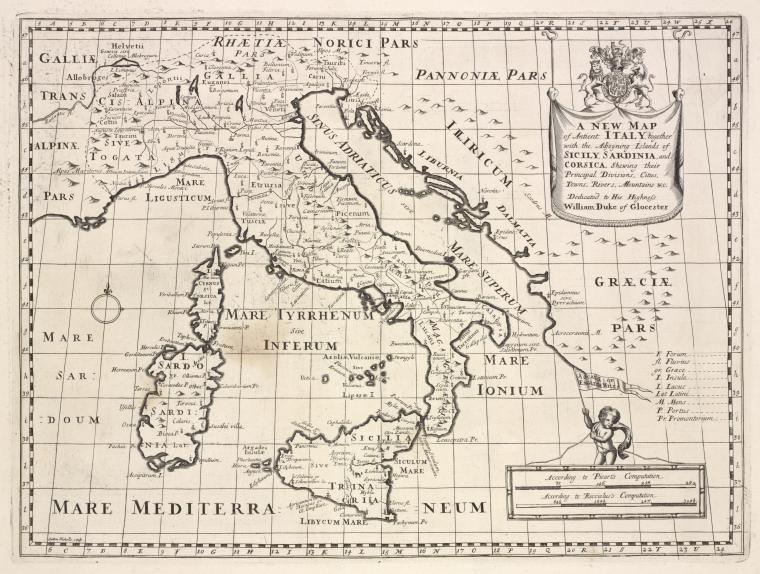
A 1700 map of the Tyrrhenian Sea is available online.
‘Tyrrhenia’ is sometimes used as a geological term to describe a sunken landmass in the Western Mediterranean Basin(b)(c).
(a) (link broken) *
Ghembaza, Thérêse
Thérêse Ghembaza is a French researcher who has a website, in French and English, entitled The Great Enigmas of Antiquity(a) in which she discusses matters such as the Hyksos, the identity of Moses and the Kushites. The site also addressed her theory that Atlantis had been situated in Meroë on the Upper Nile, a theory that she developed in a number of other papers(c), which are certainly worth a read.
While at first sight this might be seen as a wild claim, Ghembaza offers a well-reasoned theory which was presented to the 2nd Atlantis Conference held in Athens in 2008. She has imaginatively linked aspects of Meroitic geography and history with Plato’s story of Atlantis. For example, she identifies Tyrrhenia with Tyre in Lebanon and claims that Tyrrhenia in Italy was a later colony of Tyre! While some of her ideas are convincing, I found others a little threadbare. Nevertheless, Ghembaza must be applauded for her efforts to construct a scientific explanation for the Atlantis narrative.
Although Ghembaza quotes Plato extensively to support her Meroë hypothesis, she fails to explain how an Atlantean Meroë, situated on the Upper Nile, had territory in Southern Italy and northeast Africa (Tim 25a-b & Crit 114c), a distance of around 4,000 km. Equally difficult to account for is the fact that Meroë did not exist until sometime early in the 1st millennium BC, in contrast to the middle of the 2nd millennium, considered a reasonably late date for the destruction of Atlantis. Add to that, the fact that Meroë was never submerged or created ‘shoals of mud’, leaving the credibility of Ghembaza’s Atlantis claims in tatters.
On her homepage, Ghembaza has a link in which she claims that in his Periegesis(b) Hecateus of Miletus provided some of the details used by Plato in his Atlantis narrative.
In April 2015, Ghembaza offered a short paper(d) in support of identifying Bab-el-Mandeb as the location of the Pillars of Heracles.
Ghembaza has kindly drawn my attention to two quotations from Pliny the Elder and Ovid, which offer possible explanations for Plato’s orichalcum (see Document 091011). The former refers to a Cypriot copper mixed with gold, which gave a fiery colour and is called pyropus, while Ovid also refers to a cladding of pyropus, a term often translated as bronze. She also mentions auricupride(Cu3Au), an alloy that may be connected with orichalcum.
A lecture outline by Ghembaza with a slideshow can be accessed online(e).
(a) http://antiqua91.fr/index_en.html
(b) Hecataeus of Miletus‘ Periegesis 550 – 480 “now lost, but probably the main source of Plato and Eratosthenes”
(c) http://antiqua91.fr/atlantis_en.html
(d) See: Archive 2526
(e) https://slideplayer.com/slide/3878434/ (link broken)
Tyrrhenia
Tyrrhenia was the Greek name for that part of modern Italy formerly occupied by the Etruscans, who were known as Tusci by the Romans, from which we get its current name, Tuscany. Plato twice described (Tim.25B & Crit.114C) Tyrrhenia together with Libya (North Africa), as far as Egypt, providing the northern and southern boundaries of the Atlantean sphere of influence.
>The exact extent of Egyptian-controlled territory in Libya at the time of Atlantis is unclear. We do know that “In the mid-13th century, Marmarica was dominated by an Egyptian fortress chain stretching along the coast as far west as the area around Marsa Matruh; by the early 12th century, Egypt claimed overlordship of Cyrenaican tribes as well. At one point a ruler chosen by Egypt was set up (briefly!) over the combined tribes of Meshwesh, Libu, and Soped.”(e) Another site(d) suggests that Egyptian control stretched nearly as far as Syrtis Major, which has been proposed by some as the location of Atlantis.<
Anton Mifsud points out[209] that the present Maltese Islands were considerably more extensive in prehistoric times and is situated between these two locations adding considerable credence to his claim that the Maltese Islands are probably the remnants of Atlantis. Some ancient maps mark the sea to the west of the Strait of Messina between Sicily and Italy as the ‘Atlantic Ocean’. Furthermore, this strait has also had the title of ‘the Pillars of Heracles’.
One dissenting voice is that of R. McQuillen who is convinced(a) that the Platonic tale refers to another Tyrrhenia, in Turkey, while Taylor Hansen considered the Tyrrhenians to have moved east where they were known as Phoenicians[0572.34]. However, there are persistent claims that the Tyrrhenians did originate in Anatolia with Troy, Lemnos and Lydia being frequently mentioned. There are also counterclaims based on the conflicting account by classical authors(a). The matter remains unresolved.
The Tyrrhenians were also known to the Greeks as Tyrsenians and some have identified them with the Teresh, one of the Sea Peoples(c).
(a) http://gizacalc.freehostia.com/Atlantis.html
(b) Tag – Anatolian origin theory – Someone Was Wrong On The Internet (archive.org)
(c) http://www.ancient-origins.net/myths-legends/identifying-teresh-sea-peoples-001959
(d) https://starshinetours.com/first-signs-of-weakening/ (link broken) *
(e) https://www.penn.museum/sites/expedition/egyptians-and-libyans-in-the-new-kingdom/ *
Tyre
Tyre was located in what is modern Lebanon and is considered to have been originally a colony of Sidon. According to  Egyptian records they ruled it during the middle of the second millennium BC, but lost control when their influence in the area declined. Independence brought commercial success that saw Tyre surpass Sidon in wealth and influence and eventually establish its own colonies across the Mediterranean. One of these was Carthage in North Africa, which in time became independent and eventually rivalled the Roman Empire in the west. It also had colonies in Greece and frequently fought with Egypt.
The location of Tyre, on an island with a superb natural harbour and which had great wealth and was supported by its many colonies, has been seen as a mirror of Atlantis. The Old Testament prophecies of Ezekiel, writing around 600 BC, described (26:19, 27: 27-28) the destruction of Tyre in terms that have prompted some to link it with Plato’s description of Atlantis’ demise, written two hundred years later.*The earliest claim that Ezekiel’s Tyrus was a reference to Atlantis was made by Madame Blavatsky in The Secret Doctrine [1495] in 1888.
However, although both J.D. Brady and David Hershiser promote the idea of a linkage between Ezekiel’s Tyrus and Atlantis, they are certain that Tyrus is not the Phoenician city of Tyre. Beyond that, Brady identifies Tyrus/Atlantis with Troy, while Hershiser has placed his Tyrus/Atlantis in the Atlantic just beyond the Strait of Gibraltar(b).
Early in the 20th century Hanns Hörbiger also cited Ezekiel as justification for identifying Tyre as Atlantis.*
Recently, a sunken city has been discovered between Tyre and Sidon and according to its discoverer, Mohammed Sargi, is the 4,000 year old City of Yarmuta referred to in the Tell al-Amarna letters.
Carl Fredrich Baer, the imaginative 18th century writer, proposed a linkage between Tyre and Tyrrhenia. This idea has been  revived recently by the claims of Jaime Manuschevich[468] that the Tyrrhenians were Phoenicians from Tyre. Other supporters of a Tyrrhenian linkage with Tyre are J.D.Brady, Thérêse Ghembaza and most recently Dhani Irwanto. J.S. Gordon also claims[339.241] that Tyre was so named by the Tyrrhenians.
In Greek mythology it is said that Cadmus, son of the Phoenician king Agenor, brought the alphabet to Greece, suggesting a closer connection than generally thought.
J.P. Rambling places the Pillars of Heracles on Insula Herculis, now a sunken island, immediately south of Tyre(a).
(a) https://redefiningatlantis.blogspot.ie/search/label/Heracles
(b) http://web.archive.org/web/20191216194901/https://atlantipedia.ie/samples/archive-3395/
North Africa
North Africa has received considerable attention as a possible location for Atlantis since the beginning of the 19th century. Gattefosse and Butavand are names associated with early 20th-century North African theorists. They, along with Borchardt, Herrmann and others, have proposed locations as far west as Lixus on the Atlantic coast of Morocco, on through Tunisia and Libya and even as far east as the Nile delta.
One of the earliest writers was Ali Bey El Abbassi, who discussed Atlantis and an ancient inland sea in the Sahara. The concept of such an inland sea, usually linked with Lake Tritonis, has persisted with the Chotts of Tunisia and Algeria as prime suspects.
There is some acceptance that a seismic or tectonic upward thrust in the vicinity of the Gulf of Gabés created a barrier that cut off this inland sea from the Mediterranean, leaving the trapped water to gradually evaporate. However, the chotts still receive some runoff from the Atlas Mountains in winter, which liquefies the salty crust. Diodorus Siculus records this event (Bk.3.55). “The story is also told that the marsh Tritonis disappeared from sight in the course of an earthquake, when those parts of it which lay towards the ocean were torn asunder.” [1731a.179] However, this is more a description of the removal of a barrier, rather than the creation of one! Ludwig Borchardt suggested that this event took place around 1250 BC(c).
If such an event did not occur, how do we explain the salt-laden chotts? However, proving a connection with Atlantis is another matter.
Whether this particular geological upheaval was related to the episode that destroyed parts of ancient Malta is questionable, as the Maltese event was one of more massive subsidence.
It should be kept in mind that Plato described the southern part of the Atlantean confederation as occupying North Africa as far eastward as Egypt (Tim.25b & Crit.114c).
The exact extent of Egyptian-controlled territory in Libya at the time of Atlantis is unclear. We do know that “In the mid-13th century, Marmarica was dominated by an Egyptian fortress chain stretching along the coast as far west as the area around Marsa Matruh; by the early 12th century, Egypt claimed overlordship of Cyrenaican tribes as well. At one point, a ruler chosen by Egypt was set up (briefly!) over the combined tribes of Meshwesh, Libu, and Soped.”(b) Another site(a) suggests that Egyptian control stretched nearly as far as Syrtis Major, which itself has been proposed by some as the location of Atlantis.
All this, of course, conflicts with the idea of the Atlanteans invading from beyond ‘Pillars of Heracles’ situated at Gibraltar since they apparently already controlled at least part of the Western Mediterranean as far as Italy and Egypt.
One of the principal arguments against Atlantis being located in North Africa is that Plato clearly referred to Atlantis as an island. However, as Papamarinopoulos has pointed out that regarding the Greek word for island, ‘nesos’ “a literary differentiation between ‘island’ and ‘peninsula’ did not exist in alphabetic Greek before Herodotus in the 5th century BC. Similarly, there was not any distinction between the coast and an island in Egyptian writing systems, up to the 5th century BC.” In conversation with Mark Adams[1070.198], Papamarinopoulos explains that in the sixth century BC, when Solon lived, ‘nesos’ had five geographic meanings. “One, an island as we know it. Two, a promontory. Three, a peninsula. Four, a coast. Five, land within a continent, surrounded by lakes, rivers or springs.”
Personally, from the context, I am quite happy to accept that the principal city of the Atlantean alliance existed on an island as we understand the word. This was probably north of Tunisia, where a number of possible candidates exist. However, it may be unwise to completely rule out a North African city just yet!
Another argument put forward that appears to exclude at least part of North Africa is that Plato, according to many translations, he refers to Atlantis as ‘greater’ than ‘Libya’ and ‘Asia‘ combined, using the Greek word, ‘meizon‘, which had a primary meaning of ‘more powerful’ not greater in size. Atlantis could not have been situated in either Libya or Asia because ‘a part cannot be greater than the whole’. However, if Plato was referring to military might rather than geographical extent, as seems quite likely, North Africa may indeed have been part of the Atlantean alliance, particularly as Plato describes the control of Atlantis in the Mediterranean as far as Tyrrhenia and Egypt.
(a) https://starshinetours.com/first-signs-of-weakening/ (Link broken)
(b) https://www.penn.museum/sites/expedition/egyptians-and-libyans-in-the-new-kingdom/
(c) Ludwig Borchardt – Dictionary of Art Historians (archive.org)