Latest News
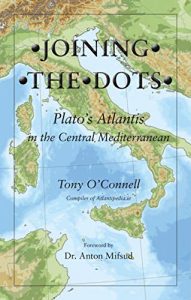
Joining The Dots
I have now published my new book, Joining The Dots, which offers a fresh look at the Atlantis mystery. I have addressed the critical questions of when, where and who, using Plato’s own words, tempered with some critical thinking and a modicum of common sense.Read More »
Jason Colavito
Giants
Giants are featured in the mythologies of many cultures globally. However, many of these same cultures also have ‘little people’ in their folklore (a). In Ireland, they were known as leprechauns.
Some commentators have striven to prove that a race of giants, as described in the Bible, such as the Nephilim, actually existed. This idea appeared to gain traction with the discovery of what appeared to be human bones in the 19th and early 20th centuries, that suggested above normal stature. This has led to ongoing controversy. A study of the biblical Goliath and his family is relevant here(j).
There is a rare genetic form of giantism known as acromegaly. The BBC published an interesting article on the genetic mutation that causes the condition being more common in Mid Ulster in Northern Ireland than anywhere else in the British Isles(h). A scientific study confirmed this localised prevalence(i).
Wikipedia has noted that the giants’ bones were either the result of “hoaxes, scams, fabrications or the misidentifications of extinct megafauna”(b). It also notes that as early as 1934, the idea of giants was debunked by Aleš Hrdlicka, curator of anthropology at the Smithsonian Institution(l). The Smithsonian has since been accused of a cover-up by creationists and conspiracy theorists. However, that institution has been ably defended by more rational researchers, such as Jason Colavito (c)(d)(e). He returned to the subject again in August 2025(k), when it was reported that US congressman Eric Burlinson, a creationist and UFO believer, suggested that there should be an investigation into the claim that the Smithsonian is hiding the bones of biblical giants!
A more recent development has been the linking of giants with Atlantis. I suspect that in some instances, Atlantis was added to the book titles, simply to enhance their salebility! The best known and probably the earliest extensive study came from Denis Saurat in the 1950s [536][537]. Since then, many, such as Tony Finlay(f), have touched on the subject. Richard Cassaro has advocated that megalithic structures in Italy had been built by giants from Atlantis(g). In the 2020s, the related book titles became more blatant – Giants of Atlantis[2115] (Patrick Chouinard, 2025), Giants and Atlantis[2114] (Laurent Glauzy, 2015). However. hard, irrefutable evidence is still lacking.
(a) Little people (mythology) – Wikipedia
(b) Giant human skeletons – Wikipedia
(c) http://www.jasoncolavito.com/1/post/2013/05/the-human-tendency-to-attribute-greatness-to-giants.html
(f) https://www.tonyfinlay.co.uk/
(g) Hidden Italy: The Forbidden Cyclopean Ruins (Of Giants From Atlantis?) – Richard Cassaro
(h) (BBC June 8, 2022) https://www.bbc.co.uk/news/uk-northern-ireland-61726811
(j) Hereditary Gigantism-the biblical giant Goliath and his brothers – PMC (nih.gov)
(l) The Oshkosh Northwestern. 3 March 1934.
Younger Dryas, The (YD)
The Younger Dryas, also known as Dryas III, was a mini Ice Age that lasted from about 10,700 BC until around 9600 BC. It is named after a wildflower called Dryas octopetala that flourished during this relatively short timespan. In Ireland, the event is known as the Nahanagan Stadial and in Britain as the Loch Lomond Stadial. In 2015, a paper constraining the date of the event to within 100 years, using Bayesian statistical analyses, proposed a period between 12,835 and 12,735 years ago(h).
For about thirteen hundred years the glaciers had been slowly retreating until within a short time-span temperature dropped and they began to advance again. The cause of this cooling is not entirely clear.
CAUSES
One view is that a sudden release into the North Atlantic of vast quantities of freshwater that had been contained by huge ice dams is assumed to have closed down the Gulf Stream, resulting in a twelve hundred year lowering of global temperatures. There is evidence that the change only took one or two decades. The same threat is said to exist today with the possibility of the melting of the Greenland ice cap. It also seems that this YD cooling ended with the same rapidity.
The most popular and controversial theory is that YD was caused by an extraterrestrial encounter. This is now known as the Younger Dryas Impact Hypothesis (YDIH) and can trace is origins back to 2006 (see below). This impact has been attributed to various bodies such as a large asteroid or comet, with Halley’s(ay) or Encke’s Comets and even a second Moon have sometimes been specified as possible culprits! Others have suggested reduced solar activity(ag) or volcanism on a global scale.
The November 2013 issue of the BBC Focus magazine [p.30] had a brief article on the impact theory, citing evidence that the northern hemisphere saw a drop of as much as 15°C around 11,000BC. In the absence of a suitable impact crater of the right age, there is still much scientific scepticism(b).
A recent application of archaeoastronomy by Martin Sweatman and Dimitrios Tsikritsis led them to conclude that the carved symbols at Göbekli Tepe recorded an encounter, involving the explosion or impact with part of Encke’s Comet around 13,000 years ago, which triggered the Younger Dryas Event, (sometimes referred to as the 13kya event) that provided the impetus for the Neolithic Revolution. Sweatman later expanded their work in his book Prehistory Decoded [1621] and an article on the Ancient Origins website(k). In June 2021, Sweatman had a paper entitled ‘The Younger Dryas impact hypothesis: review of the impact evidence’ published in the journal ‘Earth Science Review’ of the University of Edinburgh(u).
Kevin A. & Patrick J. Casey also maintain that a globally catastrophic event occurred 13,000 years ago(j). The kernel of their theory is that originally the Earth had two moons that at some later point collided, producing our current Moon, while the remnant of the second one eventually exploded over North America kick-starting what we refer to as the cooler Younger Dryas period. They are adamant that it was not a comet or asteroid that caused the devastation, and so clash with the conclusions of Richard Firestone and his colleagues.
A somewhat technical paper, published in July 2020, challenges the comet impact theory because of geochemical anomalies, Instead, they argue that the YD event was a consequence of widespread volcanic activity(s), rather than an impact! Martin Sweatman refutes this in a paper on Graham Hancock’s website(i).
A completely different view is expressed in Rod (Carl) Martin‘s latest book [1623], where he proposes that the Younger Dryas ended as a result of a catastrophic event. Is it possible that there were two cataclysmic episodes with opposite effects?
John Ackerman, a keen follower of Immanuel Velikovsky did claim that there were two such events related to “the capture of the Moon into its current orbit,” marking the beginning and the end of the Younger Dryas period(q).
Coincidentally, Professor Emilio Spedicato independently concluded that it was a cometary impact in the North Atlantic that was responsible for the Younger Dryas. Subsequently, when temperatures rose again it resulted in the flooding of vast areas of low-lying landmasses that in Spedicato’s opinion included Atlantis, which he locates in Hispaniola.
In 2020, Tony Petrangelo argued that the Younger Dryas event did not destroy Atlantis, but that it was more compatible with the story of Phaeton(ac).
A 2014 paper(ak) entitled Nanodiamond-Rich Layer Across Three Continents Consistent with Major Cosmic Impact at 12,800 Cal BP by Charles R. Kinzie et al., has developed further the idea of this event being associated with the Younger Dryas. In a similar vein is an article(ai) from Megan Gannon.
Additionally, in early 2017, further possible evidence of an impact at the start of the Younger Dryas was offered by a team led by Christopher Moore of the University of South Carolina, when they identified a distinct layer of platinum in the soil that coincided with the start of YD. Commenting on this anomaly Moore noted that “Platinum is very rare in the Earth’s crust, but it is common in asteroids and comets.”(e) In 2019, Moore published further data(m) supporting the extraterrestrial impact theory, based on studies carried out on sediments, which date back 20,000 years, from White Pond Lake, situated in southern Kershaw County, South Carolina. “Other examples of excessive platinum grains have been found across Europe, western Asia, Chile, South Africa(r) and North America.” (n)
The previous year saw two papers published online(i), reinforcing the YD impact theory as a global event and adding evidence that the event resulted in a conflagration that “may have consumed ?10 million km2, or ?9% of Earth’s terrestrial biomass.”
Related to this is a paper by Andrew Collins that draws attention to the ‘Usselo horizon’, a charcoal-rich layer of between 1 and 8 inches, found on all continents, indicating widespread fires, now dated to 12,900 years ago(l). An additional paper by Hans Kloosterman offers additional background information on the charcoal-rich layer(ab).
Ice cores from Greenland indicate a further cooling period circa 6200 BC that may be related to the abandonment of many Neolithic settlements during this period. Other periods of abrupt climate change have been identified from 3800 BC to 3500 BC and 2800 BC to 2000 BC.
The fact that Plato’s apparent date for the demise of Atlantis, circa 9600 BC, roughly corresponds with the current, best estimate for the date of the Younger Dryas is interesting but unfortunately not conclusive proof of any direct connection. On the contrary, the fact that Athens did not exist until millennia later would have made it rather difficult to have been attacked by Atlanteans at that early date. In the absence of any supportive archaeological evidence, a linkage between Atlantis and the Younger Dryas will have to remain a matter of faith rather than fact. Interesting but inconclusive.
In December 2014 Graham Hancock raised the issue of a cometary encounter as the cause of the Younger Dryas and its possible association with ancient Egypt(ah). In 2017, he reviewed the Younger Dryas debate over the previous decade in a lengthy essay(v). This was prior to the publication of America Before. He finished with the the following comment. “Perhaps the lost civilization that I have spent the last quarter of a century trying to track down had its most significant outpost, possibly even its heartland, in North America in the period BEFORE the Younger Dryas cataclysms of 12,800 to 11,600 years ago?” Hancock is inferring here that there was a single global civilisation, a hyperdiffusionist stance that I consider indefensible.
A short paper by John Patrick Hill offers a theory that requires more than faith to accept it; he wrote “Just over 12 thousand years ago, the world was struck by an immense meteor group. It destroyed all of North America and much of Europe and went weIl beyond……… I found proof to support that the creators of the Giza Three and Stonehenge used the Barringer Crater in Arizona as part of the geometry for their for their massive structures.” Later he reveals that at “Giza, when one takes the distance between the outside corners of the three large pyramids there, that distance is equal to 0.72 miles, the exact distance (diameter) at Barringer.” An extended version of Hills’s paper is available online(t).
In another paper, Hill(aa) says that “the Younger Dryas Meteor Event struck 12.8 thousand years ago and it was so large, it is wrote down not only in geologic records but also in holy books, as Noah’s Flood.”
Recent discoveries in northern Sudan of dozens of skeletons, the majority of whom were killed by flint-tipped arrows, have led to the suggestion(c) they were the result of food shortages resulting from the Younger Dryas that in turn led to warfare over diminished food availability.
In 2020, James Lawrence Powell (1936- ), a noted geologist, author, former college president and museum director entered the Younger Dryas debate with the publication of Deadly Voyager[1911]. In it, Powell offers wholehearted support to the Younger Dryas Impact Hypothesis (YDIH), understandably generating a favourable review from Graham Hancock(w). Even more important, is that Powell’s book induced a number of heavy-duty critics of YDIH, including Michael Shermer to change their opinion(x). In 2022 Powell concluded a paper reviewing the YDIH debates with the following; “Finally, we can now assess Sweatman’s suggestion that the YDIH may be ready for promotion from hypothesis to the status of theory. If we combine the definitions of “theory” from the National Academy of Sciences and the American Association for the Advancement of Science, it would read something like this:
‘A scientific theory is a well-substantiated explanation of some aspect of the natural world, based on a body of facts that have been repeatedly confirmed through observation and experiment. It refers to a comprehensive explanation of some aspect of nature that is supported by a vast body of evidence. One of the most useful properties of scientific theories is that they can be used to make predictions about natural events or phenomena that have not yet been observed.’
Those who have read this article and Sweatman’s have the information to decide whether the YDIH meets this definition. In this author’s opinion, there is a strong case that it does. Moreover, it should not be forgotten that no other single theory can explain the YD and its associated effects.”(y)
The YDIH is based on the claim that around 12,800 years ago the Earth had an encounter with a very large asteroid or comet that broke up in an airburst over North America and of which some fragments possibly hit the ground directly(ad).
Many effects have been linked with this event with varying levels of enthusiasm including a suggested association with the demise of Atlantis. Elsewhere, megafaunal extinctions, cataclysmic floods, the disappearance of the Clovis people and the creation of the Carolina Bays(aj), have all been proposed as consequences of this episode.
In 2006, Richard Firestone, Allen West & Simon Warwick-Smith published the foundations of the YDIH in The Cycle of Cosmic Catastrophes [110]. A year later the hypothesis had a more public airing at the American Geophysical Union Press Conference, Acapulco, Mexico, May 23(ag). This was followed the same year by the publication of a formal paper in the Proceedings of the National Academy of Sciences of the United States of America(ai).
Since then volumes have been written on the subject, both pro and con(af).
Martin Sweatman brought further evidence to bear on this debate in an article(al)on the Graham Hancock website. This focuses on the investigations at Hall’s Cave in Texas described in a paper by N.Sun et al, where the team concluded that the trace elements found there could indicate a volcanic rather than an impact as the cause of the Younger Dryas cooling! Sweatman disagrees with their conclusions claiming that there seems to be an element of selectivity in choosing data, leading to a wrong conclusion.
2019 also gave us a paper that included an extensive bibliography and overview of the YDIH debate(an). A Thai site also offers a wide-ranging look at the YDIH(ae). Conflicting evidence regarding the possibility of the Younger Dryas being caused by such an impact is impartially outlined on many internet sites(a).
I note that Robert Schoch claims that there is no evidence to support the Younger Dryas impact theory, instead, he believes that “it was most likely due to reduced solar activity at that time, a solar shut-down.”(aq) Schoch’s wide-ranging critique has been refuted by the Comet Research Group.(ar)
In 2012, Jennifer Marlon et al published a paper, now made available by her on the Academia website, in which they presents “arguments and evidence against the hypothesis that a large impact or airburst caused a significant abrupt climate change, extinction event, and termination of the Clovis culture at 12.9 ka. It should be noted that there is not one single Younger Dryas (YD) impact hypothesis but several that conflict with one another regarding many significant details.”(ap)
In 2011, an article by Nicholas Pinter et al offered a critical review of the evidence available at that time, which, from its perspective, did not fully support the YDIH(ax).
Scienceopen.com is a website offering “A peer-reviewed open-access journal collection covering all aspects of airbursts and impacts on Earth by comets and asteroids”. October 2023 brought the publication of five papers on the subject(as).
In March 2024, The New York Times Magazine published an updated overview of the history and current status of the YDIH(at). The sceptical tone of the article includes an interesting look at the psychological drivers behind the popularity of the hypothesis with the general public. It concludes noting that “In a sense, what West and his collaborators think now hardly matters. The hypothesis has already penetrated deeply, and perhaps indelibly, into the public imagination, seemingly on its way to becoming less a matter of truth than a matter of personal and group identity. Nobody I spoke with seemed to think it would go away soon, if ever. West, though, took a measured view. “All we can say is this is a hypothesis,” he said. “It’s still a debate. We may be wrong; we may be right. But only time will tell.”
In April 2024, geoarchaeologist Marc Young published a lengthy article(au) on Graham Hancock’s website, rebutting arguments put forward by YDIH sceptics.
Sweatman’s support for the YDIH has been challenged twice by archaeologist and geologist Vance T. Holliday and his associates(aw), the latest in December 2024, which was reviewed by Jason Colavito(av).
>>Although the 21st century has seen the YDIH gain widespread popular support, it has obscured the work of George Dodwell and Mike Baillie who have offered evidence of a more recent encounter with a comet or some other large extraterrestrial body around 2345 BC. This idea was also expressed by Willam Whiston in his 1696 book, A New Theory of the Earth [1162], where he contended that an encounter with a comet, in 2346 BC, caused the biblical Deluge, which in turn led to the destruction of Atlantis [p262 5th ed]. His book is now freely available online as a pdf file(az). Edmond Halley and Isaac Newton expressed similar opinions. We can conclude that it is possible that a number of cometary impacts have occurred over the millennia and may do so again.<<
(b) http://www.livescience.com/39362-younger-dryas-meteor-quebec.html
(d)
(f) http://www.space.com/17676-comet-crash-ice-age.html
(i) https://www.dailygrail.com/2018/02/a-comet-impact-13000-years-ago-set-fire-to-10-of-the-planet/
(j) https://www.academia.edu/38380799/13k_Theory_Atlantis_Revisited.pdf
(k) https://www.ancient-origins.net/history-important-events/younger-dryas-0012216
(l) http://www.andrewcollins.com/page/articles/Lommel.htm
(n) https://edition.cnn.com/2019/10/29/world/ice-age-extraterrestrial-impact-scn/index.html
(o) https://www.robertschoch.com/plasma_iceage.html
(p) Comet Research Group responds to Robert Schoch – The Cosmic Tusk (archive.org)
(q) Firmament and Chaos (archive.org)
(s) https://advances.sciencemag.org/content/6/31/eaax8587
(t) Archive 6555 | (atlantipedia.ie)
(u) The_Younger_Dryas_impact_hypothesis_MBS.pdf (ed.ac.uk)
(v) The Younger Dryas Impact research since 2007 – The Cosmic Tusk (archive.org) *
(w) https://grahamhancock.com/deadly-voyager/
(x) In praise of intellectual honesty – The Cosmic Tusk
(y) https://journals.sagepub.com/doi/full/10.1177/00368504211064272
(aa) Migration & Diffusion (migration-diffusion.info)
(ab) Catastrophist Manifesto (archive.org) *
(ac) https://atlantis.fyi/blog/atlantis-and-the-younger-dryas-impact-hypothesis
(ad) https://humanoriginproject.com/evidence-younger-dryas-impact-hypothesis/
(ae) YDIH: Younger Dryas Impact Hypothesis | Thongchai Thailand (archive.org)
(af) https://cometresearchgroup.org/publications/
(ag) https://www.youtube.com/watch?v=f1GCgOI3B1o
(ah) http://www.grahamhancock.com/forum/HancockG13.php
(a1) http://www.ncbi.nlm.nih.gov/pmc/articles/PMC1994902/
(aj) Carolina bays….in the Midwest? – The Cosmic Tusk (archive.org)
(an) YDIH: Younger Dryas Impact Hypothesis | Thongchai Thailand (tambonthongchai.com)
(ao) https://journals.sagepub.com/doi/full/10.1177/00368504211064272
(ap) (99+) Arguments and Evidence Against a Younger Dryas Impact Event | Jennifer Marlon – Academia.edu
(aq) https://www.robertschoch.com/plasma_iceage.html
(ar) Comet Research Group responds to Robert Schoch – The Cosmic Tusk (archive.org)
(as) https://blog.scienceopen.com/2023/10/introducing-comet-research-group-on-scienceopen/
(at) The Comet Strike Theory That Just Won’t Die – The New York Times (nytimes.com)
(au) The Younger Dryas Impact Hypothesis: A Guide For The Perplexed – Graham Hancock Official Website
(ax) https://www.sciencedirect.com/science/article/abs/pii/S0012825211000262
(az) https://gallica.bnf.fr/ark:/12148/bpt6k61715d/f14.item.r=.langEN *
Khufu
Khufu was the ruler of Egypt (2589-2566 BC) during the Fourth Dynasty and was also known as Cheops. He is generally credited with the commissioning of the building of the Great Pyramid at Giza. Herodotus accused Khufu of using slaves to build the Great Pyramid, but recent discoveries suggest that not slaves, but conscripted labourers were used. However, Khufu’s role in the building of the Great Pyramid has been disputed. In 2009 Andrew Gough published a lengthy paper on the controversies surrounding of Khufu(b), which is well worth a look.
In 2021 Marco M. Vigato involved himself in the long-running debate regarding whether Khufu was responsible for the building of Giza’s Great Pyramid. Following a ten-point argument supporting Khufu as the builder of the GP by Matt Sibson, whom we’ve met before in these pages, Vigato responded by producing a list of fifteen reasons why Khufu was NOT the builder of the GP(a).
Zecharia Sitchin, the controversial ‘alternative’ historian, entered the fray in 1980, with the claim that the only concrete evidence that the Great Pyramid had been built by Khufu, was a cartouche forged by Colonel Richard Howard-Vyse(c). In 2016 Scott Creighton published The Great Pyramid Hoax [2088] endorsing Sitchin’s forgery claim. Jason Colavito has written a two-part review of Creighton’s book(d)(e).
(a) https://www.academia.edu/45014007/15_Reasons_why_Khufu_did_NOT_build_the_Great_Pyramid
(b) https://andrewgough.co.uk/articles_khufu/
(c) http://web.archive.org/web/20191216195622/https://atlantipedia.ie/samples/archive-2494/
(d) https://www.jasoncolavito.com/blog/review-of-scott-creightons-the-great-pyramid-hoax-part-1
(e) https://www.jasoncolavito.com/blog/review-of-scott-creightons-the-great-pyramid-hoax-part-two
Abraham
Abraham is generally accepted as the Hebrew patriarch of the Abrahamic religions, Judaism, Christianity and Islam, possibly living in the 2nd millennium BC. The name Abraham and its variants has been identified(a) in many cultures, although the existence of Abraham as a real historical person has been disputed.
Nevertheless, there have been a number of efforts to connect Abraham with the religion of ancient India(b) . An Ancient Origins article(f) highlights some of the history of this idea – “A fascinating hypothesis, developed in recent years, proposes a vision of the patriarch Abraham totally different from what eminent biblical studies have until today reported. In 1552, the French linguist, astronomer and cabbalist Guillaume Postel (1510-1581) was among the first to correlate Abraham with Brahma, deducing his hypotheses from the study of the Jewish Zohar. In 1769, Immanuel Kant, similarly to what Voltaire wrote before him, compared Adam and Abraham with the Hindu Adimo and Brahma. In 1799, Joseph Priestley, in his text A Comparison of the Institutions of Moses with those of the Hindus and other Ancient Nations, took up the claims of Voltaire and Kant by re-proposing the possible derivation of Abraham from Brahma.”
The most publicised modern proponent of this view is Gene Matlock who offered his evidence in a paper titled Who was Abraham?(c)
He begins this document with three citations from ancient sources;
“In his History of the Jews, the Jewish scholar and theologian, Flavius Josephus (37-100 A.D.), wrote that the Greek philosopher Aristotle had said: “…These Jews are derived from the Indian philosophers; they are named by the Indians Calani.” (Book I:22.)
Clearchus of Soli wrote, “The Jews descend from the philosophers of India. The philosophers are called in India Calanians and in Syria Jews. The name of their capital is very difficult to pronounce. It is called ‘Jerusalem.'”
“Megasthenes, who was sent to India by Seleucus Nicator, about three hundred years before Christ, and whose accounts from new inquiries are every day acquiring additional credit, says that the Jews ‘were an Indian tribe or sect called Kalani…'” (Anacalypsis, by Godfrey Higgins, Vol. I; p. 400.)”
Matlock believes that India ruled our prehistoric world, including parts of America and furthermore. that Atlantis was located in South-East Mexico at San Lorenzo Tenochtitlan [0472]. In an attempt to link his Mexican location with Plato’s description of Atlantis, Matlock contends that the ‘elephants’ mentioned by him were the long-snouted tapirs of Meso-America!(e) Furthermore, he claims that there was a connection between India, the Phoenicians, Atlantis and Mexico.
However, Matlock by way of clarification, added “My readers should know that the ‘Atlantis’ described in this book may not be the same as Plato’s ‘Atlantis’. I’m just proving that there was once a part of the world called ‘Atlantis’ – that a part of Mexico once had the Sanskrit name Atlán, Tlan or Toltán, whose citizens were known as Atlantecas and Atlantl.” He then continues with “if my ‘Atlantis’ is not the real ‘Atlantis’ no one will ever find the one Plato mentioned.”
Matlock’s widely quoted internet article(c) begins with the identification of Abraham and his wife Sarai with the Hindu god Brahma and his wife Saraisvati.
In 2000, Matlock published Jesus and Moses Are Buried in India, Birthplace of Abraham and the Hebrews[0473], in which he develops this theme further.
A book supporting Matlock by the controversial Sri G. Ananda (Gregory Alexander) entitled Brahma: The God of Abraham [1187] was published in 2014. However, the idea is hotly debated on the internet by all interested parties, Christian, Muslim and Hindu.
Roger M. Pearlman tackled the subject of Atlantis in Plato’s Atlantis Legend Resolution: Abraham is the Real Atlas [1596]. Apart from the unexpected identification of Abraham, he also equates Hercules with the biblical Samson and places the Pillars of Hercules at Gaza. Disturbingly, he suggests that Sodom can be identified as Atlantis. Then, for good measure, he maintains that Göbekli Tepe was founded by Noah‘s family!
Jason Colavito had a critical view(d) of the recent (2017) Turkish documentary, supported by the government, which claims that Göbekli Tepe was built by Telah, Abraham’s father, and destroyed by Abraham.
(a) So Many Abrahams by Hiberia (archive.org)
(b) WELCOME TO AUM-SHALOM.COM (archive.org) (link broken)
(c) Abraham – Who Was He? / Viewzone
(e) http://viewzone.com/atlantis22.html
(f) The Other Side of the Flood: Was Abraham of Indian Descent? (ancientoriginsunleashed.com)
Dokras, Uday *
Uday Dokras is a prolific writer with a focus on Eastern religions and history. Many of his papers are available on the Academia website(a). He is reputed to have written the highest number of books and research papers! Included in his extensive output is a book entitled Atlantis – The Lost Continent. In it he reviews the subject of sunken cities and land both in the West and in the Orient, such as Kumari Kandam(b). His chapter on Atlantis offers little that is new and is simply a brief review of current theories.
He also produced a paper on the ancient lighthouse at Alexandria (Pharos)(c).
Arguably his most contentious offering is an extensive paper(d) on the existence of the vimanas of ancient India and Pakistan. He presents an array of evidence from Hindu scriptures and concludes with a review of modern writers and the unsuccessful attempts to design and build a vimana today using these old texts.
Although Dokras’ paper is worth a read, I suggest that it be undertaken along with the more critical responses of debunkers, such as, Jason Colavito who has drawn attention to the fact that “The concept of these flying chariots as UFO-style airships originates in a fraud, the Vaimanika Shastra, allegedly an ancient Sanskrit epic, but one “channeled” from the astral realm by a Hindu psychic in 1918. No evidence of this text exists prior to 1952, and even the “translator” of the text makes explicit that it was channeled from the spirit world between 1918 and 1923. The fake text specifically compares the vimanas to modern aircraft, describing their propulsion systems and other modern technological achievements.”(e) David Hatcher Childress’ story of the Vaimanika Shastra has been challenged elsewhere including an article by Andrew May(f).
(a) Dr. Uday Dokras | Stockholm University – Academia.edu (archive.org) *
(b) (DOC) ATLANTIS The lost Continent -BOOK | Dr. Uday Dokras – Academia.edu (archive.org) *
(c) https://archive.org/stream/lighthouse-of-alexandria-book/Lighthouse%20of%20Alexandria-BOOK_djvu.txt
(d) https://www.researchgate.net/publication/342491787_VIMANA_Ancient_Conquests_of_Wind *
(f) Knowledge from Nowhere | Mysterious Universe (no access) *
Le Flem, Michael
Michael Le Flem is an independent researcher and adjunct professor of history and philosophy. He is also the author of Visions of Atlantis published in December 2022.>>In February 2024, he was selected as Author of the Month on Graham Hancock’s website(b).<<
He begins by firmly placing the Atlantis story around 9600 BC, a date which you should know both archaeology and commonsense find totally unacceptable. But unfortunately, it gets worse when Le Flem proceeds to recruit Edgar Cayce as an authority on Atlantis, quoting liberally from his ‘readings’ and devoting over half the book to Cayce’s utterances on the subject, using seemingly endless quotations. Cayce’s name is mentioned 310 times, Plato’s 162 times, (actual quotes. Cayce 54 – Plato 13).
.Not content with that, he drags in the writings of Frederick Spencer Oliver, Rudolf Steiner and other theosophers to justify acceptance of Cayce’s ‘revelations’. I have pointed out elsewhere the unreliability of channelled information as well as question marks over the source of Cayce’s messages.
Le Flem frequently attacks Jason Colavito’s scepticism, which, at least, is usually based on more rational scientific grounds than Le Flem’s ideas. ‘Visions’ includes a few minor errors of fact. My final gripe is that the book lacks an index.
In January 2023, Le Flem had a chapter from ‘Visions’ published as an article on the Ancient Origins website(a) in which he puts forward the idea that the Azores might have been the location of Atlantis, although such a possibility was never suggested by Le Flem’s hero, Edgar Cayce. Before advocating such an idea Le Flem should explain how and why an Atlantis in the middle of the Atlantic would contemplate an attack on Athens which is around 4,500 km away with the primitive log boats or rafts which is just about all that was available in 9600 BC!
Overall, this book is worthless for anyone hoping for a science-based resolution to the Atlantis mystery. However, occultists will probably love it.
Corsetti, Jimmy
 Jimmy Corsetti is the owner of the YouTube channel Bright Insight which deals with a range of what is considered ‘fringe’ subjects. Over the past few years, he has been advocating the Richat Structure as the remains of Atlantis, despite a total lack of archaeological evidence and so much scientific support for its identification as a ‘salt dome‘.
Corsetti was overjoyed and felt vindicated when David Edwards published Atlantis Solved [1926] in April 2022 which also endorsed the Richat Structure as Atlantis. However, Edwards admits that he has built his claim on Corsetti’s earlier ideas regarding Richat and is only offering an echo of them.
It is now being trailed that Edward’s second book, Fingerprints of the Atlanteans, will be published in late 2023. We expect this to be a reprise of his first book. The pre-publication blurb ends with the claim that “this book changes everything!” I have heard that so many times before(a) and have always been disappointed. We can only hope that Edward does better this time rather than piggyback on Corsetti’s flawed ideas.
Having milked the Richat Structure for maximum publicity, Corsetti has now turned his focus on Gobekli Tepe and published an attention-seeking conspiracy theory regarding the management of this spectacular World Heritage site(b). Jason Colavito has recently (28/8/2025) pointed out that Corsetti’s “theory is based on a mistranslation he has never checked against the original”(c).
(a) 25% OFF PREORDER – Fingerprints of the Atlanteans – A History Of (archive.org)
Sweatman. Martin B. *
Martin B. Sweatman is a geochemist at the University of Edinburgh who gained wider recognition with the publication of  PreHistory Decoded [1621] in 2019. In it, he discusses many subjects dealt with in this compilation, such as Göbekli Tepe, Younger Dryas, and the Sphinx offering what the book’s subtitle describes as “a science odyssey unifying astronomy, geochemistry and archaeology.”
Building on the work of Clube & Napier he believes that around 10,900 BC an encounter with a fragment of Comet Encke led to catastrophic climate change of the Younger Dryas and kick-started the Neolithic Revolution. After an in-depth study of the carvings at Göbekli Tepe, he believes that they record astronomical events and in a 2017 joint paper with Dimitrios Tsikritsis, published in Mediterranean Archaeology and Archaeometry, (Vol.. 17, No 1) they offer an illustrated outline of this theory(a).
In 2021, Sweatman published two papers on the Researchgate website about the Younger Dryas Impact theory(e)(f).
He has also published a paper also on the Researchgate website in which he argues that knowledge of the precession of the equinoxes was known as far back as paleolithic times(d)(l)*.
Sweatman had previously used his scientific training to decode an early zodiacal system found across western Eurasia, from European Palaeolithic caves to sites in Turkey, Egypt and Mesopotamia. He has now gone one step further by linking Pictish symbols to this system.(b)
In May 2023, Sweatman returned to the subject of Göbekli Tepe in a paper on the Ancient Origins website(g). In it, he endeavoured to link the images found at Göbekli with the later symbols used in dynastic Egypt. He poses the question “But while the connections between Göbekli Tepe and Ancient Egypt are tantalizing, it is difficult to be certain of them. Could all these correlations between the animal symbols, constellations, Ancient Egyptian deities, mythical stories and writing methods just be a coincidence?” In a concluding paragraph, he answers it.
“So, the available genetic evidence strongly supports the idea that the builders of Göbekli Tepe were ancestral to the ancient Egyptians, and therefore all these symbolic connections we have noted are real and direct.”
In June 2023 article, Sweatman traced the evidence for the use of our zodiac symbology from the time of Paleolithic cave art (32,000 BC) and forward to Göbekli Tepe (11,000 BC) and Catal Hoyuk (7500 BC) in Turkey, the Dead Sea (4000 BC), then in predynastic Egypt and much later, on the monuments of the Picts in Northern Britain(h).
For balance, I offer links to some critical reviews of Sweatman’s theories(c)(j).
Sweatman had written a lengthy paper in which he claimed that there is clear evidence at both Göbekli Tepe and Karahan Tepe that a lunisolar calendar had been used there. He was unable to have the paper published until June 2024(i).
Sweatman’s support for the Younger Dryas Impact Hypothesis has been challenged twice by Vance T. Holliday and his associates, the latest in December 2024, which was reviewed by Jason Colavito(k).
(a) The_Younger_Dryas_impact_hypothesis_MBS.pdf (ed.ac.uk)
(b) Dr Martin Sweatman decodes ancient Pictish symbols | School of Engineering (archive.org)
(g) https://members.ancient-origins.net/articles/cosmic-symbolism
(h) Prehistoric Zodiacal Dating Code Revealed At Göbekli Tepe (ancientoriginsunleashed.com)
(i) https://martinsweatman.blogspot.com/2024/06/lunisolar-calendar-paper-accepted-for.html
Sea Peoples
The Sea Peoples is the name given by modern scholarship to a group of allies who caused havoc among the nations of the Eastern Mediterranean including Egypt, which they invaded at least twice, in the 2nd millennium BC. The phrase ‘Sea Peoples’ was never used in ancient records, in fact, the coining of the term in 1855 is now generally attributed to French Egyptologist, Emmanuel de Rougé who used the term ‘peuples de la mer’ (literally “peoples of the sea”) in a description of reliefs at Medinet Habu. The phrase was later popularized by another French Egyptologist, Gaston Maspero (1846-1916). Eckart Kahlhofer has recently suggested that even earlier, J. F. Champollion (1790–1832) employed an equivalent term ‘gens navales’ to describe the occupants of the invading swan-necked boats.
Also related to the carvings at Medinet Habu is an interesting study of the Sea Peoples’ ships depicted there, by the nautical archaeologist Professor Andrea Salimbetti’s website has a lengthy paper on Aegean Bronze Age ships(al) as well as the Sea Peoples(am).
Cyprian Broodbank in The Making of the Middle Sea [1127] argues that the Sea People “never actually existed as a single people. Instead, small roving bands were a symptom of the collapse, not the cause, and they were blown out of proportion by Egyptian propagandists working for Ramasses III.” (ai)
Broodbank is a co-author with Giulio Lucarini of a paper(av) about Mediterranean Africa that “draws on a new surge in data to present the first up-to-date interpretative synthesis of this region’s archaeology from the start of the Holocene until the threshold of the Iron Age (9600–1000 bc).”
Andrew Mark Henry offers a video in which he highlights the multiple mysteries surrounding the Sea Peoples primarily due to a lack of original documentation(bf).
Motivation
One website(h) describes the Sea People as groups of dispossessed raiders driven by hunger following crop failures resulting from climate change. The same idea is expanded on by Lu Paradise in an extensive article(v).
A different view was expressed by the Egyptologist Robert Anderson who commented “It would seem that, rather than bands of plunderers, the Sea People were probably part of a great migration of displaced people. The migration was most likely the result of widespread crop failures and famine.”(d)
Evidence is mounting that climate change played a significant part in the Late Bronze Age collapse of civilisations in the Eastern Mediterranean region. There is a school of thought that believes that the widespread societal disintegration was more the result of environmental factors rather than the depredations of the Sea Peoples(ag).
Origins
The Sea Peoples’ exact origin continues to be a matter of intense speculation(ad). The debate regarding their true identity has been ongoing for a long time and will probably continue as long as the chronologies of the Middle East are not fully harmonized to the satisfaction of most. One site offers 10 of the most popular identification theories(bh).
There is, however, some agreement that the Sea Peoples mounted two separate invasion attempts on Egypt around 1208 & 1176 BC (Facchetti & Negri).
Sea Peoples from the Adriatic
“While most of the Sea Peoples came from either the Aegean or the wider Mediterranean, many historians argue that groups from the Adriatic Sea also joined the migration. Specifically, Austrian historian Fritz Schachermeyr asserted in 1982 that the Sherden and Shekelesh were originally from the Adriatic and had connections to the ancient Illyrians.
Although Schachermeyr’s theory is not commonly held among students of the Sea Peoples, there are those who continue to believe that a famine in the Balkans drove several tribes, including the Illyrians, to migrate over land and over water(ba).”
Mycenaean Sea Peoples
The Oxford Companion to the Bible [0605] is certain that the Sea Peoples were originally Mycenaean, who moved south, following the collapse of their civilisation at the end of the Late Bronze Age. They were repelled by the Egyptians and then moved on to the Levant where they later became known as the Philistines. A paper(ab) that also links the Philistines with the Sea Peoples from a biblical perspective is available.
Shelley Wachsmann(aj), also offers evidence that at least some Mycenaeans were involved with the Sea Peoples(ak).
There is a claim that the Sea Peoples also attacked Mycenaean Greece on two occasions and that Athens survived both(ae). Contrast that with the contention that there was a Mycenaean group within the Sea Peoples. The confusion surrounding the Sea Peoples is exemplified by the response to a question on the quora.com website(af).
Sea Peoples from Anatolia (Northern Levant)
Erick Wright, formerly a regular contributor to the now-defunct Atlantis Rising forums(b) had initially thought that Atlantis had been situated in Morocco but further research led him to conclude that Atlantis was located in what today is Southern Turkey and that Atlanteans were among the Sea Peoples who attacked Egypt in 1200 BC. Another Atlantis Rising forum(e) on the subject is also worth a look as is another illustrated site(f) which includes a map of the homelands of the Sea Peoples.
The historian, Sanford Hoist, published a paper in which he argued(j) for an Anatolian origin for the Sea Peoples together with other groups such as the Phoenicians.
David Rohl, a high-profile archaeologist, has proposed an Anatolian homeland for most of the Sea Peoples listed by the Egyptians in his book, The Lords of Avaris [0232].
The most recent addition to our knowledge of the Sea Peoples appears to be imminent with the publication of a paper in the December 2017 issue of the journal Proceedings of the Dutch Archaeological and Historical Society. Written by Frederik Woudhuizen and Eberhard Zangger, the authors offer a translation of a 3200-year-old inscription That may refer to the Sea Peoples and link them with western Turkey. You can read more, now, on the Livescience website(z). In a 2006 paper(ac), The Ethnicity of the Sea Peoples, Woudhuizen included some groups from the Central Mediterranean as part of the Sea Peoples.
Erich Fred Legner offers an extensive paper(au) on the diversity of the Sea Peoples. Brian Janeway explored the idea that the Sea Peoples originated in the Northern Levant(aw).
Sea Peoples from Southern Levant (Modern Syria, Lebanon, Israel & Palestine)
Joseph Morris in his thesis(m) presented to the Classics Department of Florida State University in 2006 defined the Sea Peoples as “a coalition consisting of the indigenous populations of Syria-Palestine led by the neo-Hittite states.”
Eric Cline noted in 1117 BC: The Year Civilization Collapsed [1005] that the only member of the Sea Peoples alliance whose identity has been ‘firmly established’ is that of the Peleset who are accepted as Philistines. He also comments that identifying the Shekelesh with Sicily and the Shardana with Sardinia is based in part on the ‘consonantal similarities’ [p.4]. In a 2016 article, Cline wrote, “As for what role the Sea Peoples actually played in the destruction of civilizations around 1200 BCE and shortly thereafter, I personally think that they have been set up as a scapegoat, because of the Egyptian inscriptions, and that they were as much victims as oppressors. I doubt that they were responsible for all of the destructions that we blame on them and I think that they are only one of the many factors that together contributed to a “perfect storm” that ended the Bronze Age. These stressors, as they are sometimes called, probably also included drought, famine, earthquakes, and possible internal rebellions in addition to external invaders, all of which combined to cause a system to collapse.” (az)
In another paper(bi), Cline concluded as follows; “Let us simply restate the obvious, but frequently overlooked, observation that the earliest records attesting to the existence of Israel and the first indications of the phenomenon known as the Sea Peoples occurred simultaneously, in the fifth year of Merneptah’s reign. It is possible that these are not independent events, although they are usually treated as such in published studies of ancient Israel, and instead were related processes.
To the legendary figures of Moses and Joshua associated with the biblical stories of the Exodus and the Conquest of Canaan, we might want to now add the far less legendary but still anonymous and mysterious warriors within the Sea Peoples – the Eqwesh, Teresh, Lukka, Shardana, and Shekelesh coming across the sea from Greece, Turkey, Sicily, and Sardinia – or without the chaos and destructions that they wrought in the land of Canaan, and the power vacuum that they created in the area, the Israelites might never have taken over the region and the history of Western Civilization might have taken a radically different course.”
Sea Peoples or North Sea Peoples?
Until the middle of the 20th century, there was a consensus that the Sea Peoples originated in the Mediterranean region. That is until Jürgen Spanuth published his claim that Atlantis had been located in the North Sea and equated the Atlanteans with the Sea Peoples. This radical idea, with some variations, was adopted by several commentators and unsurprisingly, many were from Northern Europe. Spanuth referred to them as the North Sea Peoples [0015] and offered a range of evidence from the Egyptian inscriptions at Medinet Habu to support this idea. This evidence includes a variety of features that Egyptians used to portray the Sea Peoples such as types of swords, the shape of ships, shields and helmets as well as hair, clothing and shaving fashions. He then identified these Scandinavians as Atlanteans who later attacked Egypt. His opinion in this regard was strongly supported by Felix R. Paturi [1339.218]. More recently, Spanuth’s ideas have also been echoed by Walter Baucum in his Bronze Age Atlantis [0183].
In the 2007 DVD, Atlantis: Secret Star-Mappers of a Lost World, Childress identifies the Baltic as the original home of the Sea Peoples, reminiscent of the theories of Jürgen Spanuth, half a century earlier.
Similarly, Ellis Peterson endorses Spanuth’s Scandinavian location for Atlantis(ax).
Eckart Kahlhofer has now (2022) been investigating the idea of ‘North Sea Peoples’ for thirty years and supports the concept in his free ebook. He claims that in the twelfth century BC, the Egyptians referred to the Sea Peoples as the Nine Bows people, which is a geographical term.
Before the emergence of these Bronze Age seafarers, there was a history of Northern Boat-Peoples who gradually expanded globally after the last Ice Age. A paper by Andres Pääbo charts their story(k). Zach Zorich is a freelance journalist and contributing editor at Archaeology magazine. In January 2016 he wrote an article(r) that would seem to contradict the idea of Northern European ‘Sea People’ invading Egypt, for the simple reason that sailing boats were not developed in Scandinavia until around the time of the Vikings! – “The plank boats and log boats being built in northern Europe were not the most advanced watercraft of their time. The Greeks, Egyptians, and other cultures around the Mediterranean Sea used sailing ships to conduct trade, and sails wouldn’t be used in Northern Europe until the Iron Age, during the seventh or eighth century CE.”
Another site(an) also describes the various ships of the period used by the Egyptians, Greeks and the Sea Peoples. One unusual suggestion on the same site is that some of the Sea Peoples, although allied with groups from across the Mediterranean, came from Britain and Northern Europe(ao)!
The Sea Peoples’ Alliances
I have used the plural because the evidence suggests that over the extended period of the Sea Peoples activities, the alliances did experience some change in members.
Federico Bardanzellu offers several papers on his Museo dei Dolmen website(n) in which he suggests specific homelands for many of the members of the alliance(o).
Bob Idjennaden along with co-author, Mebarek S. Taklit, have produced The Mysterious Sea Peoples attack Egypt [1195], which provides an overview of the various incursions against Egypt during the 2nd millennium BC. The prominent part played by the Berbers or their ancestors in varying alliances that constituted the Sea Peoples is highlighted.
According to Raffaele D’Amato & Andrea Salimbeti [1152.20]+, the Denyen was one of the major groups of the Sea Peoples and have been known in ancient sources by different names; Danai, Danaoi, Danaus, Danaids, Dene, Danaids, Danuna. Others have linked them with the Danaan of Irish mythology. The Tuatha de Danaan invaded Ireland in prehistoric times. Having noted that Dan/Don/Danu were ancient words for water, it is not such a wild supposition that the Tuatha de Danaan were at least a constituent part of the Sea Peoples, an idea promoted by Leonardo Melis. A short review of D’Amato’s and Salimbeti’s book is available(bb).
On the other hand, Egerton Sykes thought that the Tuatha de Danaan were refugees from Atlantis, an idea he expressed in his 1949 edition of Ignatius Donnelly’s Atlantis. A paper offering a sober Irish (not an oxymoron) view of the Tuatha de Danaan should also be read(bc).
Sykes was convinced that Murias one of the four legendary cities of the de Danann had been located in Bimini. This highly speculative idea failed to bear fruit as have all efforts to identify the location of the other three cities, Falias, Finias and Gorias.
Speculation regarding the identity of individual tribes in the federation can be found on various websites(i)(f). One of the most comprehensive is provided by two Italian military historians, D’Amato & Salimbeti in their 2015 booklet [1152]+ and on the internet(l) and both are to be highly recommended. They highlight the complexities involved in definitively identifying the members of the varying alliances that were loosely described as the ‘Sea Peoples’ over a three-hundred-year period.
Atlantis and the Sea Peoples
The German classical scholar, Wilhelm Christ, was probably the first to identify the invading Sea Peoples with the Atlanteans(p), predating Jürgen Spanuth’s theory by the better part of a century. Christ’s idea was also supported to varying degrees by Theodor Gomperz, Spyridon Marinatos, John V. Luce, and Herwig Görgemanns. A translation of the relevant text of Christ’s 1886 paper was recently published by Jason Colavito(bd).
Quite a number of other writers have identified the Atlanteans as the Sea Peoples whose invasion of the Eastern Mediterranean has been recorded in some detail by the Egyptians. One such high-profile identification in the 20th century was by Spyridon Marinatos. One of the latest to join this school is Dr Rainer W. Kühne who not only makes the same identification but, using satellite images, believes that he has pinpointed the capital of Atlantis in Southern Spain. His website has a list of comparisons of Atlanteans to the Sea Peoples(a), which is worth consideration.
‘Rider’, the anonymous author of an article(ae) concerning ‘the campaigns of the Sea Peoples’ on the allempires.com website also suggests that Plato’s Atlanteans can be identified with the Sea Peoples.
Frank Joseph contends that conflict between the Egyptians and the Sea Peoples was part of the Trojan War [0108.11] and has identified the Meshwesh, one of the Sea Peoples, as Atlantean [1535]. His speculation extended to describing ‘the Atlantean Sea Peoples’ as culture bearers who were responsible for, among other matters, the famous Serpent Mound of Ohio(ay).
Eberhard Zangger argues that the Sea Peoples were survivors of the Trojan War that fled to various parts of both the central and eastern Mediterranean(g). He has written further on this identification and more on the Luwian Studies website(s). Zangger claims that the Sea Peoples were an alliance of Libyans and Western Anatolian (Luwian) states(w)(y), which seems odd since Plato describes the Atlanteans as mightier than Libya and Asia combined. If Zangger is correct in identifying Troy as Atlantis [0483], he is also implying that according to Plato, a part (Troy) is greater than the whole (Libya and Asia combined), Troy being part of Asia! Something is wrong with his theory.
In a 2022 article in Popular Archaeology (Oct.15 2022)(bg) Zangger returns to the identification of Luwians as part of the Sea Peoples.
In 2020, Sean Welsh maintained that survivors of the eruption of Thera, which held the capital of Atlantis ‘morphed’ into the Sea Peoples [1874].
Other Theories
A more recent (2017) paper(aa) on a conservative website suggests that the Sea Peoples were ‘early Western Europeans’.
W.S. Baird has also offered a western Mediterranean identification for the Sea Peoples, whom he considers to have originally been colonists from the Aegean who settled in the southeast of Spain and are known as the El Argar culture! Their society suffered some form of collapse around 1350 BC and according to Baird is in some way connected with the emergence of the Sea Peoples!(ap)
The most radical suggestion regarding the Sea Peoples has come from Jim Allen, who promotes a South American location for Atlantis. He also seemingly equates at least some of the Sea Peoples with his South American Atlanteans [077.123], and has drawn attention to the similarity of some of the Sea Peoples’ headgear with that of Amazonian ‘Indians’(c)!
The Malagabay website published a lengthy article(t) in July 2016, offering evidence along with some conjecture, supporting the equally extreme idea that the Sea Peoples had originated in India and having migrated westward, some of them reached the Aegean and became known as Dorians! The author of the article appears to have followed the ideas of Edward Pococke (1604-1691) published in his India in Greece [1231].
Another unexpected twist is the claim by the discoverer of the Phaistos Disk, Luigi Pernier, that the characters used on the Disk are similar to the representations of the Sea Peoples at Medinet Habu.
Peter Adamis, an Australian ex-military serviceman has devoted a section of his website to the question of the Sea Peoples’ identity. It offers a large number of related videos and papers(be).
Two contributors to the Sea Peoples debate in the 1970s were Alessandra Nibbi (1923-2007) [1670] and Nancy K. Sandars (1914-2015) [1671] who, although they had their differences, appear to have agreed on: “(a) the ‘Sea Peoples’ were not one particular people, (b) their label as being ‘of the sea’ is misleading, and (c) earlier attempts to blame the cataclysmic collapse throughout the East Mediterranean in the Late Bronze Age on the Sea Peoples is untenable.”
Sources
The earliest book devoted entirely to the Sea Peoples, which I am aware of, was Immanuel Velikovsky’s Peoples of the Sea. However, Velikovsky was more concerned with revising the chronologies of the Middle East and so focused on dating the invasion of the Sea Peoples rather than identifying their origins. Velikovsky has an interesting footnote in his Peoples of the Sea [758.4], which reads; “When Ramses III speaks of ‘Peoples of the Sea’ he specifies the Tkeker, the Shekelesh, the Teresh, the Weshesh and the Sherden (or Sardan); he specifies the Denyen as ‘Peoples of the Isles.'” It would be interesting to know the reason for the distinction.
Trude & Moshe Dothan have added another valuable book to the Sea Peoples’ literature with their People of the Sea which has the interesting sub-title of The Search for the Philistines [1524]. Related to their work, is the result of recent excavations at Ashkelon, an important Philistine city, which suggests that the city had received migrants from southern Europe during the Bronze Age, who may have constituted a component of the Sea Peoples(ah). Clearly, further investigation will be required to confirm these indications.
An extensive review of all the available material relating to the Sea Peoples was also published online in October 2015(q). The MalagaBay website (now closed) had also a wide-ranging illustrated article(u) about the Sea Peoples, although without reaching any firm conclusions.
[1152.20]+ https://img.4plebs.org/boards/tg/image/1498/88/1498880873171.pdf
(a) Location and Dating of Atlantis (archive.org)
(c) http://web.archive.org/web/20210514155705/http://www.atlantisbolivia.org/headgear.htm see part atlantis bolivia part 4 conclusion, mummies,uente magna and links
(d) https://web.archive.org/web/20181014190855/http://www.touregypt.net/featurestories/seapeople.htm
(g) http://archive.aramcoworld.com/issue/199503/who.were.the.sea.people.htm
(h) http://www.historyfiles.co.uk/KingListsMiddEast/AnatoliaSeaPeoples.htm
(i) Archive 2813 | (atlantipedia.ie)
(j) http://www.phoenician.org/sea_peoples.htm
(k) http://web.archive.org/web/20211202125709/https://atlantipedia.ie/samples/archive-2337/ (all three parts)
(l) http://www.salimbeti.com/micenei/index.htm
(n) http://www.museodeidolmen.it/englishdefault.html
(o) http://www.museodeidolmen.it/englishpopomare.html
(p) Abhandlungen der bayerischen Akademie der Wissenschaften, Vol.. XVII, 2nd part, Munich 1886, pp. 451-512. (German)
(q) http://www.salimbeti.com/micenei/sea.htm
(r) https://hakaimagazine.com/news/uncovering-culture-bronze-age-logboats/
(s) https://luwianstudies.org/the-sea-peoples-inscriptions-and-excavation-results/
(t) https://malagabay.wordpress.com/2016/07/07/catastrophic-english-india-in-greece/
(u) https://malagabay.wordpress.com/2016/02/18/deja-vu-vikings/
(w) https://luwianstudies.org/the-sea-peoples-inscriptions-and-excavation-results/
(x) http://rlebling.blogspot.ie/2012/03/where-was-ogygia-isle-of-calypso.html
(z) https://www.livescience.com/60629-ancient-inscription-trojan-prince-sea-people.html
(aa) http://web.archive.org/web/20210726013908/https://atlantipedia.ie/samples/archive-3429/
(ab) https://img.4plebs.org/boards/tg/image/1498/88/1498880873171.pdf
(ac) https://www.academia.edu/7287651/The_Ethnicity_of_the_Sea_Peoples_dissertation_
(ad) https://listverse.com/2016/06/06/10-theories-regarding-the-sea-peoples/
(ae) The Campaigns of the Sea Peoples – All Empires (archive.org)
(ah) https://advances.sciencemag.org/content/5/7/eaax0061
(ai) https://www.reddit.com/r/history/comments/c3fm5j/who_were_the_mysterious_sea_people_during_the/ (halfway down page)
(aj) https://www.academia.edu/4594906/The_Ships_of_the_Sea_Peoples
(ak) https://www.academia.edu/4635111/Were_the_Sea_Peoples_Mycenaeans_The_Evidence_of_Ship_Iconography
(al) http://www.salimbeti.com/micenei/ships.htm
(am) http://www.salimbeti.com/micenei/sea.htm
(an) Ancient Ships: The Ships of Antiquity (archive.org)
(ap) The Origin of the Sea Peoples (archive.org)
(as) Cambridge Ancient History, Ist edition, Vol.II, p.8
(at) https://www.academia.edu/34555497/The_Sea_Peoples_Superior_on_Land_and_at_Sea
(au) File: <seapeopl (archive.org)
(ax) https://hiddenhistorysecrets.blogspot.com/2008/01/hidden-history-scandinavia-atlantis.html
(ay) Atlantis Rising magazine #36 http://pdfarchive.info/index.php?pages/At
(ba) https://listverse.com/2016/06/06/10-theories-regarding-the-sea-peoples/
(bc) https://www.irishcentral.com/opinion/others/tuatha-de-danann-irish-gods-aliens
(bd) Atlantis and the Sea Peoples – JASON COLAVITO
(be) SEA PEOPLES – ABALINX (archive.org)
(bf) https://www.thearchaeologist.org/blog/who-were-the-sea-peoples
(bh) Wayback Machine (archive.org)
(bi) https://www.academia.edu/355166/2009_Cline_Sea_Peoples_and_Israelites_article
Deluge of Noah
The Deluge or Noah’s Flood are the commonly used terms when referring to the biblical flood of Genesis. It might perhaps be more accurate to use the plural, as there is evidence of several large-scale catastrophic inundations within the human memory. The Noachian deluge has been the subject of continuous debates: was it real or pure fantasy, was it local, regional or global and is the Ark to be found on Mt. Ararat?
Reginald Fessenden controversially noted in his, The Deluged Civilization of the Caucasus Isthmus [1012] that “the traditions were collected, tabulated and compared. This developed the fact that there were only five traditions of an inundation of more than local character.”
1. The Greek tradition; of Deucalion; the Aegean, 100 to 250 miles southwest of the Black Sea.
2. The Egyptian-Phoenician; of Atlantis and the Greeks; the western and northeastern shores of the Black Sea.
3. The Cimmerian; of the Crimea; the north shore of the Black Sea.
4. The Hebrew-Babylonian; of Noah and Atra-Hasis; the southeast shore of the Black Sea.
5. The Phrygian; of Noe; the south shore of the Black Sea.
The Flood of Noah is an echo of the Babylonian Gilgamesh epic, which in turn has a resonance with the deluge story of Manu in Indian mythology. If all three relate to the same event, it would be of great interest to discover if there was an even earlier shared origin.
Noah is the hero of the Deluge story in Genesis. He was also an accomplished shipbuilder and viticulturist. According to some, he was also an Atlantean! Cosmas Indicopleustes, a 6th century AD theologian and geographer from Alexandria, wrote of Atlantis as a large island in the western ocean. He also added a twist to the tale by recording an ancient tradition that Noah had resided on Atlantis! More recently, Frank Joseph [108.85] has endorsed this daft idea.
Interestingly, so many of the deluge stories include a scenario where the ’hero’ is warned of impending doom. To me, this would make sense that where a landbridge was threatened by gradually rising waters on one side, simple observation would have provided adequate time to warn those at risk on the other side.
Another identification, by Robert Bowie Johnson Jr., is that Noah is Nereus in Greek mythology and widely depicted in Greek art(c). Confusingly, it has also been suggested(a) that Enoch, usually accepted as the grandfather of Noah, was the same person.
According to Plato, Atlantis was destroyed by the gods as a punishment for their wickedness, while the same reason is given in the Bible for the obliteration of Noah’s people. Coincidentally, both Atlantis and Noah’s homeland, which was probably located in Mesopotamia, were destroyed by water, leading to the not unreasonable suggestion that the two stories are related.
While the biblical account of the Deluge does not stand up to detailed scrutiny(j), the global ubiquity of Flood stories is seldom adequately explained. Some possibilities that occur to me are related to the ending of the last Ice Age, which had watery consequences around the world. While the rising sea level took place in fits and starts, there were more dramatic events during this period, such as the huge meltwater lake discharges and Heinrich Events that occurred across North America and Eurasia. The effect in the southern hemisphere was less spectacular. Survivors would have been forced to migrate in all directions, bringing their account of these floods with them. Another explanation, but in my view, a more likely cause of global floods, would have been a close encounter with a large extraterrestrial body, an idea promoted by various researchers such as Emilio Spedicato, who nominated Mars as the guilty party.
Apart from the story of the actual flood, global or otherwise, the detailed biblical account of the building of the Ark, along with the gathering of the animals and the voyage itself does not hold water (sorry)(y). Some decades ago, Roger A. Moore offered a forensic study of the account, which, is still impressive(x).
In March 2019, a paper by Roger M. Pearlman, put forward another radical idea, namely, that Göbekli Tepe had been founded by Noah (Noach) and his sons(u).
A more light-hearted look at the story of Noah is also worth a read(n).
Every aspect of Noah’s Deluge story in the Bible has been a source of controversy for centuries. From the nature and cause of the Flood itself, as well as the building of the Ark and its final resting place and of course the date of the event.
Some years ago, Pastor Bertrand L. Comparet (1901-1983), a staunch racist(w), denied that the Flood of Noah had been a global event(v).
2018, began with matters hitting rock-bottom, when an English-language newspaper offered the following headline(l) “Turkish academic claims Prophet Noah used a cell phone to call his son before the flood.” Unsurprisingly, Jason Colavito has covered this story with an interesting blog(m).
DATE
Plato’s Atlantis story contains a curious reference in Timaeus (23a-c) to a series of floods that occurred in the Eastern Mediterranean(ah) since the Atlantean war, namely, those of Ogyges, Deucalion and Dardanus. If based on historical fact, on its own, the Biblical Flood or the breach of a landbridge cannot explain this succession of inundations, but suggests that there could be a much more complex story still to be revealed, which was spread over millennia.
Anastasios Stamou, presented a paper [750.183] to the 2008 Atlantis Conference, in which he reviewed the evidence relating to three floods that befell ancient Greece and alluded to by Plato. Drawing on ancient Greek texts, including the Parian Marble, he places these events in chronological order, beginning with the flood of Ogyges, then Deucalion’s and finally that of Dardanos.
Three very ancient global floods are proposed by Marin, Minella & Schievenin in The Three Ages of Atlantis [972] and date them to 10,500, 9600 and 6700 BCE.
Stamou accepts that conventional wisdom has it that these flood events occurred in the 2nd millennium BC and based his paper on that assumption. However, he expressed serious doubts about this dating, suggesting a much earlier date for some inundations and promising a future paper dealing with this revision.
Stephen Oppenheimer mentions [0004] three sudden ice melts, 14,000, 11,500 and 8,000 years ago that would have had a global effect. It should be considered that the second date is close to Plato’s apparent date for the destruction of Atlantis.
Since writing, as we know it, did not develop until long after de-glaciation, it is virtually impossible to precisely identify the date, location or extent of any of the early myths relating to these possible de-glaciation inundations.
In an August 2017 paper, on the Migration & Diffusion website(s), Stuart L. Harris put forward his reasons for dating the Flood of Noah to 3161 BC and the Exodus Flood to 1445 BC.
Similarly, Gérard Gertoux places the Deluge circa 3200 BC in a lengthy paper(z), in which he also controversially touches on subjects such as radiocarbon dating, the age of the patriarchs, the Ice Ages, evolution and more.
China has its own ‘Great Flood’ tradition, which in the August 2016 edition of Science journal had its reality given strong support in a paper(bi) by a mainly Chinese team of researchers, who date the event to 1920 BC.
Recent years have seen the above-mentioned flooding of the Black Sea, or even more controversially, the flooding of the desiccated Mediterranean basins, following the breaching of a suggested landbridge at Gibraltar, proposed as possible sources of the story of Noah in the Bible. These inundations are dated to around 5600 BC and their memory should have survived in the traditions and mythologies of the region. In addition to that, the Persian Gulf is also accepted by many to have been dry during the last Ice Age, but also began to flood around 5000 BC. In Northern Europe, the Baltic Sea and the Celtic Shelf both suffered post-glacial inundations, while around the same time in the South China Sea, the enormous Sunda Shelf suffered extensive flooding.
The flooding of the Celtic Shelf along with parts of southwest Britain and southeast Ireland is the subject of a 2016, thought-provoking book [1166] by Philip Runggaldier
On a more controversial level, Donald Patten and Samuel Windsor presented evidence [0277] for a series of close encounters between Mars and the Earth during the 1st millennium BC. David Rohl, the Egyptologist, dates Noah’s Flood to 3114 BC [0229] and links it with the climatic consequences of a major catastrophe in the Aleutian Islands.
Alexander and Edith Tollman linked the Noachian Deluge with the consequences of a cometary impact in 7552 BC. On the other hand, G.F. Dodwell, the Australian astronomer, after studying ancient gnomons, concluded that it was a worldwide catastrophe in 2345 BC, that altered the Earth’s tilt, leading to the Deluge. This is comparable with the 1696 claim by William Whiston, that the earth had an encounter with a comet in 2346 BC, which caused the Flood of Noah. Emilio Spedicato advocates 3161 BC, as the date of the biblical Deluge(ac), which has also been endorsed by Stuart L. Harris(ad).
In a paper(r) revised in 2017, Barry Warmkessel noted that theologians and historians have attempted dating Noah’s Flood event, both recently and as far back as the time of Christ. The following are just a few of the results from these attempts:
- JOSEPHUS GREAT FLOOD DATE: (3148 BC)
- HALES GREAT FLOOD DATE: (3155 BC)
- SEPTUAGINT GREAT FLOOD DATE: (3246 BC)
- SAMARITAN PENTATEUCH GREAT FLOOD DATE: (2998 BC)
Therefore. theologically at least, it seems quite reasonable (to Warmkessel) that Noah’s Flood occurred between 3000 and 3250 BC and that the Ark would have been built slightly before that time.
When Ryan & Pitman(ae) published their 1997 theory that around 5600 BC, the Black Sea had been flooded by water from the Aegean breaching the Bosporus, it did not take long before it was speculated that the event was reflected in the story of Noah’s Deluge. With little delay, strong objections to the idea were raised by many others(af)(bz).
T.R.Holme has an interesting article(ax) on the flooding of the Black Sea and the migration from the region that resulted. He also links that event with the work of the late Marija Gimbutas (1921-1994).
Nick Thom, an engineering lecturer at Nottingham University has written The Great Flood [776] which gives an overview of many Flood myths, but more importantly, he identifies the emptying of glacial Lake Agassiz around 6250 BC, as the mechanism that caused a tilting of the Earth, which in turn generated a global deluge remembered by the survivors in myth and later recorded in scriptures. This is also fully outlined in a lengthy entitled, A Re-interpretation of the 8.2ky BP Event(ag). Also relevant to our subject is his claim that the flow of water was from the Black Sea into the Aegean rather than the other way around!
The most radical date for the Flood of Noah comes from Rich McQuillen who in a 2022 paper “links the flood of Noah to the flood of Ahmose and Atrahasis, and shows it to be a real flood caused by Santorini”!(bv)
THE CAUSE
Jeffrey Goodman, the controversial author of Psychic Archaeology [781], maintains that “Noah’s Flood was, in reality, a tsunami caused by a comet” and supports this contention with a retranslation of Genesis 7:11 (ar).
Kirk Kirchev in a recent (April 2018) two-part article(bb) “offers a unifying scientific hypothesis that connects diverse ancient flood myths with mainstream scientific fact.” and concluded that “If my calculations and assumptions are correct, an object of around 900 km in diameter passing the earth at an altitude of less than 1000 kilometres (621.37 miles) (of average, rocky density) would be large and heavy enough to create a strong localized tidal uplift in the oceans beneath its flight path (approximately 50 times the current tidal amplitude). That is large enough to destroy most of humankind, and a large portion of the fauna, but small enough to not cause a major extinction event or to disturb earth’s orbital path and rotation.”
Immanuel Velikovsky’s controversial cosmological ideas suggest that our Earth had at one point been a satellite of Saturn! In his unpublished book, In the Beginning (bk), he proposed that “The conflict between the larger planets resulted in long-stretched filaments ejected by a disturbed Saturn to cross the Earth’s orbit. The hydrogen of the planet combined with the oxygen of the terrestrial atmosphere in electrical discharges and turned into water” and so generated the Deluge!
In 1993, Alexander Tollman and his wife Edith published, Und die Sintflut gab es doch. Vom Mythos zur historischen Wahrheit, “which claimed that Noah’s flood was the consequence of a bolide impact about 9500 years ago, and supported the claim through geology (impact craters, iridium, shatter cones, stress lamination of minerals, radiocarbon dating, dendrochronology, a peak of acid in the Greenland ice) and legends and folk traditions.”(bj) Christian O’Brien has endorsed the Tollmans’ ideas(bl).
Aloys Eiling (1952- ) a German researcher, has offered a variation on the close encounter theory, suggesting that the Deluge was one of the consequences of the capture of our Moon that took place when our planet was already populated – somewhere between 40,000 and 13,000 BC. He notes(bn) that “the capture of the Moon caused worse than a flood; it changed the geography of the world. Earth’s surface was devastated, millions died, and life in total was brought to the brink of extinction. In the collective memory of mankind, the event indelibly remained in the myths about a Deluge.”
Nevertheless, there is one rather disturbing element to be found alongside some of the flood myths, namely that the deluge event was concurrent with the sun seemingly standing still and in some cases, it is recorded that the Moon also appeared to stop(o)(av)! One explanation on offer is that it is a reference to an eclipse(aw). This might be acceptable if it was compatible with other myths from different parts of the world, which does not appear to be the case. Furthermore, it does not explain the association of the stopping of the sun with the global deluge. A very close encounter between the Earth and another large celestial body might.
As I see it, we are left with the two popular explanations for the global flood myths, either a close encounter with an extraterrestrial body that created a megatsunami on such a scale that it swept around the globe, perhaps many times before dissipating, or the melting of the Ice Age glaciers produced the cyclical bursting of ice-dams and landbridges and the inundation of vast areas of low-lying land. I’m inclined to believe that the balance of probabilities favours the latter explanation, although I find it difficult to accept that gradual deglaciation would or could, have generated floods that ‘covered mountains’ (Gen. vii.19)!
Other floods may have been caused by tsunamis resulting from underwater earthquakes and/or storegga. Quite recently it was discovered(bh) that around 6000 BC, a calamitous tsunami was generated in the Mediterranean when Mt. Etna in Sicily sent approximately 6 cubic miles of rock and rubble crashing into the sea. One could be forgiven for speculating that this event may have triggered the flooding of the Black Sea, which is dated to this same period.
GLOBAL or LOCAL
The scientific case against a global deluge is presented in a paper by Lorence G. Collins(bt), who also published a study of Genesis 7:11, which in describing the Deluge notes “on the same day all the fountains of the great deep burst open, and the floodgates of the sky were opened.”
In 2013, Geologist David R. Montgomery, a professor at the University of Washington, authored The Rocks Don’t Lie [2029] which offered a fresh open-minded look at Noah’s Flood and how it is viewed today by both science and religion. He concluded – “Like most geologists, I had come to see Noah’s Flood as a fairy tale—an ancient attempt to explain the mystery of how marine fossils ended up in rocks high in the mountains. Now I’ve come to see the story of Noah’s Flood like so many other flood stories—as rooted in truth.”
“It appears that humanity’s rich legacy of flood stories reflects a variety of ancient disasters. The global pattern of tsunamis, glacial outburst floods and catastrophic flooding of lowlands like Mesopotamia or the Black Sea basin, fits rather well the global distribution and details of flood stories.”
So Montgomery considers the source of Noah’s Flood to have been a local event such as the flooding of the Black Sea region and refers to Angelos Galanopoulos, who similarly associated the tsunamis generated by the mid-second millennium BC eruption of Thera (Santorini) with the Flood of Deucalion. Montgomery’s views were given further exposure on the LiveScience website(bx).
A decade later (May 2023), the Greek Reporter website re-examined the possible extent of Noah’s Flood(by).
THE ARK
An interesting overview of traditional, as well as modern thinking, regarding the possible historical reality behind the Deluge of Genesis is presented(ai) by Robert Squillace, on the New York University website.
On January 1st,2010 it was revealed(b) that a 3,700-year-old Babylonian tablet which, unlike the biblical record, describes an ark made of reeds, 70 metres in width and round in shape(aj)(ak). This would have been recorded a thousand years before the Genesis story was written down. Understandably, this has caused the knickers of some fundamentalist Christians to become seriously twisted! The discovery has now been expanded on by a cuneiform specialist at the British Museum, Irving Finkel, in The Ark before Noah [0995]. Jason Colavito offers an interesting review of the book(d).
There is an unexpectedly large number of books written over the last century on the subject of Noah’s Ark that is listed on a specialist website(e). One such offering, resurrected by Jason Colavito(f), provides some comic relief with the claim in 1922 by C. E. Getsinger, who wrote that Noah’s Ark was the Great Pyramid!(g) Even earlier, John Taylor (1781-1864) claimed [1451] that Noah had built the Great Pyramid! Nevertheless, a recently deciphered fragment of the Dead Sea Scrolls has suggested that the Ark was shaped like a pyramid!(h)(i)
Even more radical is the result of a high-tech study of fragments of the Dead Sea Scrolls, which suggest that Noah’s Ark was pyramidal in shape(al)! Commenting on this report,
Even more radical is the result of a high-tech study of fragments of the Dead Sea Scrolls which suggest that Noah’s Ark was pyramidal in shape(al)(h)(i)! Jason Colavito has pointed out that the concept of a pyramid-shaped ark is not new(am).
Haaretz reported that the new reading of the fragments has changed our understanding about Noah’s Ark. Thanks to the high-resolution imagery, a word following the phrase “the ark’s tallness” had previously been illegible. However, the new scans showed that the correct words is ne’esefet, meaning “gathered,” which according to researcher, Dr. Alexey Yuditsky, means that the ark’s ribs were gathered together at the top in the shape of a pyramid. Dr Yuditsky said that the Septuagint, a Greek translation of the Bible dating to the third century BC, used a Greek verb with a similar meaning to describe the Ark. Moreover, medieval authors like Maimonides suggested that the ark’s roof was pointed.
Commenting on this report, Jason Colavito has pointed out that the concept of a pyramid-shaped ark is not new(am)citing the work of Lorenzo Ghiberti (1378-1455), who was actually depicting a widespread Jewish and early Christian belief about the Ark. Origen, in Genesis Homily 2, Philo in Questions and Answers on Genesis 2.5, and Clement in Stromata 6.11, all claimed that the Ark was pyramidal in shape. They derived this from the account in Genesis, which claimed that the Ark is 300 by 50 cubits at the base, but rose to a window embedded in a peak, but one cubit square. They concluded, therefore, that the ship must be pyramidal to fit those measurements.
Barry Warmkessel also entered the fray with the suggestion that aliens had been involved in the design and construction of the Ark(r)!He believes “that it was NOT built by humans ~5200 years ago. It offers details of alien engineering principles involving the Golden Ratio. Its metallurgy shows ironwork not even possible until ~3200 years ago as well as the presence of other metals (e.g. titanium and aluminum) that would have been difficult to fabricate even in the early twentieth century. The Book of Noah explicitly specifies that “angels” (with extensive metallurgical skills) built the Ark. They were likely the Nommos, an amphibian species reportedly from the Sirius star system. They left mankind with cuneiform writing and the wheeled vehicle (alien technology of that day). They offered us astronomical knowledge of their own and our solar system (including Vulcan) and evidence of a past major comet/meteorite Earth impact. Finally, they appear to have left repositories of technologies far more advanced than our own.Their story tells of an alien species’ attempt to save a deceitful mankind from an approaching comet impact catastrophe that caused Noah’s Great Flood.”
Nevertheless, Warmkessel’s idea certainly competes with the suggestion of Xavier Séguin that the ‘Ark’ of Noah had been an Earth satellite(aa)!
Even more radical is the claim by Hebrew scholar Richard Seary that the Ark never actually existed, but that conventionally accepted understanding of the Genesis text is the result of some incorrect translations(aq). One example is that there is no such material as gopher wood and that the word ‘gofer’ means lava!
A life-sized replica of Noah’s Ark was due to cross the Atlantic Ocean from Holland in the summer of 2016(an). It was built over four years by a carpenter, Johan Huibers, completing it in 2012. It is 410 feet long, 95 feet wide and 75 feet tall. It weighs 2,500 tons and is said to hold more than 5,000 people at any one time. However, there is no provision for live animals! The replica was sold to Aad Peters, a Dutch artist, who in 2019 brought it to Ipswich in Britain. Unfortunately, it has been impounded by the authorities there as it lacks the appropriate paperwork to permit it to leave. There are also serious concerns regarding its seaworthiness and it is also clocking up port fees of £500 a day(ao)(ap).
Michael Hearns, an Irish researcher, has just published (Aug.2023), an interesting article on the Ancient Origins website recounting the many anomalies in the biblical story of the Ark(bw).
UBIQUITY OF FLOOD MYTHS
Flood myths are found throughout the world and for centuries were seen as confirmation of the reality and universality of the Biblical Flood of Noah. However, when it was discovered that the Earth had endured a series of Ice Ages and that following each of these, the melting ice caps led to worldwide inundations with consequent immortalisation of these events through locally developed myths, it led to speculation that Noah’s Flood may have been just a regional, but a catastrophic event. It is also probable that separate regional inundations would have occurred as deglaciation continued at the end of the last ice age, so when recounted through mythology many centuries later, they may appear to refer to a single global event.
The competing concepts of global deluge versus local inundations are discussed in a brief paper(bc) by L. James Gibson, who concluded that “these local floods do not explain important features of the biblical flood.”
Nevertheless, megafloods are not necessarily only caused by tsunamis and melting glaciers. “A 43-day storm that began in December 1861 put central and southern California underwater for up to six months” a catastrophic event that is now generally forgotten. An extensive 2013 article(bd) in Scientific American has full details.
These ancient flood stories are to be found to contain content with a remarkable similarity of detail. It is worth pointing out that none of these legends ever recount the ‘hero’ of their particular tale returning to his former home. One simple explanation for this might be that the original homelands no longer existed. This would not normally be the case if the floods in question were tidal, storm-driven or even giant tsunamis. However, if the inundations were the result of rising sea levels, resulting from the melting of Ice Age glaciers, we could expect two principal effects. The first would have been the gradual submergence of all low-lying flood plains that are now identified as continental shelves. Two of the best known of these would be the Sunda Shelf (Sundaland) and the area stretching from the west coast of mainland Europe across the North Sea, encompassing the British Isles and into the Atlantic beyond Ireland. The second effect would have been the dramatic inundation of valleys and basins protected by low landbridges or dams. Again, we have examples, some debatable, such as the Baltic, the Red Sea, the Persian Gulf, the Black Sea, the Mediterranean and perhaps the Caribbean, the Gulf of Mexico and the Sea of Japan.
An extensive and more general collection of Flood myths can be found on the internet(be). A USGS list of the world’s greatest floods, ancient and recent, is available as a pdf file(bf). Similarly, a website by Mark Isaak, offers an extensive overview of flood myths around the world, although the site does not appear to have been updated for some years(bg).
Despite the existence of these huge collections of worldwide flood myths(ay) there appears to be one glaring omission, from all such databases, namely a contribution from Egypt where, inexplicably, there is no such deluge tradition, apart from the predictable annual flooding of the Nile. However, there is the Egyptian story of Hathor/Sekhmet(az)(ba) who flooded the land with blood, which some may interpret as a mythological code for water!
The flooding of all these worldwide locations would have occurred quite slowly over an extended period following the last Ice Age, possibly providing the basis for the widespread existence of these flood myths. However, it could not explain the biblical claim that the flood covered mountains.
Dhani Irwanto, author of Atlantis: The Lost City in Java Sea [1093], offers a number of interesting articles on his website, including an extensive overview of the ubiquity of Deluge stories, concluding with the following comment “Thus, Noah and the waters of the great Flood are not only recalled in the ancient traditions of all nations, but their names have also become incorporated in many and varied ways into the very languages of his descendants. The trails are tenuous and often almost obliterated so that some of the inferred connections are speculative and possibly mistaken, but the correlations are too numerous to be only coincidental, thus adding yet one more evidence for the historicity of the Great Flood.(bs)“
Many Atlantologists have sought to link the Deluge with the inundation of Atlantis. As early as 1915, Garrett Serviss, put forward the possibility that a lost continent in the Arctic Ocean, containing Atlantis, was destroyed and that this cataclysm also generated Noah’s Flood(ca).
Egerton Sykes was a keen supporter of the idea of a connection between the destruction and Noah’s Deluge. Joseph S. Ellul has interpreted the biblical story to support the idea of a landbridge at Gibraltar, which eventually collapsed when the waters of the Atlantic rose after the last Ice Age. Ellul maintains that Genesis 7:11 ‘All the springs of the Great Deep broke through’ is a reference to the percolation of the Atlantic waters, through the Gibraltar dam, which eventually led to its collapse as the sea level rose or was shattered by seismic or tectonic movements. I find it hard to accept this, because the pressure that is exerted by the Atlantic would have rapidly changed any such seepage into a major breach and the subsequent collapse of the dam. Gerhard F. Hasel, Professor of Old Testament and Biblical Theology offers a more conventional interpretation of “the fountains of the great deep” in a paper with the same name(ab).
MT. ARARAT
Nevertheless, 2017 finished with renewed interest in Noah’s Ark being generated by media reports(k) of statements emanating from The Geoscience Research Institute, which is sponsored by the Seventh-day Adventist Church, claims that a 2010 expedition to Mount Ararat in Turkey, carbon-dated timbers found there to 4,800 years ago.
A sceptical 2019 article has looked critically at many aspects of the story of the Ark, including the most commonly offered Turkish site as the resting place of the Ark – “One of the most famous supposedly-Noah’s-ark sites is the admittedly very boat-looking Durupinar site in the Mount Tendurek area in Turkey. According to Atlas Obscura, the site was exposed in the late 1940s after a series of earthquakes and storms.”(an)
The late David Allen Deal was another investigator to propose the Ararat region as the landing place of the Ark, with Mt. Judi (Judi Dagh) as the specific location(o). A more recent article supports his ideas(p). David Rohl has also been drawn to Mt. Judi as a probable contender(bu). The precise location of the biblical Ararat is a matter of continuing and intense debate(q).
The UK’s Daily Mail added that talking after the initial claims in 2010, Mike Pitt, a British archaeologist, said the evangelical explorers had yet to produce compelling evidence. He said: ‘If there had been a flood capable of lifting a huge ship 2.5 miles [4km] up the side of a mountain 4,800 years ago, I think there would be substantial geological evidence for this flood around the world. And there isn’t.’
In his 2020 book, Apocalypse [1874], Dr Sean Welsh agreed that Noah’s Ark finally rested on Mt. Ararat, but took everyone by surprise by claiming that it was not Ararat in Turkey, but Ararat mountain on Crimea’s Kerch Peninsula! Welsh does not explain where Shinar was in relation to his Ararat. Conventional wisdom locates it in southern Mesopotamia, placing them around 2,500 km apart.
Eberhard Zangger has drawn attention to the fact that originally ararat would have been written without vowels – RRT. While the vowel ‘a’ was usually inserted to fill the gaps, Zangger as shown that RRT is read in Assyrian texts as Urartu, the name of an ancient state in what is now Armenia near Lake Van [484.215].
Angelo Palegro was an Italian researcher who spent 35 years seeking Noah’s Ark on Mount Ararat (Mount Agiri) on the Turkish-Iranian border(bq). Unfortunately, in 2021 he fell ill while in Turkey and died on August 15th, aged 86, and in accordance with his wishes, was buried on the slopes of Mt. Ararat(bp).
However, a more valuable offering was a paper(ab) delivered in 2008, to the Sixth International Conference on Creationism in Pittsburgh, PA by Anne Habermehl. She finished her contribution, Review of the Search for Noah’s Ark, with the following conclusions;
“(1) It would appear that the Ark cannot have landed on Mount Ararat, because scientists have shown that this mountain did not exist until some time after the Flood had ended. (Also, the area that Mount Ararat occupies was probably not yet included in Urartu at that time.)
(2) In light of historical and geographical considerations, Mount Cudi near Cizre, Turkey, is the most likely place where the Ark landed.
(3) It seems doubtful that anyone has actually seen the Ark anywhere in modern times. The alleged sightings all seem to evaporate on careful examination.
(4) It is unlikely that very much of the Ark exists today; it is probable that over the millennia it has decayed, and various scavengers have taken most of it away.
(5) Because of 14C dating problems, it may not be possible to prove that any given samples are or are not the right age to have come from the Ark.
(6) More archaeological work needs to be done if we are ever to reasonably prove the Ark’s landing spot anywhere.
(7) It is probable that no matter what is found in any location, there are those who will remain unconvinced.
(8) Interest in finding the Ark is unabated, and the Ark search will go on.
At the end of the day, we have to face the reality that it may be difficult, or even impossible, ever to prove where the Ark landed. This author would have liked to end on an optimistic note for the soon recovery of a largely intact, proven Ark, but this seems unlikely; and this paper therefore ends, in the words of T. S. Eliot (1925): “Not with a bang but a whimper.”
In 2021, author S.H. Scholar, in a short book entitled Heavenly Flood [1891] modestly claimed to have “uncovered history’s greatest secret – the influence of ancient astrology on the development of Noah’s Ark and the Great Flood Tale.” John McHugh has also offered a comparable zodiacal link with the biblical Deluge story in, The Celestial Code of Scripture [1892] which has been critiqued by Gary D. Thompson(bm).
Eugenio Ralbadisole who advocates India as the home of Atlantis, also locates the landing place of Noah’s Ark in the same region. Based on texts in the Vedas where “we read that a man after a catastrophic flood arrived with his ship full of animals in a village called Naubandhana. A location with similar names can be found near “Barda Hills” in Gujarat.” (bo)
(a) The First Eden (archive.org)
(b) http://www.guardian.co.uk/uk/2010/jan/01/noahs-ark-was-circular
(c) http://njbiblescience.org/presentations/Greek%20Mythology%20and%20Genesis.pdf
(d) http://www.jasoncolavito.com/1/post/2014/05/on-irving-finkels-the-ark-before-noah.html
(e) http://www.throneofgod.com/SBG/sbg.htm
(g) The Thomson Review, Thomson, Illinois, July 19th, 1922 – p.3,
(k) http://www.dailymail.co.uk/sciencetech/article-5020131/Experts-claim-Noah-s-Ark-Mount-Ararat.html
(o) https://noahsfloodnoahsark.wordpress.com/category/chapter-13-discovery-of-lost-ancient-city/
(q) https://web.archive.org/web/20190128072213/http://compmyth.org/journal/index.php/cm/article/view/15
(r) http://web.archive.org/web/20201024124331/https://atlantipedia.ie/samples/archive-3514/
(s) http://www.migration-diffusion.info/article.php?id=540
(t) The First Eden – Part One (archive.org)
(u) https://www.academia.edu/38664571/Gobekli_Tepe_founded_by_Noah_and_sons
(v) https://israelect.com/ChurchOfTrueIsrael/comparet/comp19.html
(x) https://ncse.ngo/impossible-voyage-noahs-ark
(y) https://www.grunge.com/145325/the-untold-truth-of-noahs-ark/
(aa) https://eden-saga.com/en/looking-noahs-ark.html
(ab) https://www.academia.edu/39177466/A_Review_of_the_Search_for_Noahs_Ark
(ac) http://www.migration-diffusion.info/article.php?id=498
(ad) http://www.migration-diffusion.info/article.php?id=540
(ae) https://www.researchgate.net/publication/222471228_An_Abrupt_Drowning_of_the_Black_Sea_Shelf
(af) https://barryhisblog.blogspot.com/p/why-black-sea-is-not-site-of-noahs-flood.html
(ag) https://www.researchgate.net/publication/304674803_A_Re-interpretation_of_the_82ky_BP_Event
(ah) https://web.archive.org/web/20200216200648/http://www.ancient-wisdom.com/mythologyhome.htm
(ai) Untitled Document (archive.org) (link broken)
(ak) https://www.theatlantic.com/technology/archive/2014/01/noahs-ark-round/283335/
(an) https://www.grunge.com/145325/the-untold-truth-of-noahs-ark/
(an) http://www.huffingtonpost.com/entry/life-sized-noahs-ark-to-sail_us_571f99cbe4b0b49df6a91ffc
(ao) https://en.wikipedia.org/wiki/Johan%27s_Ark
(aq) Fortean Times, April 2014, p.55
(bl) Giant Comet Launched Noah’s Ark (goldenageproject.org.uk)
(ar) http://www.newscientificevidenceforgod.com/2011/03/noahs-flood-was-really-tsunami-caused.html
(as) https://grahamhancock.com/eilinga2/
(at) A R T I C L E S THE FOUNTAINS OF THE GREAT DEEP. Gerhard F. Hasel Associate Professor of Old Testament & Biblical Theology Andrews University – PDF Free Download (archive.org) *
(av) https://biblehub.com/joshua/10-13.htm
(ax) http://www.geocities.ws/gardenofdanu/the_great_deluge.htm
(ay) https://web.archive.org/web/20200922201924/http://www.talkorigins.org/faqs/flood-myths.html
(az) A Drunk, Bloodthirsty Goddess: The Flood Myth Of Egypt – Parallel Myths (wordpress.com)
(ba) https://digitalcommons.georgiasouthern.edu/cgi/viewcontent.cgi?article=1443&context=honors-theses
(bc) Geoscience Research Institute | Local Catastrophes, or a Worldwide Deluge? (archive.org)
(be)Flood Stories from Around the World (archive.org)
(bf) http://pubs.usgs.gov/circ/2004/circ1254/pdf/circ1254.pdf
(bg) See (be)
(bh) Towering Ancient Tsunami Devastated the Mediterranean | Live Science
(bi) http://science.sciencemag.org/content/353/6299/579
(bj) https://en.wikipedia.org/wiki/Alexander_Tollmann
(bk) http://varchive.org/itb/hydrox.htm
(bl) Giant Comet Launched Noah’s Ark (goldenageproject.org.uk)
(bm) Critique of John McHugh’s Astronomical Interpretation of Noah’s Flood (westnet.com.au) (Link Broken)
(bn) https://grahamhancock.com/eilinga2/
(bo) City of Atlantis – Atlantide (archive.org)
(bp) Italian researcher buried in Turkey after decades… | Rudaw.net
(bq) Studies by Palego (noahsark.it) (account suspended)
(bs) Great Flood and the Repopulation of Man | Atlantis in the Java Sea (atlantisjavasea.com)
(bt) https://ncse.ngo/yes-noahs-flood-may-have-happened-not-over-whole-earth
(bu) https://davidrohl.blogspot.com/2012/03/
(bv) (99+) A Simple Chronology for Biblical Archaeology | Rich McQuillen – Academia.edu
(bw) Stairway To Heaven In Noah’s Ark | Ancient Origins Members Site (ancient-origins.net)
(bx) Did Noah’s flood really happen? | Live Science
(by) https://greekreporter.com/2023/05/15/noah-flood/
(bz) https://www.latimes.com/archives/la-xpm-2003-jan-19-adfg-noah-story.html
(ca) https://chroniclingamerica.loc.gov/lccn/sn83045389/1915-01-03/ed-1/seq-46/
* See Atlantis Vol.6, Nos.1,2&3, May, July & September 1953